
Let’s help you
plan your journey
Explore responsibly, discover offbeat places, guided by locals, rooted in culture.
Let’s help you
plan your journey
Explore responsibly, discover offbeat places, guided by locals, rooted in culture.
Soumen Bhowmick
Soumen Bhowmick founded Pollen Dots in 2024 to plan journeys across India and Bhutan. He works in the Commercial Department of Indian Railways, where he has been since 2000. From 2016 to 2020 he was Head of Business Development and Partnerships at ScoutMyTrip, a community-driven road trip planning platform. There he built a nationwide network of local Scouts who helped travellers on the road, and grew the Road Trippers Club to 16 Indian cities. As a core member of Devil On Wheels, he helped travellers plan Himalayan trips and started Spreading Smiles. He has driven solo from Arunachal to Goa and from Himachal to Karnataka, and has run his own caravan for more than ten years. His photographs have won national and international salon awards, and his writing has appeared in Outlook Traveller.
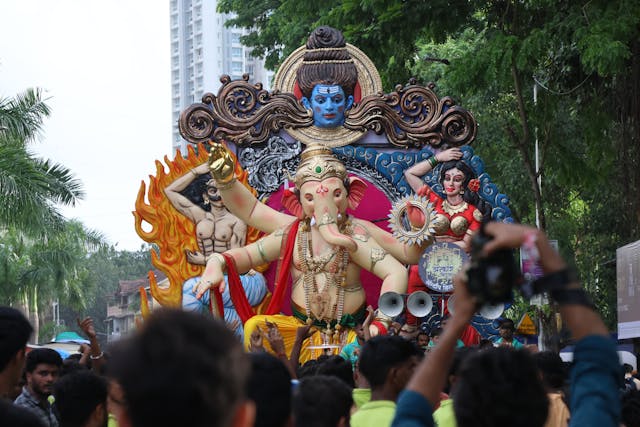
Festival advice for Indian destinations tells you what is celebrated and where, which is the least useful part of it. Ladakh holds Losar two months before the rest of the Tibetan Buddhist world, and that gap is the kind of thing that decides whether a trip works. A festival rearranges a place for weeks either side of the date, and knowing which weeks matters more than knowing the date.
Destinations get spoken about as fixed. Known for a landscape, a monument, a climate. But places are not static, and at certain points in the year they pause, reorganise and behave completely differently for a while. Then they settle back, quietly, into the rhythm they had before. Watching that happen tells you more about a place than the festival itself ever will.
By suspending the ordinary rules for a stretch, and the stretch is longer than the festival.
Work does not stop uniformly. Some things slow down days ahead, some pause for an afternoon, and some carry on untouched. Markets keep irregular hours. Offices thin out. Social obligations start outweighing professional ones, and nobody announces any of it.
Movement changes too. People who work elsewhere come home, so buses and trains fill in one direction and empty in the other. In places hosting anything large, accommodation tightens weeks in advance.
What it exposes is what a place actually values. A destination that suspends its own efficiency for a week is telling you where collective time sits in its order of priorities, which is not something you can read off a monument.
This is the same thing the Destinations series is about. A place is not only where it is. It is also when it pauses.
More than during it, and almost nobody writes about this part.
Around anything large, the signs start early. Rooms go before you would expect. Transport prices move. Suppliers stock up. Households begin spending on things they do not buy the rest of the year.
Around anything small, which is most of them, the signs are quieter. A village gets busier in a way that has nothing to do with visitors. People are cleaning, cooking, repairing and preparing, and the pace of ordinary work picks up before it drops.
Both are visible if you are out at the right hours. Watching what a place does in the early morning will tell you a festival is coming before any sign goes up.
The week after is its own thing. Places do not restart cleanly. Shops open late, people are tired, and the town runs at half speed for several days. That week is often the best time to be somewhere, and the cheapest.
They fall where the year allows a pause, and the year is decided by weather rather than by convenience.
In the Uttarakhand hills, Phool Dei marks the start of spring with children carrying flowers to doorsteps, and it sits where the season turns rather than on a date somebody chose. Village festivals through Uttarakhand and Himachal Pradesh tie to sowing and harvest in the same way, so they move with the year rather than sitting in it.
Preparation starts long before anything visible happens. Supplies get stocked, travel becomes secondary, and the roads feel emptier because people have stayed closer to home.
Kashmir works to the valley's own agricultural clock, and across the border Bhutan runs its tsechus on a monastic calendar that shifts against the Gregorian one every year.
Afterwards nothing restarts abruptly. Life resumes at the speed the terrain and the weather allow, which is the same thing that set the date in the first place. A slow journey through Kumaon in spring is built around exactly that window.
Because both run on calendars that answer to their own history rather than to anybody else's.
Losar in Ladakh falls roughly two months before Tibetan Losar, and it has stayed there for centuries. A traveller who books around the Tibetan date arrives in Ladakh to find the new year long over.
Hemis runs on the Tibetan lunar calendar, so its Gregorian date moves every year, and the giant thangka it is famous for is only unfurled once every twelve years. Most people who travel for Hemis are not there in a year when it appears.
In Spiti, the Ladarcha fair sits where the passes are open and nowhere else. It began as a trading ground where Tibetan, Ladakhi, Kinnauri and Spiti traders met, and the trade that created it ended when the border closed in 1962. What happens now is the gathering without the commerce that caused it.
Both regions are only reachable for part of the year, which is why the festival calendar and the travel calendar are the same calendar. Ladakh journeys and the Spiti route built around Ladarcha run inside the same months for the same reason.
Because in a place where the year has a rhythm, the festival marks the joint rather than the date.
In Assam, Bihu is not one celebration. It is three, spread across the farming year, marking sowing, a lean month and the harvest. Before each one the pace of work rises rather than falls, because fields need tending and produce needs storing before anybody can stop. Rongali Bihu in particular sits at the point where the agricultural year begins again.
The same plain holds festivals that belong to one community rather than to the state. Ali-Ai-Ligang is the Mising sowing ritual, tied to the first planting rather than to the Assamese new year. It falls on its own day and is barely visible from outside the community.
In West Bengal, Nabanna follows the new rice rather than a fixed day, and north Bengal runs to its own timing again because the hills and the plains harvest differently. In Odisha, the seasonal rituals attach to agriculture and to the rivers, and the whole calendar moves with them.
This is the same logic that decides what these regions eat. Harvest sets the food and the food sets the festival, and both of them are downstream of the water. A journey through Assam and Meghalaya is timed against that same cycle.
Because they are three communities with three different years, inside one small state.
The Khasi hills hold Shad Suk Mynsiem in spring, a thanksgiving dance performed after the sowing is done. The Jaintia hills hold Behdeinkhlam in the middle of the monsoon, and its stated purpose is driving out disease at the point in the year when disease actually arrives. The Garo hills hold Wangala after the harvest, in late autumn.
Three festivals, three seasons, three reasons, inside a drive of a few hours. A visitor who treats Meghalaya as one festival calendar will plan for the wrong month more often than not.
There is a second thing worth knowing before you book. Several of these now exist twice over. There is an organised public event on a fixed date and an older village observance on its own timing, and the two are not always in the same week. The organised version is the one that gets listed.
The Khasi and Jaintia hills route works that geography, though no published journey reaches the Garo hills.
Because in a dry country with scattered settlement, a festival is the only reason everybody is in one place at once.
That is the original function and it is easy to miss under the tourism that has grown on top of it. In Rajasthan, the regional gatherings created short windows where trade, marriage negotiation, storytelling, music and ritual all happened at once. The alternative was people staying dispersed across enormous distances.
Preparation ran days ahead, and households adjusted their routines to be present rather than productive.
In Gujarat, the Rann of Kutch turns from empty salt flat into a temporary settlement for a season, and then empties again. What looks like a festival from outside is closer to a town that exists for four months a year.
That is why arid destinations can feel intensely social during a festival and extremely quiet the rest of the time. Both are the same place, answering the same problem in two different ways. The Marwar and Thar route and the Kutch journey both run in the season that exists for this reason.
Because on a coast the water decides what is possible, and the calendar comes second.
In Kerala, Onam sits at the meeting point of harvest and the end of the monsoon, which is a window rather than a date. Preparation starts well ahead. Markets respond first, transport fills next, and by the festival itself the state is busy but turned inward, occupied with its own households rather than with visitors.
In Goa and in Meghalaya, Christmas and New Year do something different again. Both have large Christian populations and both fill months in advance, so the destination reorganises around arrivals rather than around harvest. Afterwards they empty fast.
Along the Konkan coast and through coastal Karnataka, fishing cycles decide when a pause is even possible. Some weeks work stops almost completely. Others carry on regardless of what the calendar says. Inland, the Western Ghats run to plantation timing instead, which is a third clock again within a few hours' drive.
A Kerala journey and a Goa one sit either side of that difference.
Because they wait for readiness rather than for a day.
Across Jharkhand, Chhattisgarh, Madhya Pradesh and much of the northeast, a festival happens when the harvest is finished, when the forest produce is in, or when the community agrees the moment has come. That can move by a fortnight and nobody minds.
Arunachal Pradesh has dozens of these across its communities. Mopin belongs to the Galo, and it is a fertility and protection ritual rather than a harvest celebration, which is a different thing again from what the state's festival listings suggest.
The preparation is communal and so is the pause. To an outsider these places can look subdued during a festival, because there is no procession and no ticketing. Inside the community it is the busiest week of the year.
If you are present for one of these, knowing how to behave as a guest matters more here than anywhere else. You will be inside somebody's home rather than watching from a street. The Jharkhand plateau route runs through this kind of country.
The ones whose reason is still working, rather than the ones that photograph well.
That distinction does most of the work. A festival that still regulates something, a harvest, a water source, a disease season, a trading window, behaves differently from one that has become a performance of itself. The first will reorganise the place around you. The second will be staged for you and will end when the schedule says.
Twelve of them are set out here with the months they fall in, which is the companion to this page. Use that for the when, and use this one for the what happens around it.
The honest answer for most trips is to plan around one festival and build the journey on either side of it. Stacking several means spending the trip in transit.
Just before or just after, unless the festival is the reason you are going.
During, you get the concentrated version. More colour, more people, more of what a place values on display in one week. You also get no ordinary life at all, because ordinary life has been suspended, and you get full accommodation, full transport and prices that reflect both.
A few days either side gives you the preparation or the recovery, both of which are more revealing and considerably easier to book. The town is doing something unusual and is not yet or no longer performing it.
If you do go during, go for the whole arc rather than the peak day. Arrive three days early and stay two days after, and you will see the place change and change back, which is the actual subject.
And whichever you choose, do it knowingly. The mistake is not attending a festival. The mistake is arriving in the middle of one without having noticed, which is what preparation is for.
Not on a listicle, because most Indian festivals move every year.
Many follow lunar calendars, agricultural cycles or local decisions, so a date that was correct last year is often wrong this year. Anything published without a year attached should be treated as unreliable.
The official national listing is the Incredible India festivals and events page at incredibleindia.gov.in, which is where the Ministry of Tourism now consolidates this. The older utsav.gov.in site is still live but now directs users to the Incredible India portal instead.
Beyond that, state tourism board sites carry regional events, and anything ticketed usually has its own site with confirmed dates. For village festivals, none of these will help, and the only reliable source is somebody local.
Check twice. Once when you plan and once about three weeks out, because dates get confirmed late and shift more often than anyone expects.
They suspend the ordinary rules for a stretch that is longer than the festival itself. Markets keep irregular hours, offices thin out, people who work elsewhere come home, and accommodation tightens weeks ahead. Work does not stop uniformly, and none of the changes get announced.
Three to six months for the large ones such as Christmas and New Year in Goa or Meghalaya, Hornbill Festival in Nagaland, Ziro Music Festival in Arunachal Pradesh, or Rann Utsav in Gujarat. Capacity in these places is limited and both rooms and transport fill early.
Most do. Many follow lunar calendars, agricultural cycles or local decisions, so dates shift annually. Anything published without a year attached should be treated as unreliable. Check when you plan and again about three weeks out, because dates get confirmed late.
The Incredible India festivals and events page run by the Ministry of Tourism is the official national listing. State tourism boards carry regional events, and ticketed festivals have their own sites. For village festivals none of these help, and somebody local is the only reliable source.
Ladakhi Losar falls roughly two months earlier than Tibetan Losar and has done for centuries. The practical effect is that a traveller planning around the Tibetan date arrives to find the Ladakhi new year already finished.
No, and that catches people out. The Khasi hills hold Shad Suk Mynsiem in spring, the Jaintia hills hold Behdeinkhlam in the monsoon, and the Garo hills hold Wangala after the autumn harvest. Three communities, three seasons, inside one state.
Just before or just after, unless the festival is why you are going. During it you get the concentrated version and no ordinary life at all, plus full accommodation and higher prices. Either side gives you the preparation or the recovery, both of which are more revealing and much easier to book.
Severely, because capacity is small to begin with. In small towns and rural areas rooms can go months ahead and walk-ins become impossible. The alternative is staying an hour or more away, which changes the whole shape of the trip.
Flights, trains and long-distance buses fill well before the dates, and they fill in one direction. People who work elsewhere travel home, so inbound seats disappear while outbound ones stay available. Road travel also slows because local movement rises sharply.
No. Mountain festivals are set by weather and season, river plain festivals follow the harvest, and desert festivals exist to bring dispersed communities together. Coastal festivals follow water and fishing cycles, while forest and tribal festivals wait for collective readiness rather than a date.
Because a harvest is when there is both food and time, and neither is available at other points in the year. This is why the same region can have festivals that move by a fortnight from one year to the next, since the crop decides and not the calendar.
Often yes, and hospitality in these places is genuine. But you will be inside somebody's home rather than watching from a street, so the ordinary rules of being a guest matter more. Go with somebody local, ask before photographing anybody, and accept what you are given.
The three or four days after a festival ends. Shops open late, people are tired, and the town runs at half speed. It is unglamorous and it is also when a place is most itself, with none of the performance and none of the crowds.