
Let’s help you
plan your journey
Explore responsibly, discover offbeat places, guided by locals, rooted in culture.
Let’s help you
plan your journey
Explore responsibly, discover offbeat places, guided by locals, rooted in culture.
Soumen Bhowmick
Soumen Bhowmick founded Pollen Dots in 2024 to plan journeys across India and Bhutan. He works in the Commercial Department of Indian Railways, where he has been since 2000. From 2016 to 2020 he was Head of Business Development and Partnerships at ScoutMyTrip, a community-driven road trip planning platform. There he built a nationwide network of local Scouts who helped travellers on the road, and grew the Road Trippers Club to 16 Indian cities. As a core member of Devil On Wheels, he helped travellers plan Himalayan trips and started Spreading Smiles. He has driven solo from Arunachal to Goa and from Himachal to Karnataka, and has run his own caravan for more than ten years. His photographs have won national and international salon awards, and his writing has appeared in Outlook Traveller.
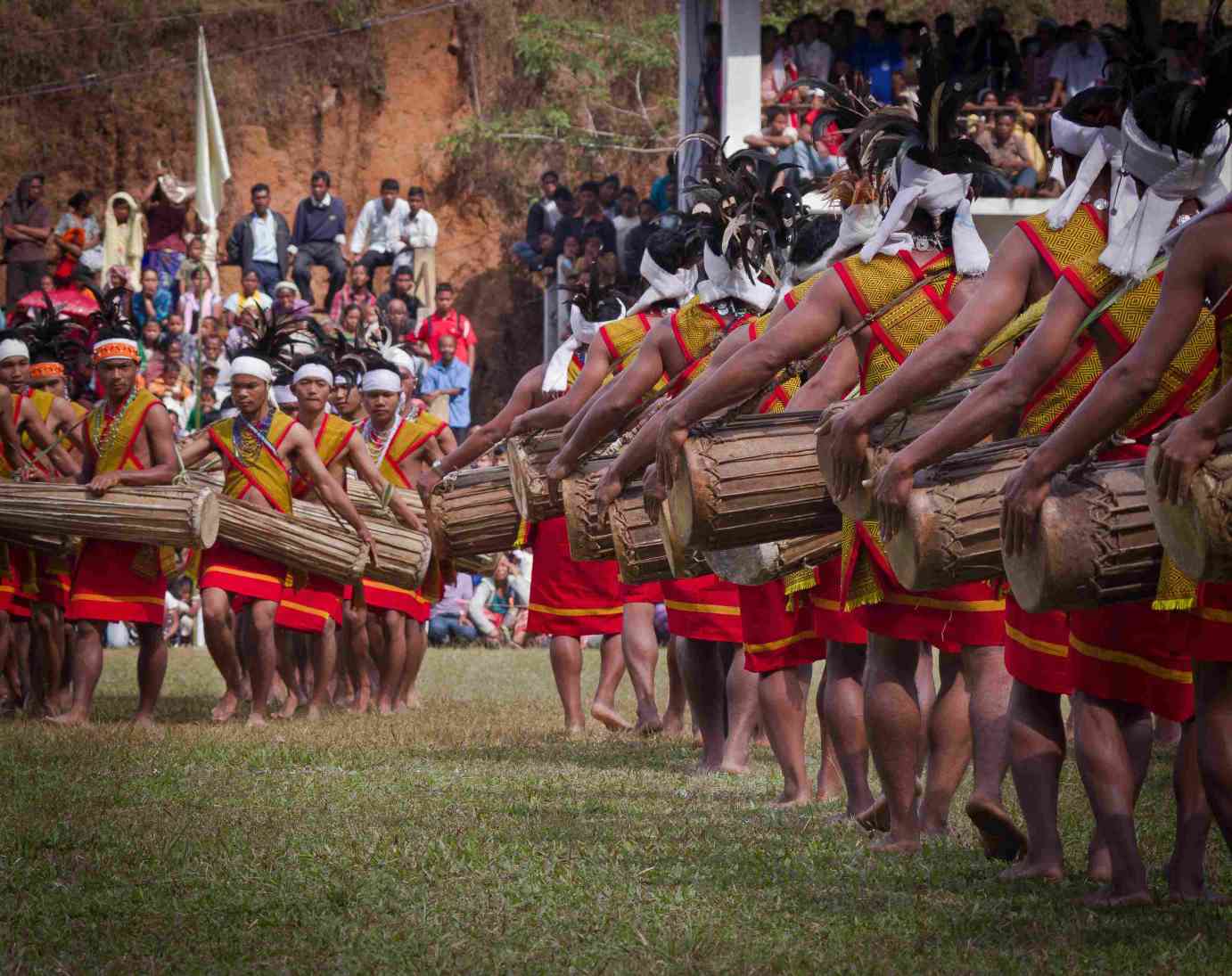
Wangala is a Songsarek harvest rite, and most Garo have not been Songsarek for generations. The Hundred Drums festival at Asanang, which supplies nearly every photograph of Wangala, was created in December 1976 as a state-backed event, and its performers may not be Songsarek at all. The village version continues in Songsarek villages on dates each village sets for itself, and the two are not the same festival.
None of that is a debunking and I want to be plain about it. A community whose religion has shrunk to a minority is entitled to keep its harvest festival as heritage, and a state that funds the keeping is doing something useful. But a traveller who books Asanang thinking they are seeing the older thing has misunderstood what they bought, and nobody writing about this festival tells them.
Wangala is the thanksgiving the Garo make when the harvest is in. The thanks go to Misi Saljong, the sun, also called Pattigipa Ra·rongipa, which translates as the Great Giver.
That second name is the more useful one. It says what the relationship is. The sun is not being worshipped as a force of nature in the abstract. It is being credited as the party that gave, at the end of a year in which the giving either happened or did not.
The offerings are correspondingly literal. Rice beer, cooked rice, vegetables, livestock. Not symbols of the harvest. The harvest.
You will find the deity written as Salgong in some places, including in earlier versions of this page. Misi Saljong is the form used in Garo Hills.
Between September and December, and each village sets its own date.
This is the single most common error made about Wangala and it matters for anybody planning around it. The festival is not on a fixed date and it is not confined to November. Village Wangala happens when that village has finished bringing its crop in, which is a different week in a different place depending on terrain, rainfall and what was planted.
November is the answer everybody gives because the Asanang event is held in the second week of it. That is one Wangala with a diary entry. The rest of them do not have one.
For a traveller the practical consequence is straightforward. Anywhere in the Garo Hills across those four months, something is likely to be happening somewhere, and none of it can be looked up in advance. It has to be asked about locally, close to the time.
Because the sequence is the point. Celebration is not permitted until subsistence is secured.
Farming in the Garo Hills runs on jhum, shifting cultivation on hill slopes, and on the monsoon. The labour is long and the outcome is not knowable until the end. Until the crop is cut and in store, the question of whether the year worked is open.
So Wangala is not a festival of hope. It is what happens when the answer comes back and it is yes. That gives it a different emotional register from the spring festivals elsewhere in the Northeast, which are asking rather than acknowledging, and it is why the mood is release rather than optimism.
The Bihu calendar in Assam splits the same year into three and gives each part its own festival. The Garo put nearly everything into one, at the end.
Songsarek is the indigenous Garo religion, and it is now followed by a small minority. The great majority of Garo are Christian, the result of missionary work through the nineteenth and twentieth centuries.
Wangala belongs to Songsarek. Its rituals are Songsarek rituals, made to a Songsarek deity, performed by Songsarek officiants. Village Wangala continues in the Songsarek villages that remain, of which Sadolpara in West Garo Hills is the best known.
This is the same shape as the Khasi story one range east, where the indigenous faith became a minority religion and Seng Khasi was formed to hold its practices in organised existence. Meghalaya has run the same experiment twice with different communities and the two answers are worth comparing.
A committee, on 6 and 7 December 1976, at Asanang near the Rongram block office, about eighteen kilometres from Tura.
It has run every year since, under the patronage of the state government, and it has grown a great deal. Dance troupes now come from outside the Garo Hills entirely, from Karbi Anglong, from Tripura, from Bangladesh, and there is prize money for the best of them.
If this is starting to sound familiar, it should. Mopin in Arunachal was fixed to 5 April by a committee in 1966. Shad Suk Mynsiem was constituted at Weiking Ground in 1911 by Seng Khasi. Ali-Ai-Ligang was tightened from any day in a month to a specific weekday.
Four Northeast festivals, four institutional histories, all of them within living memory or just outside it. These are not survivals that happened to persist. They are things communities under pressure deliberately organised, and asking when a festival was organised tells you more about what you will see than asking how old it is. Almost nobody asks it.
Often not, and this is the fact everything else turns on.
The contingents at Asanang are drawn from across the Garo Hills and from well beyond them, and the performers may or may not be Christian and may or may not be Songsarek. The reference works say so plainly. What is being performed is Garo heritage rather than Songsarek observance, by people demonstrating a culture they belong to rather than enacting a rite they practise.
That is not fraud and it is not decline. It is what happens to a religious festival when the religion contracts and the culture does not. Somebody has to keep the drums going.
But it does mean that the thing at Asanang and the thing at Sadolpara are two different events wearing one name, and only one of them is a religious act. A visitor who does not know that will photograph the first and believe they have seen the second.
The opening, and it happens indoors before anybody sees anything.
Rugala takes place in the Nokma's house. The Kamal, the priest, pours rice beer and offers cooked rice and vegetables to Misi Saljong. Cha·chat So·a is the burning of incense alongside it. These are the acts the whole festival exists to perform, and they are conducted in a room by a handful of people.
Then the rang, the gong, is struck. That is the signal, and from that point the festival becomes public.
The ordering tells you what the priority is. The offering comes first, in private, and the drumming is what follows from it rather than the other way round. The rules of being a guest matter more around the first part than the second, and access to it is not something a traveller should expect.
Three days at Asanang, and two or three in the villages.
The first day carries Rugala and Cha·chat So·a. The second is Kakkat, which continues the offerings and the blessings for the village and the crop. The third is the large public celebration, the drumming and the dancing that everything before it has been earning.
Village Wangala follows the same order at a smaller scale. Same sequence, fewer people, no stage, no prize money and no visitors from Bangladesh.
Dama Gogata is the principal dance, and the dama is the long drum it is danced to, carried at the hip and played with the hands. A hundred of them together is where the popular name comes from, and the number is descriptive rather than precise.
Alongside the dama are the rang, the gongs, and flutes. The rhythm sets the pace and the sequence for a formation of dancers moving as one body. That is the visual signature of the festival and the reason it photographs the way it does.
The dress is the dakmanda, the daksari and the gando, and the headgear is the do·me, made with feathers. In the photographs the black and white plumes above a line of drummers are do·me.
The synchronisation is the content, not the decoration. Jhum farming on a hill slope is coordinated labour or it is nothing, and a hundred people keeping one rhythm is that fact expressed in a field.
The Garo are matrilineal, like the Khasi, and the office of Nokma sits inside that in a way that catches people out.
Property and clan descend through women. The heiress daughter inherits, and her husband holds the position of Nokma, the village headship, by virtue of the marriage. So the title passes through the woman and is exercised by the man, and Rugala is performed in the house that came down her line.
Compare the Khasi arrangement, where the women dance the inner circle as the lineage and the men circle outside as its defence. Two matrilineal societies in one state, expressing the same structure in completely different ways, one through office and one through choreography.
Asanang if you want to see it, a village if you want to understand it, and the honest answer is that most people should do the first.
Asanang in the second week of November is large, organised, welcoming and genuinely impressive, and there is no arrangement required beyond turning up. It is eighteen kilometres from Tura, and Tura is a long way west of the Meghalaya most visitors see. Guwahati is the practical approach, roughly 220 kilometres, rather than Shillong.
The village version needs a host, a Songsarek village, and a date nobody can tell you far in advance. It is not something to attempt casually and it is not something to attempt at all without an invitation.
What decides which one you are going to is not budget or effort. It is timing, and ecology and the farming year set that rather than any calendar. If you want to work from Meghalaya or the wider Northeast, the Garo Hills are the part of the state almost nobody goes to, which is most of their argument.
Knowing which of the two Wangalas you are attending, before you book anything, is most of what care-based travel comes down to here.
The harvest thanksgiving of the Garo community of Meghalaya, made to Misi Saljong, the sun, after the crop is cut and stored. It belongs to Songsarek, the indigenous Garo religion, and marks the end of the farming year rather than the start of anything.
It refers to the thanksgiving given once the harvest is in. The thanks go to Misi Saljong, also called Pattigipa Ra·rongipa, the Great Giver, and the offerings are literal rather than symbolic: rice beer, cooked rice, vegetables and livestock.
Anywhere between September and December, with each village setting its own date according to when its own harvest finishes. The commonly given answer of November refers only to the Hundred Drums festival at Asanang, which is one Wangala among many.
Across the Garo Hills of Meghalaya. The largest public gathering is at Asanang, about eighteen kilometres from Tura in West Garo Hills. Village celebrations continue across West, East and South Garo Hills, and Sadolpara is the best known of the Songsarek villages.
The large organised version, first held on 6 and 7 December 1976 at Asanang under state patronage. It has run every year since and now draws contingents from beyond the Garo Hills, including Karbi Anglong, Tripura and Bangladesh, with prize money for the best troupe.
Often not. The contingents are drawn from across the region and the performers may or may not be Christian and may or may not be Songsarek. What is performed at Asanang is Garo heritage rather than Songsarek observance, which makes it a different event from village Wangala despite the shared name.
The indigenous Garo religion, now followed by a small minority. The great majority of Garo are Christian. Wangala is a Songsarek rite, which is why the distinction between the village celebrations and the organised festival matters.
The sun, and the deity Wangala gives thanks to. The alternative name Pattigipa Ra·rongipa translates as the Great Giver, which describes the relationship more precisely than the title of sun god does.
The opening ritual, performed indoors in the Nokma's house. The Kamal, the priest, pours rice beer and offers cooked rice and vegetables to Misi Saljong, with incense burned alongside in the rite called Cha·chat So·a. The striking of the rang, the gong, then opens the public part.
The principal dance of Wangala, performed to the dama, a long drum carried at the hip and played by hand. Gongs and flutes accompany it. The rhythm sets the pace for a formation of dancers moving as a single body.
The dakmanda, the daksari and the gando, with the do·me, a feathered headgear, worn by the men. The black and white plumes above the line of drummers in most Wangala photographs are do·me.
The village headman, and in the matrilineal Garo system the office comes with the marriage. The heiress daughter inherits the property and her husband holds the headship. Rugala is performed in that house.
Tura is the main town, and Guwahati is the practical approach at roughly 220 kilometres rather than Shillong, which is further and slower. Asanang is about eighteen kilometres from Tura. The Garo Hills are the part of Meghalaya that almost no visitors reach.