
Let’s help you
plan your journey
Explore responsibly, discover offbeat places, guided by locals, rooted in culture.
Let’s help you
plan your journey
Explore responsibly, discover offbeat places, guided by locals, rooted in culture.
Soumen Bhowmick
Soumen Bhowmick founded Pollen Dots in 2024 to plan journeys across India and Bhutan. He works in the Commercial Department of Indian Railways, where he has been since 2000. From 2016 to 2020 he was Head of Business Development and Partnerships at ScoutMyTrip, a community-driven road trip planning platform. There he built a nationwide network of local Scouts who helped travellers on the road, and grew the Road Trippers Club to 16 Indian cities. As a core member of Devil On Wheels, he helped travellers plan Himalayan trips and started Spreading Smiles. He has driven solo from Arunachal to Goa and from Himachal to Karnataka, and has run his own caravan for more than ten years. His photographs have won national and international salon awards, and his writing has appeared in Outlook Traveller.
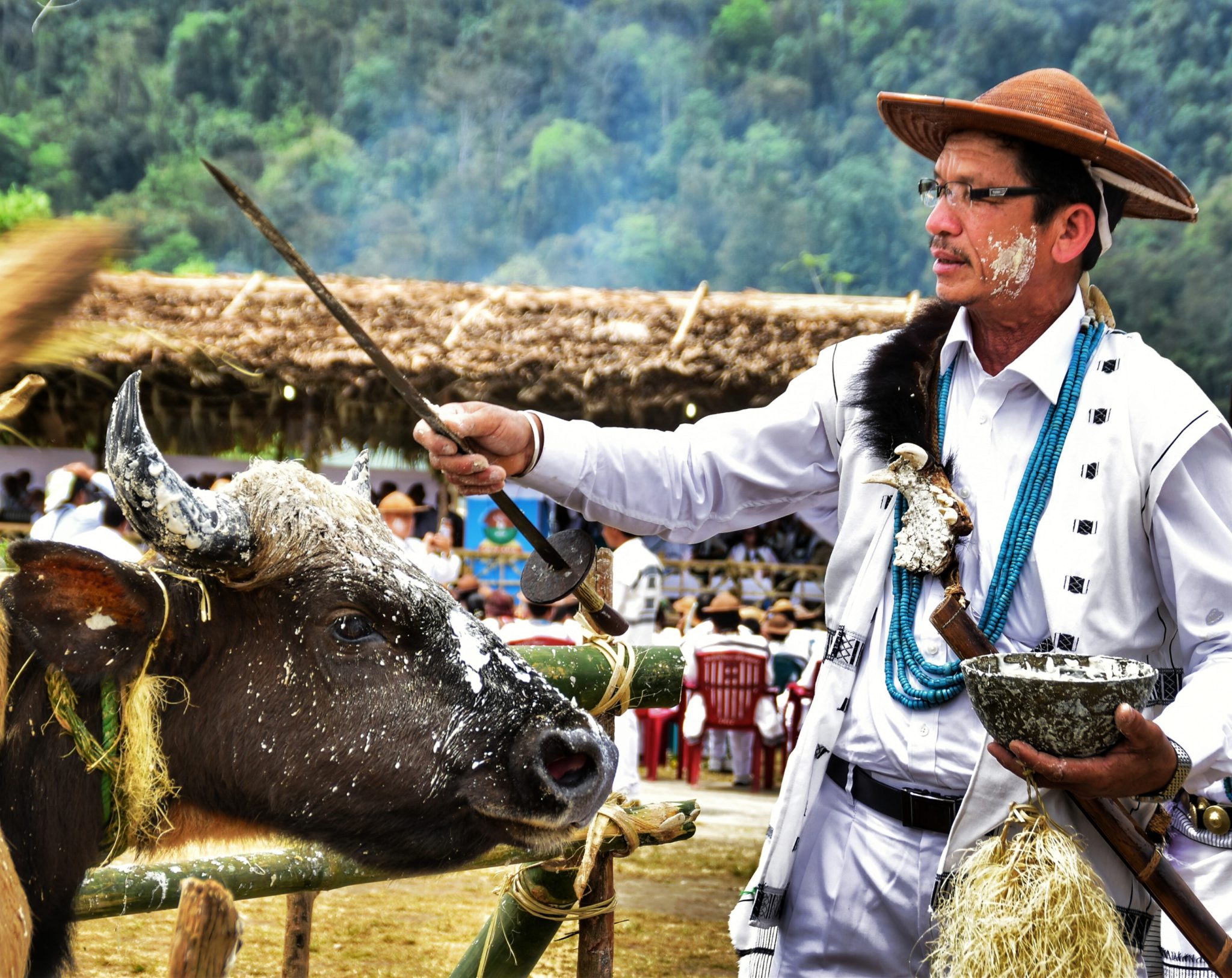
Every guide to the Mopin festival gives the date as 5 April, and none of them mention that the date was set by a committee in 1966. Before that it was found rather than fixed, read each year by a priest from omens, which is why village Mopin and the Aalo Mopin are not the same festival. What you see depends entirely on which of the two you turn up to.
That is not a complaint about authenticity. Fixing the date was a deliberate decision with a reason behind it, taken by Galo people for Galo reasons, and it worked. But it changed what the festival is, and a visitor who books flights around 5 April without knowing any of this will see the version that was built to be seen.
Mopin is the main festival of the Galo, a Tani people of west-central Arunachal Pradesh, and it marks the opening of the agricultural year. It is held across West Siang, Lepa Rada, East Siang, Lower Siang and Upper Subansiri, with Aalo and Basar as the two largest public celebrations.
The Galo follow Donyi-Polo, the sun and moon faith shared across the Tani group. Their origin story runs back to Abo Tani, the first man and the ancestor the Tani communities take their name from.
It is usually filed as a harvest festival. It is not one, or not only one. It sits at the turn of the year, before the paddy goes in, and what it asks for is protection through the season rather than thanks for the last one.
The main day is 5 April. Preparation begins around 2 April, and the observance runs on to 7 or 8 April, closing with Riga Alo, a visit to the paddy fields.
In villages it stretches much further. Cultural activity, games and Popir practice can begin as much as a month before the main day, which means the calendar published for the public celebration describes the smallest part of it.
So there are two answers to when. The official one is a five day window with 5 April at the centre. The real one, in a Galo village, is most of March.
Because it was standardised in 1966, when Mopin moved from a village observance to a shared Galo one and a central committee was formed at Aalo to organise it.
The reason was practical. Galo settlements are spread across several districts of difficult country, and people had begun moving to towns for work. A single announced date let a dispersed community hold one festival instead of dozens, and let those living in Itanagar or Naharlagun come home for it. Arunachal Pradesh now treats it as a state festival and 5 April is a holiday.
That is a real gain and it should be read as one. It is also a change, and the thing it changed is worth naming.
By reading it, each year, through the priest.
Traditional Mopin practice put the timing in the hands of the Nyibu, the Galo priest, along with the sequence of the rites, the yidum oblation and the rest of it. Determining the date was itself a ritual act, done through divination, which across the Tani communities has long included reading the liver of a sacrificed chicken.
A date arrived at that way is a reading of the year. A date printed on a holiday calendar is not. Academic work on the festival is direct about the consequence: fixing 5 April eliminated the traditional determination of the date and much of what surrounded it, at least in the towns. In most village celebrations the older practice continued.
This is the single most useful thing to know before travelling for it. The Aalo event is large, organised and welcoming, and it is a committee festival. The village version still runs on the priest. The land and the season set the terms in one and a calendar sets them in the other, and they are worth telling apart.
Mopin Ane is the goddess the festival is named after, and she is the deity of agriculture and vegetation in Galo belief. The story holds that she taught Abo Tani how to cultivate and how to keep what he grew.
What is asked of her is not abundance on its own. The prayers are about protection: from disease, from crop failure, from misfortune arriving alongside a good year. That is a specific request and it tells you what the risk actually looks like in forest-edge farming on steep ground with unreliable rain.
Digo Ane is invoked alongside her. The rites are led by the Nyibu, and they are measured rather than ecstatic.
It is called ette, sometimes etting, and it is ground rice flour worked into a paste.
It goes on faces, on houses, on granaries and on livestock. It is a blessing and a protection, applied to the things the coming year will test. The mithun in most Mopin photographs is white-marked for the same reason.
For a visitor the important part is what it means when it is put on you. Being smeared by somebody you have never met is not a bit of festival fun. It marks you as welcome and under the same protection as everyone else on the ground, which is a considerable thing to be handed by a stranger and worth accepting properly. The ordinary rules of being a guest apply, and the first of them is not to wipe it off.
Popir is danced by women and girls, in a slow circle, arms linked, to folk songs about Mopin Ane. It is the image of the festival that travels furthest and the one every photograph is of.
The dress is the Egin, white, because white carries purity and the presence of the divine in Galo usage, with the Takom Lepok shawl over it, woven in patterns that carry lineage. Men do not dance Popir. They have a related form called Erap.
The songs are the Ja-Jin-Ja. Apong, the rice beer, goes round in bamboo cups throughout.
Because the mithun is the animal Galo wealth is counted in, and offering one is therefore a measurable act rather than a symbolic one.
The mithun is a semi-domesticated bovine found only in the eastern Himalaya and upper Burma. It is not milked and it is not worked. It is kept, mostly loose in the forest, as stored value, and it appears in bride price, in the settlement of disputes and in the largest ritual obligations.
The sacrifice is conducted by the Nyibu and the meat is distributed across households. Visitors should know it is coming and decide in advance how they feel about being present, rather than discovering it on the day.
They are the same kind of festival, held by two branches of the same people, and their dates work in opposite ways.
The Mising of the Assam floodplain are also a Tani community and also observe Donyi-Polo. They came down from these hills to the Brahmaputra. Their sowing festival, Ali-Ai-Ligang, was once held on any convenient day in the month of Fagun. It was later tightened to the first Wednesday of Gimur Polo, because Wednesday is the day held right for putting seed in the ground. That is a rule about conditions, and it still floats against the Gregorian calendar. It fell on 2 February in 2016 and 18 February in 2026.
Mopin went the other way. It was tightened to a fixed calendar date, 5 April, chosen for administrative convenience rather than for anything about the ground.
Same origin, same faith, one festival now anchored to a weekday and the other to a date. The gap between them is about six weeks, and it is the difference between a floodplain and a hillside. This is also the difference between the two Assamese agricultural years set out in the article on Rongali Bihu, which is the loud one, and Ali-Ai-Ligang, which is not.
Yes, and this catches people out.
Indian citizens who are not residents of the state need an Inner Line Permit to enter Arunachal Pradesh. Foreign nationals need a Protected Area Permit instead, which takes longer and usually has to go through a registered operator. Neither is difficult, both take time, and neither can be sorted out at the last minute in early April when everybody else is applying too.
Apply well before you book anything that cannot be moved.
Aalo, formerly Along, is the headquarters of West Siang and holds the largest celebration. Basar, in Lepa Rada, is the other big one. Both are worth seeing and both are the public version.
For the village version you want the Galo settlements away from the district headquarters, and you want to be there before 5 April rather than on it. The weeks running up to the main day are when the festival is lived rather than staged. That requires a host. There is no way to arrange it on arrival.
Getting there takes a day. The nearest airports are Dibrugarh in Assam, roughly 250 km away, and Lilabari, roughly 270 km. From Dibrugarh it is an eight to ten hour drive by way of Pasighat. Trains reach Dibrugarh and Murkongselek.
April is a good month to be in Arunachal regardless. Winter has cleared the roads, the monsoon has not started, and village life is fully running. Six to nine days is a sensible length, which allows for the drive at both ends and for the ordinary days on either side of the festival that explain what it is for.
If you want to build something around Arunachal Pradesh or the wider Northeast, this is the window. Choosing which Mopin you are going to, and staying long enough for it to matter, is most of what care-based travel comes down to here.
The main festival of the Galo community of Arunachal Pradesh, marking the opening of the agricultural year rather than the close of a harvest. It is held across West Siang, Lepa Rada, East Siang, Lower Siang and Upper Subansiri, and asks the goddess Mopin Ane for protection through the coming season.
The main day is 5 April. Preparation starts around 2 April and the observance runs to 7 or 8 April, closing with Riga Alo, a visit to the paddy fields. In villages the wider festival period can begin as much as a month earlier.
Because the date was standardised in 1966, when a central committee was formed at Aalo to hold one Galo festival instead of many. Arunachal Pradesh now treats 5 April as a state holiday. Before 1966 the date was determined each year by the priest rather than set in advance.
By the Nyibu, the Galo priest, through divination, which across the Tani communities has long included reading the liver of a sacrificed chicken. Fixing 5 April removed that determination along with much of what surrounded it in the towns. In most village celebrations the older practice continued.
The goddess the festival is named for, deity of agriculture and vegetation in Galo belief, said to have taught Abo Tani how to cultivate and how to preserve what he grew. She is asked for protection from disease, crop failure and misfortune rather than for abundance alone.
Ette, sometimes written etting, a paste of ground rice flour. It is applied to faces, houses, granaries and livestock as a blessing and a protection. Being smeared by a stranger marks you as welcome and under the same protection as everybody else present.
The signature dance of Mopin, performed by women and girls in a slow linked circle to songs about Mopin Ane. Dancers wear the white Egin dress with a Takom Lepok shawl over it. Men do not dance Popir and have a related form called Erap.
Because the mithun is the animal Galo wealth is measured in, so offering one is a real cost rather than a symbolic gesture. It is a semi-domesticated bovine kept loose in the forest as stored value. The sacrifice is led by the Nyibu and the meat is shared across households.
Yes. Indian citizens who are not residents of the state need an Inner Line Permit. Foreign nationals need a Protected Area Permit, which takes longer and usually has to be arranged through a registered operator. Apply well ahead of early April, when demand is highest.
Aalo, the headquarters of West Siang, holds the largest celebration, and Basar in Lepa Rada is the other major one. Both are the organised public version. The village version, which still runs on the priest rather than a committee, is in the Galo settlements away from the district headquarters and needs a host.
The nearest airports are Dibrugarh in Assam at roughly 250 km and Lilabari at roughly 270 km. From Dibrugarh it is an eight to ten hour drive by way of Pasighat. Dibrugarh and Murkongselek are the nearest railheads. Allow a full day at each end of the trip.
Yes. Winter has cleared the roads, the monsoon has not begun, and village life is running at full pace. Six to nine days is a sensible length, since the drive in and out takes a day at each end and the days either side of the festival are what explain it.