
Let’s help you
plan your journey
Explore responsibly, discover offbeat places, guided by locals, rooted in culture.
Let’s help you
plan your journey
Explore responsibly, discover offbeat places, guided by locals, rooted in culture.
Soumen Bhowmick
Soumen Bhowmick founded Pollen Dots in 2024 to plan journeys across India and Bhutan. He works in the Commercial Department of Indian Railways, where he has been since 2000. From 2016 to 2020 he was Head of Business Development and Partnerships at ScoutMyTrip, a community-driven road trip planning platform. There he built a nationwide network of local Scouts who helped travellers on the road, and grew the Road Trippers Club to 16 Indian cities. As a core member of Devil On Wheels, he helped travellers plan Himalayan trips and started Spreading Smiles. He has driven solo from Arunachal to Goa and from Himachal to Karnataka, and has run his own caravan for more than ten years. His photographs have won national and international salon awards, and his writing has appeared in Outlook Traveller.
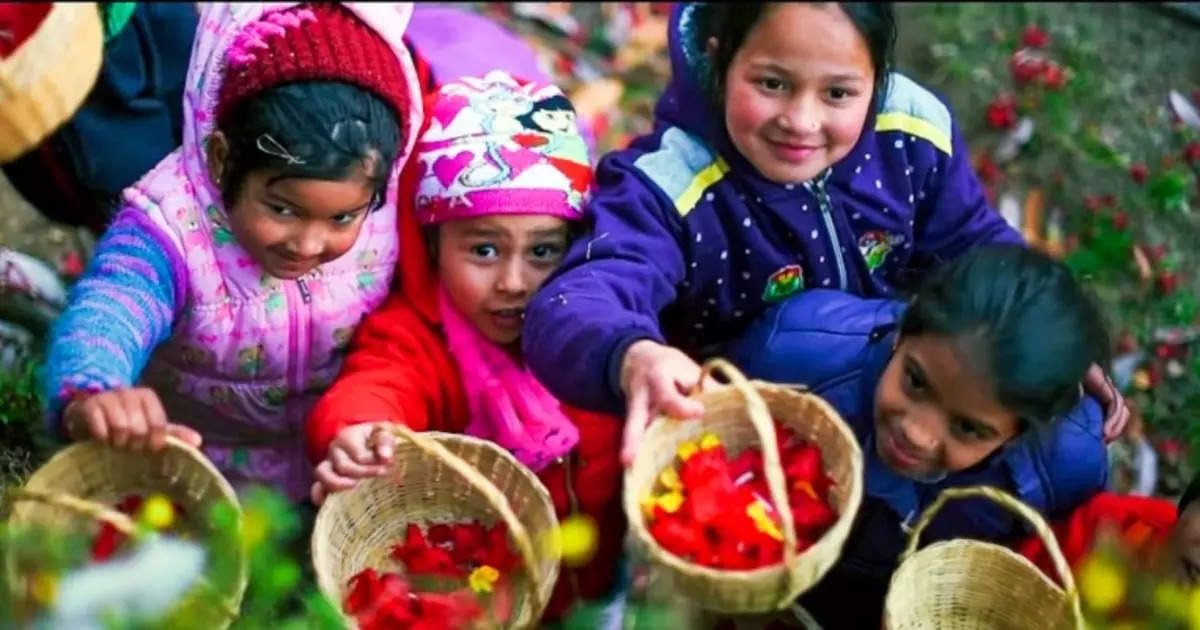
Phool Dei is filed as a spring festival, which undersells it, because nothing is being celebrated. It is a signal, sent by children going door to door with flowers on the first morning of Chaitra, that the ground has thawed and the working year starts now. The pudding they are given in return is made of jaggery, curd and flour, all of it stored since autumn, which is the household saying it got through.
In Uttarakhand you know the season has changed by what people start doing, not by a date on anything. Paths that were unused for months get walked again. Work moves back outdoors. Fields get looked at properly for the first time since October. Phool Dei sits exactly on that line, and it is the only festival I know of that is run entirely by children.
A seasonal marker observed across the hill districts of Uttarakhand, on the first day of the month of Chaitra.
Children collect flowers in the morning, go from house to house, and place them on doorsteps and thresholds. They sing a short verse. They are given something sweet, or grain, or a small coin, and they move on to the next house.
That is the whole festival. There is no venue, no procession, no organiser and no priest.
What separates it from everything else in the Himalayan calendar is what it is about. Ladarcha marked the arrival of salt. Losar turns the year. Hemis marks a birth. Phool Dei marks the ground becoming workable again, which in an agrarian mountain society was the piece of information everything else depended on.
Because the pudding is the point, and it is easy to miss.
Phool means flower. Dei is the sweet the children are given in return, made with jaggery, curd and flour, sometimes with rice.
Look at what is in it. Jaggery, kept since the cane was pressed. Flour, milled from grain stored after the autumn harvest. Curd from animals that were fed through a winter when nothing was growing.
Every ingredient is something that had to survive five months of storage. A household that can hand that out in March, to every child in the village, is making a statement about how the winter went.
That is the difference between a harvest festival and this one. A harvest festival celebrates what arrived. Phool Dei quietly demonstrates what was left. Food carries this kind of information everywhere in India, and here it is the whole festival in a bowl.
Whatever is out, and in the hills that is a short and specific list.
Phyonli, small and yellow, is the one most associated with the festival. Buransh, the red rhododendron, comes in around the same time and is the flower most people picture. Lower down there is mustard and marigold.
The important part is that these are not decorative choices. Buransh flowering is the signal. It comes into bloom at a particular altitude at a particular point in March, and its arrival tells a village what the season is doing more precisely than any calendar could.
Which means the children are not gathering flowers because flowers are pretty. They are gathering the physical evidence that the year has turned, and carrying it to every door.
This is the land setting the terms in the most literal way it happens anywhere. The festival waits for a plant.
Because it works, and because somebody had to be taught.
The children are young, mostly under ten, and they go out unsupervised in a way that would be unusual almost anywhere else. Older children age out of it.
Practically, this does several things at once. Every household gets the same message on the same morning without anybody organising it. Children learn the seasonal calendar by walking it rather than being told it. And a village re-establishes who lives where after a winter when people stayed indoors.
There is no hierarchy in it either. No family runs it. No committee sets it. The whole thing moves horizontally, house to house, which is why it survives without any institution supporting it.
Full stores, healthy animals, rain that arrives when it should, and a household that holds together.
The verses are short and they are not metaphorical. They name the specific conditions an agricultural year needs to go well, in the order a farming household would rank them.
That is worth noticing, because it tells you what was actually at stake. This is not a wish for happiness or prosperity in the abstract. It is a list of the four or five things that decided whether a family in a hill village had a difficult year or a manageable one.
The children singing it are mostly too young to understand that. Which is rather the point of teaching it to them.
On the first day of Chaitra, which in most years puts it on 14 or 15 March.
It follows the solar reckoning rather than the lunar one, so unlike most Indian festivals its date barely moves. That makes it unusually easy to plan around.
In some villages it is a single morning. In others it runs for eight days. In a few places children continue through the whole month of Chaitra, going out on successive mornings until the month ends.
The variation is local and it is worth asking about in advance if you are travelling for it, because a one-morning village and a month-long village are quite different things to arrive into.
The structure holds. The scale and the wording change.
In Garhwal it tends to be household-focused. Children visit nearby homes, and the verses are passed down inside families, so they vary from house to house.
In Kumaon the groups are larger and they cover whole neighbourhoods, working through a settlement rather than a handful of doors. The songs vary by dialect and by village, and people can often tell where a version comes from by hearing it.
Neither is more authentic. What the difference shows is that nobody standardised this, because nobody was ever in charge of it.
Very little, and that is what makes it worth watching.
Schools start late. Work waits until the children have been round. Elders stay at home to receive them rather than going out early, which for one morning inverts the usual order of who is where.
Shops open slowly. The lanes are busier than usual at an hour when they are normally empty.
By late morning it is over and the day resumes. If you were not looking for it you could pass through and register nothing except that there were a lot of children out.
That is the level at which most of India actually operates, and it is visible on any ordinary morning if you are up early enough to see it.
Because it costs almost nothing and it still does something.
It needs no venue, no funding, no permissions and no organiser. A handful of flowers and whatever is in the kitchen. That alone has carried it through periods when more elaborate traditions became unaffordable.
It also still works. The seasonal information it carries is real, the social function of re-connecting a village after winter is real, and the children enjoy it.
Compare that with festivals that survive on institutional support or tourism revenue. Those change shape as the money changes. Phool Dei has nothing to change shape around.
It has spread into towns for the same reason, at neighbourhood level, without anybody deciding it should.
Yes, and it is one of the better weeks in the year to be there regardless.
Mid-March in the Kumaon and Garhwal hills is a good window. Winter roads have settled, visibility after the winter rain is unusually clear, villages are active again, and the summer crowds have not started. Buransh is in flower, which is worth the trip on its own.
Stay in a village or a small town rather than a hill station. Phool Dei happens on doorsteps, so a place with doorsteps around you is the requirement.
Watch, do not join. This is a child-led household observance and there is no visitor role in it. Do not stage photographs, do not direct anybody, and do not follow the children around. Sit where you are and let it come past you, which it will.
Five to eight days is a sensible length. Our eight-day Phool Dei and Kumaon spring journey works through Naukuchiatal, Almora, Binsar and Nainital at the pace the season suggests rather than around a single morning.
And if the dates slip, come anyway. The point of all this is that when you arrive changes what you see, and mid-March in these hills is a good answer whatever the calendar says.
A seasonal marker observed across the hill districts of Uttarakhand on the first day of Chaitra. Children collect flowers in the morning, place them on doorsteps across the village, sing a short verse, and are given something sweet in return. There is no venue, organiser or priest.
On the first day of the month of Chaitra, which in most years falls on 14 or 15 March. It follows solar reckoning rather than lunar, so unlike most Indian festivals the date barely moves, which makes it unusually easy to plan around.
Phool means flower. Dei is the sweet the children are given in return, made with jaggery, curd and flour, and sometimes rice. Every ingredient had to survive five months of storage, so handing it out in March says something about how the winter went.
Phyonli, small and yellow, is the one most associated with the festival, and buransh, the red rhododendron, comes into flower around the same time. Lower down there is mustard and marigold. Buransh flowering is itself the seasonal signal the festival responds to.
Mostly children under ten, going out largely unsupervised. It means every household gets the same message on the same morning without anybody organising it, children learn the seasonal calendar by walking it, and a village re-establishes who lives where after winter.
Across both Garhwal and Kumaon, mainly in villages and small towns rather than in hill stations or tourist centres. In Garhwal it tends to be household-focused. In Kumaon children move in larger groups covering whole neighbourhoods.
Mid-March is one of the better windows in the year. Winter roads have settled, visibility is unusually clear, villages are active again, and the summer crowds have not arrived. Buransh is in flower, which is worth the trip on its own.
None. It is a household-level, child-led observance with no stages, fairs or performances. It is experienced as a series of repeated small actions across doorsteps in a village, and by late morning it is over.
Watch, do not join. There is no visitor role in it. Do not stage or direct photographs, do not follow the children around, and do not interrupt a household receiving them. Stay where you are and let it come past you, which it will.
Five to eight. That allows time to settle into a village, be present on the morning itself without rushing, and see the surrounding forests and valleys. Staying in a village or small town matters more than the number of days, since the festival happens on doorsteps.
Not directly, since it draws no crowds. But spring demand in Uttarakhand starts rising through March and village homestays have very limited inventory, so booking early matters more for location than for availability.