
Let’s help you
plan your journey
Explore responsibly, discover offbeat places, guided by locals, rooted in culture.
Let’s help you
plan your journey
Explore responsibly, discover offbeat places, guided by locals, rooted in culture.
Soumen Bhowmick
Soumen Bhowmick founded Pollen Dots in 2024 to plan journeys across India and Bhutan. He works in the Commercial Department of Indian Railways, where he has been since 2000. From 2016 to 2020 he was Head of Business Development and Partnerships at ScoutMyTrip, a community-driven road trip planning platform. There he built a nationwide network of local Scouts who helped travellers on the road, and grew the Road Trippers Club to 16 Indian cities. As a core member of Devil On Wheels, he helped travellers plan Himalayan trips and started Spreading Smiles. He has driven solo from Arunachal to Goa and from Himachal to Karnataka, and has run his own caravan for more than ten years. His photographs have won national and international salon awards, and his writing has appeared in Outlook Traveller.
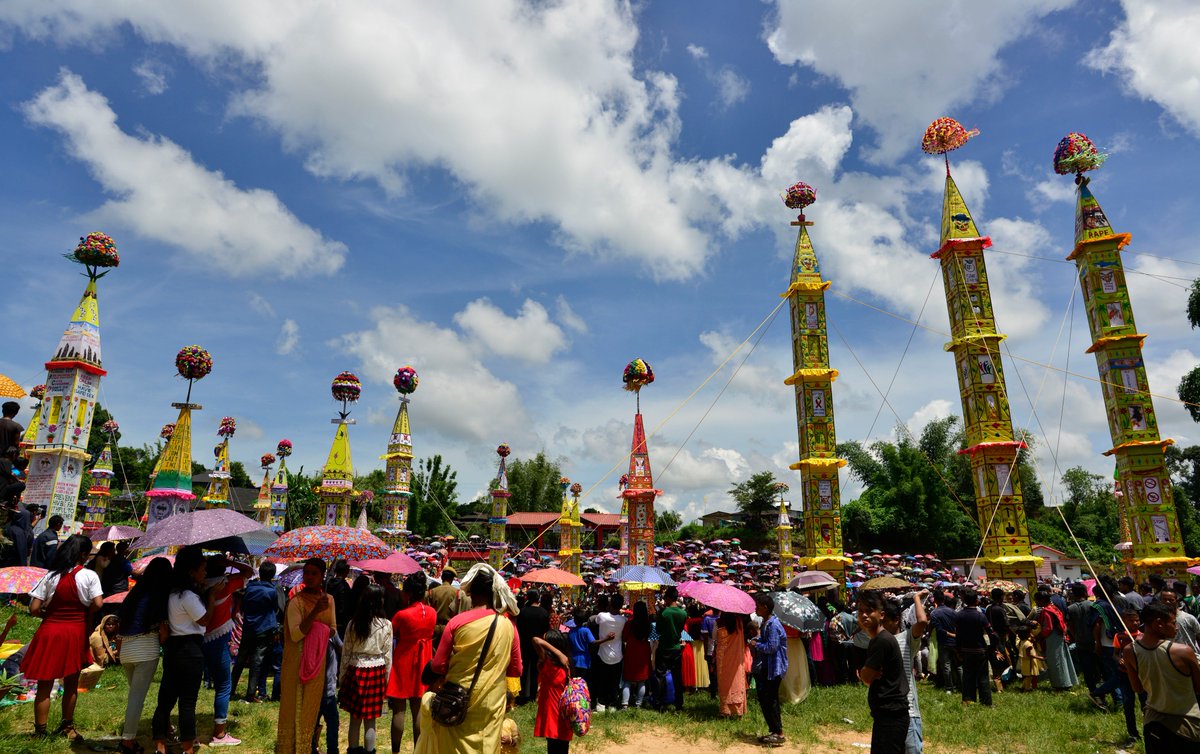
The name Behdeinkhlam means driving the plague away with wooden sticks, and that is what the festival does, literally, over four days in mid-July at Jowai. What counts as plague is not fixed. The tall bamboo rots carried through the town to the sacred pool name it fresh each year, and recent ones have warned about artificial intelligence, digital addiction and depression alongside the older afflictions.
That last part is the reason to pay attention to this one. Most festivals of this age are held in place by repetition. This one still updates. The thing being driven out is whatever the town has decided is currently doing the damage. That makes it less a survival from the past than a working institution that happens to be very old.
Beh dien is to drive away with wood. Khlam is plague or pestilence. Put together the name describes an action performed with sticks, and the festival is that action carried out at scale.
It runs four days in mid-July, after the sowing is finished. The dates shift a little year to year and are set locally, so they need confirming for the year you plan to travel rather than assumed.
Mid-July is not a neutral choice. It is the middle of the Meghalaya monsoon, when the rain is continuous, the ground is saturated and waterborne illness is at its annual peak. The festival is placed at the point of maximum exposure rather than before or after it.
The Pnar, also called Jaintia, are one of the three main communities of Meghalaya, alongside the Khasi and the Garo. Their country is the Jaintia Hills in the east of the state and Jowai is its principal town.
Behdeinkhlam belongs to Niamtre, the indigenous Pnar religion, and it is the largest festival in that calendar. Christianity is widespread across Meghalaya and Niamtre is now the faith of a minority, which makes the scale of the festival worth noticing. It draws thousands.
Authority sits with two offices. U Langdoh is the priest and leads the rites. The Daloi is the traditional chief and holds the civil side, to the point of refereeing the football match on the last day.
The Khnong and the Dein Khlam are tree trunks, felled in designated forest, then rounded, polished and brought into Jowai. They are the physical centre of the whole thing.
The Symbud Khnong, a long log, is brought to the pool and people press in to touch it. The belief is that touching it protects against sickness through the year and brings prosperity in work. The Khnong Blai, the sacred log, is carried to the water as the climax of the festival.
It is worth being clear about what is happening here, because it is easy to file under folklore and move on. A community facing an annual disease season is putting its hands on a piece of wood cut from its own forest and asking to be spared. That is a serious act, performed by people who take it seriously, and a visitor standing in that crowd should understand which of the two they are.
The rots are the part nobody outside Meghalaya expects.
They are structures of bamboo, coloured paper and tinsel, built by the young people of each locality in the town, standing between ten and forty feet tall. Every neighbourhood makes its own. They are paraded through the streets and brought to the pool on the final day, where they are immersed.
They are not decorative. Each one carries a message, and the messages are current. Recent years at Jowai have produced rots on environmental destruction, on political subjects, on depression, on addiction to phones and screens, and on artificial intelligence. One of them argued that a machine intelligence made by people risks hollowing out the intelligence of the people who made it.
Read that against the name of the festival and it holds together exactly. Khlam is whatever is afflicting the community. In the seventeenth century that was cholera and crop failure. In the twenty-first it also includes what a screen does to a teenager. The category did not change. What went into it did.
This is what an old institution looks like when it is still doing its job rather than being maintained. Festivals reshape places temporarily, and the ones that last are usually the ones that keep answering a question the community is actually asking.
Aitnar is where it ends. It is a pool at Jowai and by the last day of the monsoon festival it is a field of mud.
The rots are brought there and immersed. The Khnong is carried in. Thousands of people go into the mud and dance to drums and pipes, and the crowd in every photograph of Behdeinkhlam is this, on this day, in that pool.
The immersion has an obvious parallel with the way an image is given to the water at the end of a puja, and people in Jowai make that comparison themselves. What is being released is the year's affliction, named and built in bamboo and then taken apart in water.
Because that is the driving away, done house by house.
On the appointed morning young men go through the town striking the roofs of homes with bamboo poles, working through the settlement so that nothing is skipped. Evil, sickness and misfortune are being physically chased out of each building.
It is the plainest expression of what the festival is for and it is the part that most directly matches the name. It also explains why this is a town festival rather than a temple one. It has to cover every house to work, which means it has to move.
A game played with a rounded wooden ball between two sides drawn from the upper and lower valleys of the Myntdu river, Langdoh against Sangot Paswet. Whichever side pushes the ball to its own end wins, and the winning valley is held to be due a good harvest.
The Daloi referees. It is played on the last evening and it is the point at which the festival stops being solemn.
There is a working logic underneath the game. The two sides are the two halves of the town's agricultural land, and the contest is a public reading of which half will do well. Whatever anybody believes about the outcome, the effect is that the whole town watches its own farmland being talked about for an evening, just after the sowing is done.
Not in the way a health programme is, and it is worth being honest about that rather than dressing it up.
Behdeinkhlam is a ritual. Nobody is chlorinating a water source. The Niamtre faithful themselves describe it as being about driving out social ills as much as sickness, which is a wider claim than public health.
But the timing is not decoration. It falls in the week of the year when the rain has been falling longest, the ground holds the most standing water and illness in a hill town is at its most likely. Whatever else the four days do, they put an entire settlement's attention on affliction at precisely the moment affliction is most likely. They do it through work that requires every locality to organise itself.
And the rots have quietly turned it into something more direct. A town that builds a forty foot structure about depression and carries it through its own streets has named a health problem in public. That is not nothing, and there are far better funded systems that have not managed it.
The land does a great deal of the deciding here, as it does everywhere in these hills. Ecology sets the terms and people build the calendar around them.
It rains. That is the honest answer and there is no arranging around it.
Meghalaya in July is one of the wettest inhabited places on earth and the rain is continuous rather than intermittent. Roads slow, visibility drops, and the waterfalls and living root bridges everybody comes for are at their most spectacular and their least accessible at the same time. Landslides on hill roads are a real possibility and are the reason to build slack into a route rather than a reason not to go.
What you get for it is a state doing something rather than showing something. Nearly all Meghalaya tourism happens between October and April. In July the crowds are gone and the festival is on, which is a straightforward trade.
Five to seven days is right. Stay near enough to Jowai that you are not driving far in heavy rain, keep the daily distances short, and treat the schedule as approximate. What an ordinary day looks like matters more than usual here, because the days around the festival are when the town is preparing and that is half of what there is to see.
Jowai is the headquarters of West Jaintia Hills, about 60 km from Shillong on the road towards Silchar, which is roughly two hours in good conditions and longer in July. Shillong is about 100 km from Guwahati, and Guwahati has the nearest airport and railhead. Umroi, near Shillong, has limited flights.
On conduct, the important thing is that this is not staged for anybody. Senior politicians now attend the final day and there is press, so it is a public event in that sense. It remains a religious observance of a minority faith, carried out by a town for itself. Watch the mud pool from the edge rather than the middle unless you have been invited in. Ask before photographing the rites, as distinct from the crowd. The ordinary rules of being a guest hold, and they hold harder at a festival about affliction than at one about harvest.
Jowai sits on our ten-day Assam and Meghalaya route, which runs in the drier months and covers the Jaintia and Khasi hills at the pace they deserve. A trip built around the festival itself is a different shape and a wetter one. If you want to work from Meghalaya or the wider Northeast, those are the starting points.
State involvement has grown, as it has at Mopin in Arunachal, where a committee fixed the date in 1966 and the public version and the village version drifted apart. Behdeinkhlam has not split that way yet. Choosing to be there while it is still one festival rather than two is most of what care-based travel means here.
Driving away the plague with wooden sticks. Beh dien is to drive away with wood and khlam is plague or pestilence. The name describes the central action of the festival, in which evil and sickness are physically chased out of the town.
Over four days in mid-July, after the sowing season ends. The exact dates are set locally and shift a little from year to year, so they should be confirmed for the year you intend to travel rather than assumed from a previous one.
The Pnar, also called Jaintia, of the Jaintia Hills in eastern Meghalaya, and specifically those following Niamtre, the indigenous Pnar religion. Jowai, the headquarters of West Jaintia Hills, is where the main observance takes place.
A tree trunk, felled in designated forest and then rounded and polished, which is carried into Jowai and forms the physical centre of the festival. The Symbud Khnong and the Khnong Blai are the two named logs. Thousands press in to touch them, believing it brings protection from illness through the year.
Structures of bamboo, coloured paper and tinsel, between ten and forty feet tall, built by the young people of each locality in Jowai. They are carried through the streets and immersed at the sacred pool. Each carries a message about something currently afflicting the community.
Current ones. Recent years at Jowai have produced rots on environmental destruction, political subjects, depression, addiction to phones and screens, and artificial intelligence. The category the festival drives out has stayed the same while its contents have kept changing.
The sacred pool at Jowai where the festival ends. The rots are immersed there and the Khnong is carried in, and by the final day the ground around it is deep mud, which thousands of people dance in to drums and pipes.
A football match played with a rounded wooden ball on the last evening, between sides representing the upper and lower valleys of the Myntdu river, Langdoh and Sangot Paswet. The Daloi acts as referee and the winning side is held to be due a good harvest.
U Langdoh, the priest, leads the religious rites. The Daloi, the traditional chief, holds the civil authority and referees the Datlawakor. The two offices divide the religious and social halves of the festival between them.
Not as a health intervention would. It is a ritual, and the Niamtre faithful describe it as driving out social ills as much as sickness. What it does do is place an entire town's attention on affliction in the week of the year when illness is most likely, and the modern rots name specific health problems in public.
It is the wettest month in one of the wettest places on earth, and the rain is continuous rather than occasional. Roads slow and landslides are possible. In exchange the crowds are gone, the waterfalls are at full force and the festival is on. Build slack into any route.
Jowai is roughly 60 km from Shillong on the Silchar road, about two hours in dry conditions and longer in July. Shillong is around 100 km from Guwahati, which has the nearest major airport and railhead. Umroi near Shillong handles limited flights.