
Let’s help you
plan your journey
Explore responsibly, discover offbeat places, guided by locals, rooted in culture.
Let’s help you
plan your journey
Explore responsibly, discover offbeat places, guided by locals, rooted in culture.
Soumen Bhowmick
Soumen Bhowmick founded Pollen Dots in 2024 to plan journeys across India and Bhutan. He works in the Commercial Department of Indian Railways, where he has been since 2000. From 2016 to 2020 he was Head of Business Development and Partnerships at ScoutMyTrip, a community-driven road trip planning platform. There he built a nationwide network of local Scouts who helped travellers on the road, and grew the Road Trippers Club to 16 Indian cities. As a core member of Devil On Wheels, he helped travellers plan Himalayan trips and started Spreading Smiles. He has driven solo from Arunachal to Goa and from Himachal to Karnataka, and has run his own caravan for more than ten years. His photographs have won national and international salon awards, and his writing has appeared in Outlook Traveller.
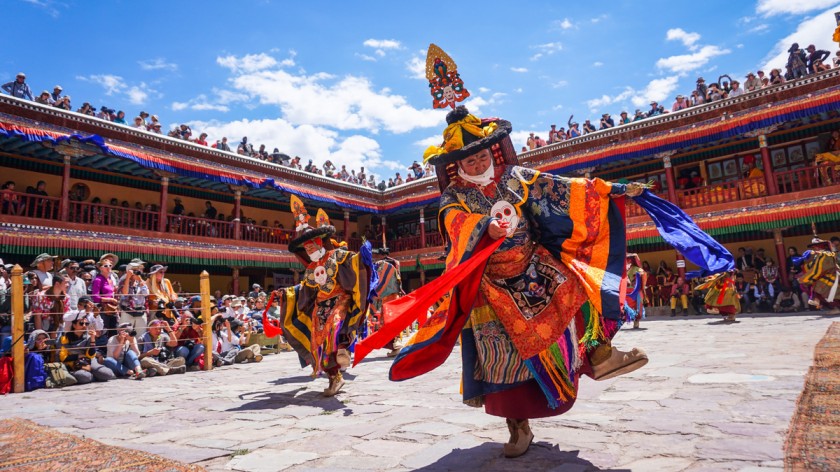
The Hemis Festival is the one Ladakhi festival that happens in public, which is why it is the one everybody has heard of. It falls on the tenth day of the fifth Tibetan month, in June or July, because that is when the passes are open and Ladakh can actually gather. Every twelve years it also unfurls a thangka the height of the monastery wall, and the next one is due in 2028.
Most Himalayan festivals unfold quietly, inside homes and villages, where a visitor sees very little. Hemis is the exception. It draws people outward, towards the monastery and the courtyard in front of it, and it brings Ladakh into a rare few days of visibility. It is not something Ladakh performs for visitors. It is something Ladakh performs for itself, and allows others to watch.
The annual festival at Hemis Monastery, marking the birth of Guru Padmasambhava.
Hemis sits about forty-five kilometres from Leh, tucked into a side gorge off the Indus valley rather than out on the open plain. That position is not incidental. Being hidden is part of why the monastery survived intact through centuries when others did not, and it is why Hemis is the wealthiest and one of the most influential monasteries in Ladakh.
The monastery belongs to the Drukpa lineage and was re-established in the seventeenth century under King Sengge Namgyal, though a monastery is thought to have stood there long before.
The festival itself runs across two days. It is a religious occasion rather than a cultural one, and the distinction matters. Visitors are welcome to watch. Nothing about it is arranged for them.
The figure credited with carrying Vajrayana Buddhism into Tibet and the Himalaya in the eighth century.
He is known across the region as Guru Rinpoche, meaning precious teacher, and in Ladakh his presence is not distant history. He appears in monastery walls, in household shrines, in the names of places, and in the stories told about how particular valleys came to be habitable.
What the tradition holds is that he subdued the forces obstructing the spread of the teaching, established monastic practice, and left instructions concealed to be found later when they would be needed.
The Hemis Festival commemorates his birth. But it does it through movement rather than sermon, which is the more interesting choice. In a society where memory was carried orally for far longer than it was written down, a festival was not a supplement to the record. It was the record.
Because it is set on the tenth day of the fifth month of the Tibetan calendar, and because that is the only part of the year Ladakh can gather at all.
The word tsechu means tenth day, and the tenth day is associated with Padmasambhava throughout the Himalayan Buddhist world. Hemis takes the fifth month.
The practical consequence is that Hemis lands in Ladakh's short open season. Passes are clear, roads are working, villages that spend half the year effectively separate can send people, and the valley is connected to the rest of the country again.
This is the exact opposite of Losar, which sits in the depth of winter and happens almost entirely indoors. Ladakh has two poles and these are they. One is a turning inward when nothing else is possible. The other is a turning outward when everything briefly is.
The date shifts against the Gregorian calendar every year, so it needs confirming annually. This is the land setting the terms again, as it does with everything else up there.
Ritual first, dance second, and a great deal of visiting around both.
The monastery courtyard is prepared and the monastic community assembles. Rituals run to their own schedule, which is fixed and does not adjust for anybody's travel plans. Musicians play long horns, drums and cymbals, and the sound carries a long way in a gorge.
The masked dances occupy the centre of both days, in sequences that build across the hours rather than repeating.
Around the edges is the part visitors often miss. Families have travelled in from villages across Ladakh, many of them meeting people they see once a year. There is a market. There is food. There is a great deal of catching up going on in the galleries while the dancing continues below.
Both halves are the festival. The dancing is what gets photographed. The gathering is what it is for.
They are practice rather than performance, and every element is fixed.
The dancers are monks. The masks, the robes, the gestures and the sequence all correspond to particular teachings and particular narratives. Nothing in it is improvised and nothing is decorative.
What the dances enact is the subduing of obstructing forces, the protection of the teaching, and the passage through death and rebirth. For the monks performing them, the dance is a form of meditation carried out with the whole body.
That is why the atmosphere at Hemis feels charged without becoming chaotic. There is real energy in it, and the energy is pointed somewhere.
A visitor watching will see colour, noise and drama, and there is nothing wrong with seeing that. It is worth knowing that the people in the masks are doing something else entirely.
A thangka of Padmasambhava said to be the largest in Ladakh, unfurled once every twelve years.
It is embroidered rather than painted, worked with pearls and semi-precious stones, and it covers the height of the monastery wall when it is hung. For eleven years out of twelve it stays rolled and stored.
The showing falls in the Year of the Monkey. The last was 2016, which puts the next in 2028.
If you are planning a Ladakh trip around Hemis, that is the single most useful date to know. An ordinary Hemis year and a Monkey year are different events, and the Monkey year draws crowds accordingly.
Bhutan does something comparable with its thongdrel, unfurled at dawn during the major tsechus and rolled away before the sun reaches it. The reasoning is the same in both places. Seeing it is understood to do something, and it is not made available casually.
The whole valley reorganises around a monastery for about a week.
Villages send representatives. Families plan their movements around the monastery schedule rather than their own. Roads towards Hemis carry far more traffic than usual, and accommodation across Leh and the surrounding area fills well in advance.
Priorities invert for the duration. Monastic timing overrides commercial routine. Community obligation outranks the working day. Visitors either adapt to ritual time or spend two days frustrated.
None of this is caused by tourism, which is the thing worth holding onto. The gathering predates the visitors by a very long way, and it would happen at exactly the same scale if none arrived.
Many, and most of them are quieter and more interesting for it.
Ladakh alone has a full calendar. Phyang Tsedup follows in summer. Thiksey Gustor and Spituk Gustor fall in the colder months. Matho Nagrang, in late winter, is the one people talk about, because it involves two oracles who take on the role after long retreat.
Spiti has its own monastic calendar again, and the Monpa areas of Arunachal Pradesh hold Torgya at Tawang in the middle of winter. Across the wider northeast there are more.
Bhutan runs the largest tsechu tradition anywhere, with festivals at Paro, Thimphu and Punakha drawing much of the country.
If Hemis is booked out or the timing does not work, one of these will usually be better. Fewer visitors, the same tradition, and considerably more room to sit and watch.
Yes, provided you plan the trip around Ladakh and not around the festival.
Three or four months of lead time is realistic, because Hemis falls inside the peak summer window when flights, vehicles and rooms in Leh are all under pressure regardless of the festival.
Give the trip six to eight days at least. Acclimatisation is not optional at that altitude and the first day is a rest day whether you like it or not. Two festival days inside a week leaves room for the monasteries and valleys around Leh, which is where most of the good time goes anyway.
Behave as you would in any monastery. Dress covered, follow whatever the person on the door tells you, sit where you are put, and do not walk into the dancing ground to get a better photograph. The ordinary rules of being a guest apply, and at Hemis the whole valley is watching.
And if you would rather see Ladakh than a crowd, come a week either side. The monastery is still there, the gorge is still remarkable, and you will have it more or less to yourself. That choice, about when rather than where, is most of what care-based travel comes down to.
On the tenth day of the fifth month of the Tibetan calendar, which falls in June or July. The date shifts against the Gregorian calendar every year and is announced by the monastery closer to the time, so it needs confirming for the year you are travelling.
The birth of Guru Padmasambhava, known across the Himalaya as Guru Rinpoche, who is credited with carrying Vajrayana Buddhism into Tibet and the region in the eighth century. In Ladakh he is present in monastery walls, household shrines and place names rather than being distant history.
About forty-five kilometres from Leh, set into a side gorge off the Indus valley rather than out on the open plain. Being hidden is part of why it survived intact through centuries when others did not, and it is the wealthiest monastery in Ladakh.
Two days, with rituals, masked dances and monastery ceremonies across both. Most travellers add days either side, partly for movement and partly because acclimatisation at that altitude is not optional.
In 2028. The thangka of Padmasambhava, said to be the largest in Ladakh and embroidered with pearls and semi-precious stones, is shown once every twelve years in the Year of the Monkey. The last showing was in 2016, and it stays rolled and stored the rest of the time.
Yes, the dances and public rituals can be watched respectfully, though some ceremonies stay internal to the monastery. Dress covered, follow whatever you are told at the door, sit where you are placed, and do not step into the dancing ground for a photograph.
Three to four months. Hemis falls inside Ladakh's peak summer window, so flights, vehicles and rooms in Leh are all under pressure whether or not people are coming for the festival. Prices around the festival dates rise as well.
Masked dances performed by monks, in which the masks, robes, gestures and sequence all correspond to particular teachings. Nothing is improvised. They enact the subduing of obstructing forces and the passage through death and rebirth, and for the dancers they are a form of meditation.
Several, and most are quieter. Phyang Tsedup follows in summer. Thiksey Gustor and Spituk Gustor fall in the colder months. Matho Nagrang in late winter involves two oracles who take the role after long retreat. Bhutan runs the largest tsechu tradition anywhere.
It can be, if you are comfortable with crowds in one place, slower movement on festival days, and building the plan around monastery timing. If you would rather see Ladakh than a crowd, come a week either side and you will have the same gorge with far fewer people in it.