
Let’s help you
plan your journey
Explore responsibly, discover offbeat places, guided by locals, rooted in culture.
Let’s help you
plan your journey
Explore responsibly, discover offbeat places, guided by locals, rooted in culture.
Soumen Bhowmick
Soumen Bhowmick founded Pollen Dots in 2024 to plan journeys across India and Bhutan. He works in the Commercial Department of Indian Railways, where he has been since 2000. From 2016 to 2020 he was Head of Business Development and Partnerships at ScoutMyTrip, a community-driven road trip planning platform. There he built a nationwide network of local Scouts who helped travellers on the road, and grew the Road Trippers Club to 16 Indian cities. As a core member of Devil On Wheels, he helped travellers plan Himalayan trips and started Spreading Smiles. He has driven solo from Arunachal to Goa and from Himachal to Karnataka, and has run his own caravan for more than ten years. His photographs have won national and international salon awards, and his writing has appeared in Outlook Traveller.
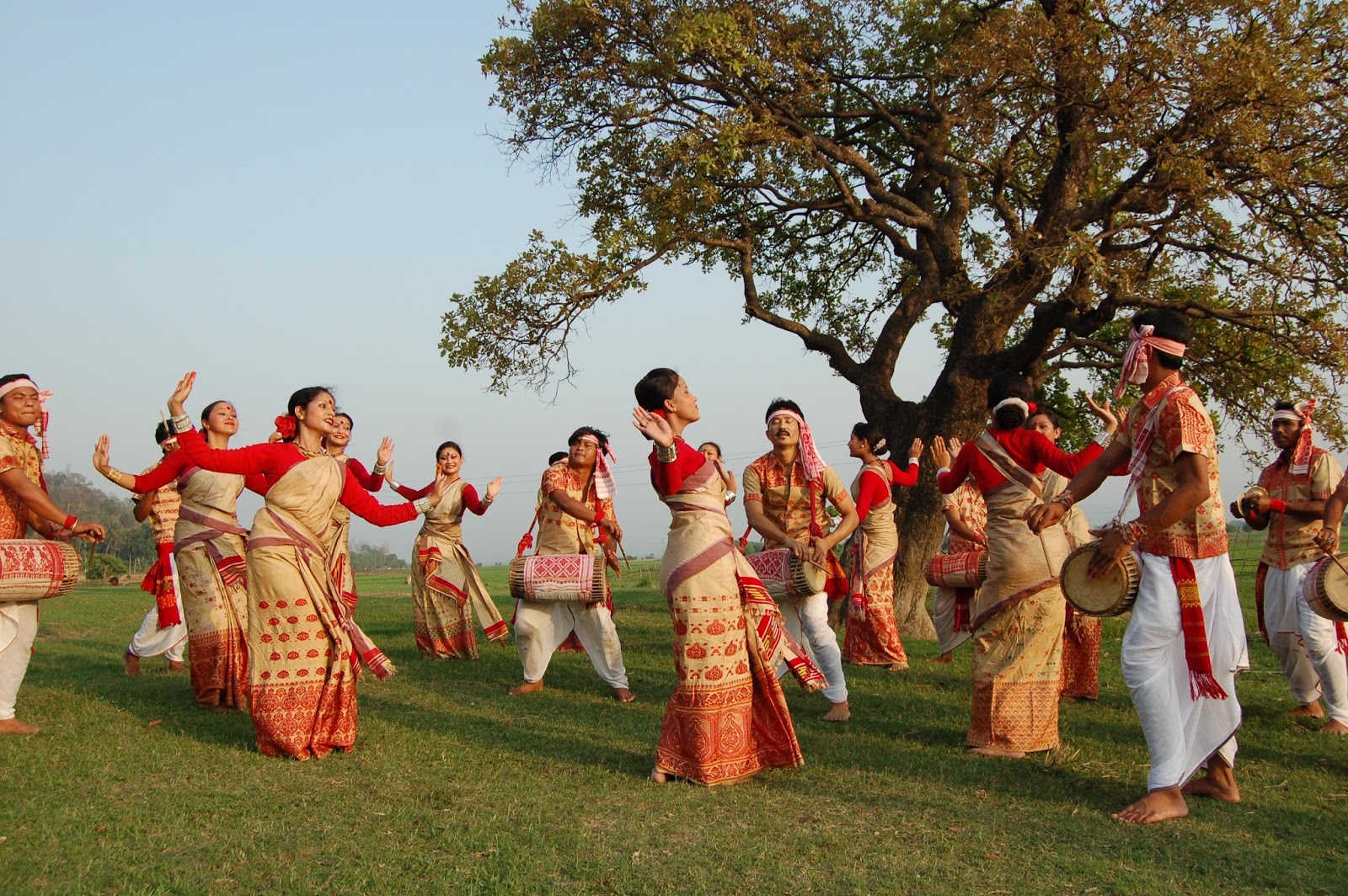
Almost every description of Rongali Bihu calls it a harvest festival, which is the one thing it is not. Assam's rice is in by December and the harvest is marked in January at Magh Bihu, while Rongali Bihu falls in mid-April with the fields prepared and nothing yet sown. It marks the moment before the work starts, and the three Bihus read together as a farming calendar of beginning, waiting and reward.
The confusion is easy to understand. Bihu is one word doing three jobs, and the version that travels furthest is the one with dancing in it. Ask anyone outside the Northeast what Bihu is and the answer will be April, dhol, mekhela chador, a field full of people. That is Rongali Bihu, and it is louder than the other two by a wide margin. But a calendar built by farmers does not put its largest gathering at the end of the work. It puts it at the start.
Because the harvest was four months earlier. Assam's main rice crop, sali, goes into the ground with the monsoon and comes out in November and December, and the festival that marks it being safely in is Magh Bihu in mid-January.
Rongali Bihu falls at the start of Bohag, the first month of the Assamese calendar, which puts it in the second week of April. By then the fields have been cleaned, the bunds repaired, the ploughs checked and the cattle brought back into condition after the cold months. Nothing has been planted. The ahu crop goes in around this point and the sali crop not until the rains arrive.
So what is being marked is not relief. It is readiness, and that produces a different kind of festival. Relief is loud once and then over. Readiness runs for about a week and touches everything, because everything is about to begin.
None of this is unusual. Across India the festival calendar is the farming year showing itself, and what varies is which part of that year a place decided was worth marking. Assam marked all three parts, which is rarer.
Assam observes three, and they are not three versions of the same event. They mark three different states of the same crop.
Rongali Bihu, in mid-April, is the beginning. The year opens, the work starts, and this is the one with the music in it.
Kati Bihu, in mid-October, is the lean middle. The paddy is standing in the fields and is not ready. Last year's granary is close to empty. It is also called Kongali Bihu, and kongali means poor. There is no feasting and no dancing. Earthen lamps are lit at the tulsi plant and out in the paddy, sometimes raised on a bamboo pole. The whole observance is a request that the crop survives.
Magh Bihu, in mid-January, is the payoff. The harvest is in and the granaries are full. Structures of bamboo and thatch are built and burnt at dawn, and this is the eating one, which is why it is also called Bhogali Bihu, from bhog.
Read in order they are hope, discipline and reward. Only one of the three has dancing in it, and the middle one has no celebration at all. That tells you the calendar was built by people with something at stake, not by anyone arranging entertainment.
The Bihu calendar is also the Assamese one, and it is not the only agricultural year running in the state. The Mising community, living along the Brahmaputra and its tributaries, marks its own sowing at Ali-Ai-Ligang, which falls earlier, in February.
A new year fixed by a crop behaves differently from one fixed by a religious calendar. Losar runs on lunar reckoning and can land two months apart in two Himalayan valleys in the same winter. Rongali Bihu follows the solar year and sits on 13 or 14 April, which makes it one of the easiest festivals in India to plan a trip around.
The festival opens with the cattle, and it does so on the last day of the old year rather than the first day of the new one. Garu Bihu falls on the final day of Chot, the outgoing month. Manuh Bihu, the human day, follows on the first of Bohag.
That ordering is the argument of the whole festival in miniature. The animals that do the ploughing are dealt with before the people are.
On the morning of Garu Bihu the cattle are taken to a river or a pond and washed. They are rubbed with turmeric and black gram paste. They are struck lightly with sprigs of dighloti and makhioti, plants kept for their supposed protective effect. They are fed brinjal and gourd. The old ropes come off and are burnt, and new ones, tara pogha, are tied. Then the animals are let loose for the day.
Manuh Bihu the next morning is the household's version of the same act. People bathe, put on new clothes, and the young take blessings from the elders. Gosai Bihu on the third day covers the household deities. The sequence runs about seven days in all, with the later days varying by district.
Somebody who arrives on 14 April looking for the dancing has already missed the part that explains it.
Most of the first two days happens inside houses, courtyards and cattle sheds, which is worth knowing before arriving with a camera. Everyday etiquette matters more at a festival built around domestic space than at one built around a procession.
From the fields, and the instruments give it away. The dhol is a two-headed barrel drum carried on a strap, struck with a stick on one side and the hand on the other. The pepa is a pipe made from a buffalo horn. The gogona is a cut reed of bamboo held in the teeth. There is also the toka, a split bamboo clapper, and the xutuli, a small clay whistle.
Every one of these is built to carry across open ground. Not one of them is built for a room.
The movement follows the same logic. It sits low, repeats, and works from the hips and knees, closer to sustained physical labour than to display. The songs are largely courtship songs, which is the part usually left out of the description. Bihu was the point in the year when young people from different villages had a legitimate reason to be standing in the same open field.
There are two halves to this and only one of them travels. Husori is the older half, groups of singers moving house to house, performing in the courtyard, receiving a gamosa and moving on to the next gate. Bihutoli, the stage version, is a raised platform with a seated audience and a competition, and it is a twentieth century and largely urban arrangement.
Both are real. They are not the same festival, and a visitor who only sees the second one has seen the smaller half.
Because rice is what there is, and because the rice eaten in April was harvested in December.
Pitha is the category. Til pitha is rolled around sesame and jaggery. Ghila pitha is fried. Sunga pitha is steamed inside a length of bamboo. All of them use bora, the sticky rice grown for this purpose. Alongside them are chira and akhoi, flattened and puffed rice, eaten with curd and jaggery, and laru, sweet balls of coconut or sesame bound with jaggery.
Notice what is missing. Nothing fresh, nothing lifted from the fields outside, because there is nothing in the fields outside. The entire spread comes out of storage.
That is the same mechanism as Phool Dei in the Uttarakhand hills, where the pudding handed out in March is made of things kept since autumn. The meaning is not the same. In Uttarakhand the household is demonstrating that it got through. In Assam it is spending the stores down at the opening of the working year, which only makes sense if you are confident the granary is about to be filled again.
Food carries this kind of information everywhere in India, and it is usually the quickest way to understand what a place has been doing.
Most things slow and some stop. Offices and schools close for several days. Long-distance movement out of the state peaks in the week before, because people go home, and movement within the state rises afterwards as families visit each other.
The run-up is the part worth arriving for. Markets fill with new clothes, pitha ingredients and gamosa. The gamosa is the handwoven cotton cloth, white with red borders and woven motifs, given to elders and to anyone owed respect. It received a Geographical Indication tag on 13 December 2022, and the registration names eight distinct types. The one woven for this festival has its own name, bihuwan.
Weaving finishes in the days before. In a household with a loom, the gamosa handed over on 14 April was on that loom in the last week of March.
For a visitor the effect is mixed. The state is unusually sociable and unusually unhurried, and what an ordinary day looks like shifts for about a week. Family-run homestays may not take guests, because the family is doing the festival. Transport runs but is busier.
This kind of temporary reshaping is not specific to Assam. It is what festivals do to Indian destinations generally, and the size of the change is a fair measure of how much a place still depends on the thing the festival is about.
Mid-April is a good time to be in Assam whether or not the festival is the reason. The cold is finished, the monsoon has not arrived, roads are dry and the light runs long. Kaziranga is still open, though this is the dry end of its season and the closing date is set each year rather than fixed.
Where matters more than when. Rongali Bihu is observed across the state, but what you see depends almost entirely on whether you are standing in a town or a village.
Guwahati will give you Bihutoli. A stage, a sound system, a printed schedule and a large crowd. It is worth seeing once and it is not where the festival lives.
The village version sits in Upper Assam, around Jorhat, Sivasagar, Golaghat and on Majuli, and in the agrarian belts of Lower Assam. There the husori groups still move gate to gate and the week still opens with the cattle.
Six to nine days is a sensible length for a trip. Our ten-day journey through Assam and Meghalaya runs through Pobitora, Chandubi and the Khasi and Jaintia hills, which is longer than the festival alone needs but moves at the pace the season suggests. If you want to build something around Assam or the wider Northeast, mid-April is the last clear window before the rain shuts things down.
If the dates do not work, the season still does. What Rongali Bihu marks is not a week of events but a change of state, and the state lasts longer than the week. Arriving while a place is doing something rather than performing it is most of what care-based travel comes down to.
The Assamese new year, observed at the start of Bohag in the second week of April. It marks the opening of the agricultural year, at the point where the fields have been prepared and sowing has not yet begun. It runs about seven days and is the largest of the three Bihus.
On 13 or 14 April in most years. It follows solar reckoning rather than lunar, so unlike much of the Indian festival calendar the date barely moves, which makes it easy to plan travel around well in advance.
No, and this is the most common error made about it. Assam's main sali crop is harvested in November and December, and the festival that marks the harvest is Magh Bihu in mid-January. Rongali Bihu falls four months later, before anything has been sown.
Rongali Bihu in April marks the beginning of the agricultural year. Kati Bihu in October falls in the lean middle, when the crop is standing and the granary is low. Magh Bihu in January follows the harvest and is the feasting one. Together they cover hope, endurance and reward.
The first day of Rongali Bihu, given entirely to cattle. The animals are washed in a river or pond, rubbed with turmeric and black gram paste, fed brinjal and gourd, released from their old ropes and tied with new ones. It falls on the last day of the outgoing month, so the festival begins before the new year does.
The second day, and the first day of Bohag. Manuh means human. People bathe, wear new clothes, and the young take blessings from elders, usually giving a gamosa. Gosai Bihu on the third day is given to the household deities.
Because there is nothing yet to celebrate. Kati Bihu falls in October, when the paddy is in the ground but not ready and last year's stores are running out. Earthen lamps are lit at the tulsi plant and in the fields as a request rather than a thanksgiving. The absence of music is deliberate.
Almost all of it is rice. Pitha in several forms, including til pitha rolled around sesame and jaggery and sunga pitha steamed inside bamboo. Chira and akhoi, flattened and puffed rice, are eaten with curd and jaggery, and laru are sweet balls of coconut or sesame. Everything comes from grain stored since the December harvest.
A handwoven cotton cloth, white with red borders and motifs, given to elders and to guests as a mark of respect. It received a Geographical Indication tag on 13 December 2022, and the registration distinguishes eight named types. The one woven for this festival is called a bihuwan.
The dhol, a two-headed barrel drum, carries the rhythm. The pepa is a pipe made from a buffalo horn, and the gogona is a bamboo reed held in the teeth. The toka is a split bamboo clapper and the xutuli a small clay whistle. All of them are built to be heard across open fields rather than indoors.
Yes. The cold is over, the monsoon has not started, roads are dry and connectivity is stable. Kaziranga is still open at this point, though the closing date is announced each year rather than fixed. It is the last clear window before the rains.
In the villages rather than the cities. Upper Assam around Jorhat, Sivasagar, Golaghat and Majuli, and the agrarian belts of Lower Assam, still run husori groups going house to house. Guwahati offers Bihutoli, the staged competitive version, which is worth seeing once but is the smaller half of the festival.
Yes, though manageably. Long-distance travel out of the state peaks just before the festival as people return home, and movement inside the state rises during it. Family-run homestays may not take guests during the first days, since the household is observing the festival. Booking early matters more for getting the right location than for finding a room.