
Let’s help you
plan your journey
Explore responsibly, discover offbeat places, guided by locals, rooted in culture.
Let’s help you
plan your journey
Explore responsibly, discover offbeat places, guided by locals, rooted in culture.
Soumen Bhowmick
Soumen Bhowmick founded Pollen Dots in 2024 to plan journeys across India and Bhutan. He works in the Commercial Department of Indian Railways, where he has been since 2000. From 2016 to 2020 he was Head of Business Development and Partnerships at ScoutMyTrip, a community-driven road trip planning platform. There he built a nationwide network of local Scouts who helped travellers on the road, and grew the Road Trippers Club to 16 Indian cities. As a core member of Devil On Wheels, he helped travellers plan Himalayan trips and started Spreading Smiles. He has driven solo from Arunachal to Goa and from Himachal to Karnataka, and has run his own caravan for more than ten years. His photographs have won national and international salon awards, and his writing has appeared in Outlook Traveller.
Every listing of Ali-Ai-Ligang gives it as a February festival, which is true and not much use, since the date moves. It is fixed to a weekday rather than a date, the first Wednesday of Gimur Polo, because Wednesday is the day the Mising consider right for putting seed in the ground. The festival works that way throughout, tied to conditions rather than to a calendar, which is what farmers on a floodplain that reshapes itself every year would build.
Assam has two agricultural new years and most writing on the state only notices one. The loud one is in April. This is the other one, it comes seven or eight weeks earlier, and it belongs to a community that farms land the Brahmaputra takes back and returns on its own schedule.
The name is three words and all three are about seed. Ali is legumes, ai is the seed itself, and ligang is to sow. Together it reads as the sowing of legume and paddy seed, which is a description of an action rather than a name for an occasion.
It falls on Ligange Lange, the first Wednesday of Gimur Polo in the Mising calendar, which corresponds to the Assamese month of Fagun and lands in February. In 2016 that was 2 February. In 2026 it was 18 February. The spread is why a date is no use and the weekday is.
It marks the start of ahu paddy, the early rice crop, sown in late winter and taken off before the monsoon. That crop matters more here than anywhere else in Assam, because the main sali crop is the one the floods can take.
The wider Assamese calendar, with its three Bihus, is set out in the article on Rongali Bihu. This one runs alongside it, not inside it.
Because Wednesday is held right for beginning work on the land, and at some point the community fixed the festival to that rather than to a date.
It was not always so. Ali-Ai-Ligang was once observed on any convenient day through Fagun, and the first Wednesday became the settled custom later. That is a small piece of history worth holding onto, because it shows a calendar being tightened by the people using it rather than handed down finished.
Almost every other festival in India is fixed by a date, solar or lunar. Losar moves with the lunar reckoning and can fall two months apart in two Himalayan valleys in the same winter, which the article on Losar sets out. Rongali Bihu sits on 13 or 14 April and barely moves. Ali-Ai-Ligang does neither. It waits for a particular day of the week to come round inside a particular window.
For a visitor this is the single most useful fact about it. You cannot look up the date a year ahead and book around it. You can look up which month, work out the first Wednesday, and be right.
The Mising are a Tani people who came down from the hills of what is now Arunachal Pradesh and settled on the plains along the Brahmaputra and its tributaries. The 2011 Census recorded around 680,000 of them in Assam, which makes them one of the largest indigenous communities in the state.
Coming down was a choice with consequences. Hill agriculture and floodplain agriculture are different problems. A hillside is stable and steep. A floodplain is flat and unstable, and every monsoon the river rewrites it. Field edges shift. Channels move. Land that carried a crop last year may be sand this year.
The houses answer the same problem. Mising villages are built as chang ghar, raised on bamboo or timber stilts with the living floor well above the ground, so that a flood passes underneath rather than through.
They kept the faith they brought with them. Donyi-Polo, sun and moon, is the Mising religion and it is also the religion of the Galo, the Adi and the other Tani groups still in the Arunachal hills. Mopin, the Galo festival, is the same kind of agricultural marker and it falls in early April.
That is the comparison worth making. Two communities, one origin, one religion, and their sowing festivals sit six weeks apart. The gap is not cultural. It is what the land does to the people living on it, and here it is measurable in weeks.
It opens with a flag and closes with a feast, and the days in between are the interesting part.
The Laitom Tomchar, the festival flag, is raised to begin it. Offerings go to Donyi and Polo. Apong, the household rice beer, is poured, along with dried fish and dried meat. On the first day a token sowing is done, a ceremonial handful rather than a field.
Then the festival does something almost no other Indian festival does. For its duration, ploughing, cutting trees and burning are forbidden. The taboo is the mechanism. A festival that opens the sowing season also suspends work for five days.
That is worth sitting with. The obvious way to start a farming year is to start farming. What happens here instead is a symbolic first seed, then an enforced pause, then everybody begins together at the end of it.
On a floodplain that makes sense. If one household ploughs early it changes water and soil for the fields around it, and the boundaries between those fields were redrawn by the river a few months ago. A pause that everybody keeps is how you get a whole village starting from the same line.
The fifth day is Lilen, the feast that closes it. Purang Apin, boiled rice packed and wrapped, is shared out. There is pork, and more apong. Food is a record of what a place has and when it has it, and a February feast on a floodplain is built from what the last dry season left.
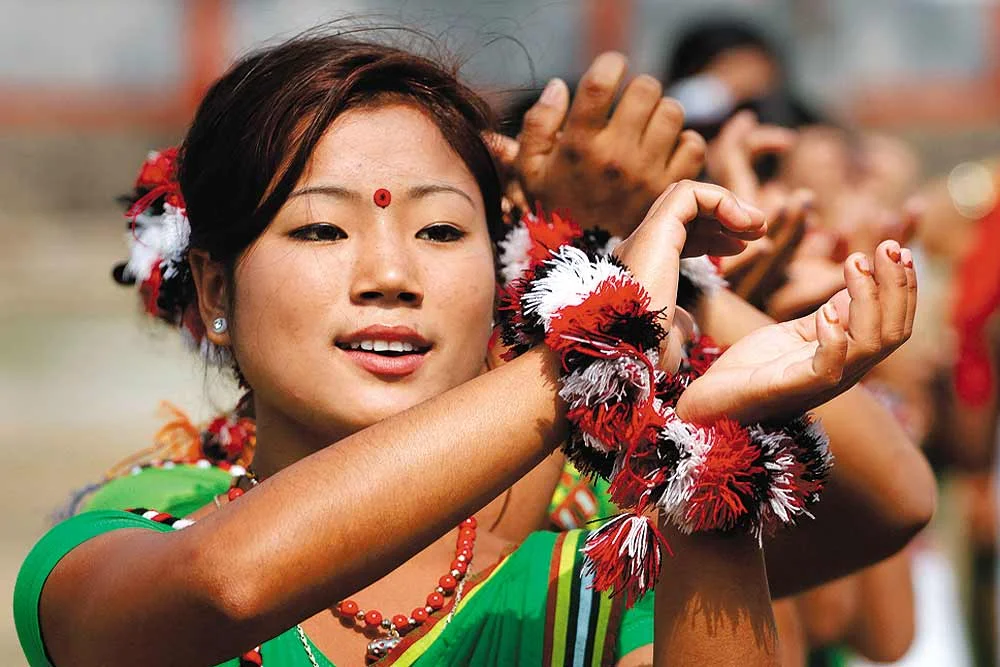
Gumrag, or Gumrag Soman, is the dance of the festival and it is done by the young, in lines, in the open. The movement is low and repetitive and reads as field labour rather than performance, which is the same thing the Bihu dance does one river valley over.
Oi Nitom are the songs that go with it. They are largely courtship songs, short verses traded back and forth, and they carry the melody the dance moves to.
The setting has been changing. Ali-Ai-Ligang was a village festival held inside village boundaries, and over the last few decades organised urban celebrations have grown, with the Jorhat gathering the best known. That is not a corruption of it. Mising families who moved to towns for work built somewhere to keep the festival, which is a reasonable thing to do.
It does change what a visitor sees. A town celebration is a programme with a stage and a crowd. A village one is a flag, a field and a household. They are both real and they are not the same event.
February is the steadiest travel month in Assam and the festival is not the only reason to use it. The floods are long gone, the rivers are low, the roads hold, the cold is mild and the pre-monsoon rain has not started. Kaziranga and Orang are both mid-season.
Where to be is Upper Assam and the river islands. Mising villages run through Dhemaji, Lakhimpur, Majuli, Sivasagar and Jorhat district, along the Brahmaputra and up its northern tributaries. Majuli is the one most travellers have heard of and it has Mising villages on it, though it is better known for its satras.
Five to seven days is the right length. The festival day itself is one Wednesday, and what is worth watching is the week around it, when the pause holds and then breaks. An ordinary day tells you more than an event does, and this festival is mostly ordinary days arranged deliberately.
Our ten-day journey through Assam and Meghalaya works through Pobitora and Chandubi, both floodplain wetlands, and February sits inside its season. It is longer than the festival needs and it covers the ground the festival is about. If you want to build something around Assam or the wider Northeast, this is the month with the fewest obstacles in it.
One thing to be clear about before going. This is a household and village observance, not a public event, and much of it happens on a raised bamboo floor inside somebody's home. The ordinary rules of being a guest apply more heavily here than at a festival with a procession, and where you stay decides almost everything about what you are shown. Choosing the week and the village rather than the itinerary is most of what care-based travel means in practice.
The sowing festival of the Mising community of Assam, marking the start of ahu paddy cultivation on the Brahmaputra floodplain. It runs five days, opens with a ceremonial first sowing, and suspends field work for its duration. It is the main festival of the Mising year.
Three words, all about seed. Ali is legumes, ai is seed, and ligang is to sow. The name describes the act of sowing legume and paddy seed rather than naming an occasion, which is a fair summary of what the festival is for.
On the first Wednesday of Gimur Polo in the Mising calendar, which corresponds to the Assamese month of Fagun and falls in February. It was 2 February in 2016 and 18 February in 2026, so the date moves by more than a fortnight from year to year.
Because Wednesday is the day the Mising hold right for beginning work on the land. The festival was once observed on any convenient day through Fagun, and the first Wednesday became the fixed custom later. Almost no other Indian festival is set by a weekday rather than a date.
Five days. The first day carries the flag raising, the offerings and a token sowing. The middle days hold a working taboo. The fifth day is Lilen, the feast that closes it and releases everybody back to the fields.
A Tani people who moved down from the hills of present-day Arunachal Pradesh and settled along the Brahmaputra and its tributaries. The 2011 Census recorded around 680,000 in Assam. They build chang ghar, houses raised on stilts, so that floodwater passes underneath rather than through.
The religion of the Mising and of the Tani groups in the Arunachal hills, centred on Donyi the sun and Polo the moon. Offerings at Ali-Ai-Ligang are made to them. It is the same faith the Galo observe at Mopin, their own agricultural festival in early April.
The dance of Ali-Ai-Ligang, performed by young people in lines in open ground, usually called Gumrag Soman. The movement is low and repetitive and echoes field labour rather than display. It is danced to Oi Nitom, short courtship verses traded between singers.
The rice beer brewed in Mising households, offered to Donyi and Polo during the festival and shared through it. Po:ro apong and nogin apong are the two common kinds. It appears alongside dried fish and dried meat in the offerings on the first day.
Boiled rice packed and wrapped in leaves, prepared for the Lilen feast on the closing day. It is shared out across the village along with pork and apong. It is a carrying food, made to be handed between households rather than served at a table.
Yes, and it is arguably the steadiest month of the year there. The floods have long receded, rivers are low, roads hold, the weather is mild and the pre-monsoon rain has not started. Kaziranga and Orang are both open and mid-season.
In Mising villages along the Brahmaputra and its northern tributaries, through Dhemaji, Lakhimpur, Majuli, Sivasagar and Jorhat district. There is also a large organised celebration in Jorhat town. The village version and the town version are both real and they look nothing alike.
The town celebration is public and anyone can go. The village observance is a household matter, held largely inside homes raised on stilts, and attending it depends entirely on being hosted rather than on turning up. Watching rather than directing, and asking before photographing, is the whole of the etiquette.