
Let’s help you
plan your journey
Explore responsibly, discover offbeat places, guided by locals, rooted in culture.
Let’s help you
plan your journey
Explore responsibly, discover offbeat places, guided by locals, rooted in culture.
Soumen Bhowmick
Soumen Bhowmick founded Pollen Dots in 2024 to plan journeys across India and Bhutan. He works in the Commercial Department of Indian Railways, where he has been since 2000. From 2016 to 2020 he was Head of Business Development and Partnerships at ScoutMyTrip, a community-driven road trip planning platform. There he built a nationwide network of local Scouts who helped travellers on the road, and grew the Road Trippers Club to 16 Indian cities. As a core member of Devil On Wheels, he helped travellers plan Himalayan trips and started Spreading Smiles. He has driven solo from Arunachal to Goa and from Himachal to Karnataka, and has run his own caravan for more than ten years. His photographs have won national and international salon awards, and his writing has appeared in Outlook Traveller.
Losar is usually translated as Tibetan New Year, which makes it sound like an event you could turn up to. It happens mostly indoors, the date moves every year, and Ladakh celebrates it two months before everybody else for a reason that goes back several centuries. What you can see is a region deciding to stop, which is worth more than a procession.
Losar arrives quietly. There is no single stage, no central gathering point, and no standard way to witness it. For communities shaped by Tibetan Buddhism it carries a shared understanding rather than a shared programme. The year is turning, and life pauses before it starts again. That pause is the festival, and most of it happens where a visitor cannot see it.
The new year observed across the Tibetan Buddhist Himalaya, and a clearing out rather than a launch.
The word means new year, and the shape of it is closer to a reset than a celebration. Before anything begins, everything gets finished. Homes are cleaned properly, not superficially. Old and broken things are thrown out. Debts get settled. Arguments that have been running are either resolved or set down.
Only after that does the new year get let in.
This is why the preparation is the festival rather than a run-up to it. By the time the date arrives, the work that mattered has already been done, and what follows is comparatively quiet.
It is observed across Ladakh, Spiti and Lahaul in Himachal Pradesh, the Monpa areas of Arunachal Pradesh, Sikkim, parts of the wider northeast, and across the border in Bhutan.
Because it follows the Tibetan lunar calendar, which does not line up with the Gregorian one.
In most years it falls somewhere between late January and early March. The exact day is announced rather than assumed, and it will not be the same date it was last year.
The timing is not accidental. It sits in deep winter, when the passes are shut, the fields are doing nothing and travel is difficult anyway. A new year in a place like this does not arrive with expansion. It arrives during the one period when nobody could be working outdoors regardless.
This is the same logic that governs everything else in the high Himalaya. The calendar bends to the season rather than the other way round.
Practically, it means any date you find written down without a year attached is useless. Confirm it for the year you are travelling, and confirm it locally.
Because a king moved it, and it stayed moved.
Ladakhi Losar falls in the eleventh month of the Tibetan calendar rather than the first. That puts it in December or January, while the rest of the Tibetan Buddhist world waits until February or March.
The usual account is that a Ladakhi king was leaving on a winter campaign. He did not want his people to miss the new year while he was away, so he had it celebrated early. The campaign ended. The date never went back.
Whether the story is exact or not, the practice is real and it has held for centuries. It matters for anybody planning a trip. Ladakh and Spiti can be observing Losar two months apart in the same winter, and a great deal of published travel advice gets this wrong.
Sikkim adds another layer. Losoong, sometimes called Namsoong, is the Sikkimese harvest new year and falls in December. Losar is separate and comes later. The two get confused constantly, including by people selling trips.
Most of it happens in kitchens, prayer rooms and monastery courtyards, in that order.
In the days beforehand there is a clearing ritual, built around a noodle soup called guthuk. Dumplings in it are filled with objects rather than food, each one a comment on whoever gets it. It is eaten with more laughing than solemnity. What is left over is thrown out along with the year.
Food gets made well in advance and it is winter food. Khapse, deep-fried and stacked, keeps for weeks. Chhang, the barley beer, is prepared ahead. Everything on the table is something that could be stored.
Prayer spaces are cleaned and re-offered. In Ladakh there is a torch procession called metho on some nights.
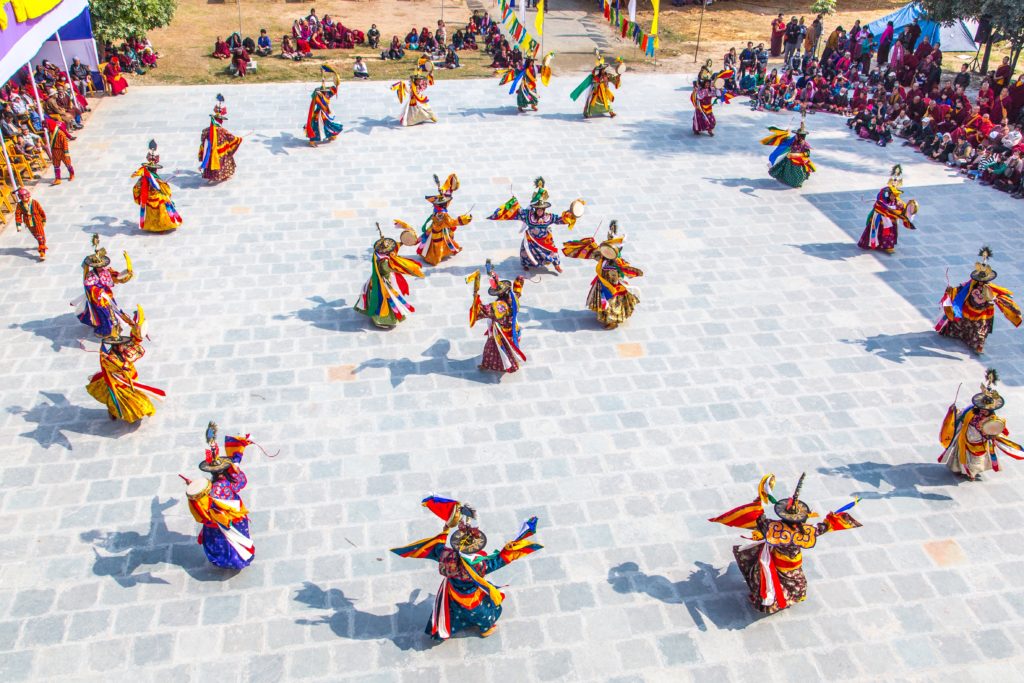
In the monasteries the masked cham dances are the one part that looks like a spectacle to an outsider. They are not entertainment. They are a ritual for clearing accumulated harm from the household, the village and the land itself.
Households visit each other for days afterwards, which is the actual social heart of it.
The festival is shared. What surrounds it is not.
In Ladakh it sits before the thaw. Supplies were stocked weeks ago, work has slowed, and social visiting replaces most of the working day. Monasteries run to ritual time and not to visitor time. The place feels paused rather than closed.
In Spiti and Lahaul, isolation shapes everything. Winter conditions keep celebration close to home, and what becomes visible is how much of survival there is communal. Shared meals, collective preparation, people covering for each other.
In the Monpa areas around Tawang, household ritual and monastic life run together, and villages organise their days around prayer schedules rather than administration.
In Sikkim it carries a different weight again. Against modern schedules and a busy tourism calendar, Losar re-centres attention on inherited timing. It functions as much as continuity as celebration.
None of these differences are decorative. They are what the terrain and the economy of each place allow, which is the same question every regional difference in India comes back to.
Only if you understand what you are travelling into, and it is not sightseeing.
What changes: transport runs irregularly, government offices and local services close for stretches, family-run homestays may not take guests because the family has other obligations, and monasteries follow ritual schedules that owe you nothing.
What is on offer instead is the chance to see a region choose stillness. That is genuinely rare and it is not available in any other week of the year.
If you go, go slowly. Five to seven days with buffer built in, not a route. Winter roads decide the pace and they do not negotiate.
And be a guest rather than an audience. Much of Losar is private and household-based. Some of it is observable at monasteries, respectfully and from where you are put. The ordinary rules of being a guest matter more here than at any public festival, because you will often be inside somebody's home.
The wider point is one that runs through all of this. When you arrive somewhere matters as much as where you go, and Losar is the clearest demonstration of it anywhere in the country.
The new year observed across the Tibetan Buddhist Himalaya. It works as a clearing out rather than a launch. Homes are cleaned properly, broken things are discarded, debts are settled and running arguments are resolved, and only then is the new year let in.
It follows the Tibetan lunar calendar and usually falls between late January and early March, though Ladakh is the exception. The date changes every year and is announced rather than assumed, so any date written down without a year attached should not be trusted.
Ladakhi Losar falls in the eleventh month of the Tibetan calendar rather than the first, putting it in December or January. The usual account is that a Ladakhi king leaving on a winter campaign had it celebrated early so his people would not miss it. The date never moved back.
No, and they are constantly confused. Losoong, also called Namsoong, is the Sikkimese harvest new year and falls in December. Losar is the Tibetan New Year and comes later, in February or March. Sikkim observes both, and they are separate occasions.
Winter food, made well in advance. Khapse, deep-fried and stacked, keeps for weeks. Chhang, a barley beer, is prepared ahead. Before the new year there is guthuk, a noodle soup whose dumplings are filled with objects rather than food, each one a comment on whoever receives it.
Cham dances, performed in monastery courtyards. They look like spectacle to a visitor but they are ritual, intended to clear accumulated harm from the household, the village and the land. They are the one part of Losar that happens in public.
Only if you know what you are going into. It is deep winter, services run thin, transport is irregular and monasteries follow ritual time rather than visitor time. What you get instead is a region choosing to stop, which is not available in any other week of the year.
Two to three months, and more for Spiti. Winter access, transport availability and whether accommodation is even staffed all need confirming early. Roads and weather decide more than bookings do, so build the plan around access rather than around dates.
Sometimes, and unreliably. Family-run places may not take guests because the family has its own obligations that week. Hotels tend to run with reduced service. Confirm directly and confirm again closer to the time, particularly in Spiti and the higher parts of Ladakh.
Five to seven, with buffer days built in rather than a fixed route. Winter roads set the pace and they do not negotiate. A tight itinerary in the high Himalaya in January is a plan that will break.
Some of it, and only where you are invited. Much of Losar is private and household-based. The monastery dances can be observed respectfully from where you are placed. Treating it as an event to attend is the mistake, and it is visible immediately to everyone around you.
Because it changes how these regions function for weeks either side. Supplies get stocked, work slows, and services thin out well before the date and take time to resume afterwards. Knowing when it falls explains a lot of what a visitor would otherwise find inexplicable.