
Let’s help you
plan your journey
Explore responsibly, discover offbeat places, guided by locals, rooted in culture.
Let’s help you
plan your journey
Explore responsibly, discover offbeat places, guided by locals, rooted in culture.
Soumen Bhowmick
Soumen Bhowmick founded Pollen Dots in 2024 to plan journeys across India and Bhutan. He works in the Commercial Department of Indian Railways, where he has been since 2000. From 2016 to 2020 he was Head of Business Development and Partnerships at ScoutMyTrip, a community-driven road trip planning platform. There he built a nationwide network of local Scouts who helped travellers on the road, and grew the Road Trippers Club to 16 Indian cities. As a core member of Devil On Wheels, he helped travellers plan Himalayan trips and started Spreading Smiles. He has driven solo from Arunachal to Goa and from Himachal to Karnataka, and has run his own caravan for more than ten years. His photographs have won national and international salon awards, and his writing has appeared in Outlook Traveller.
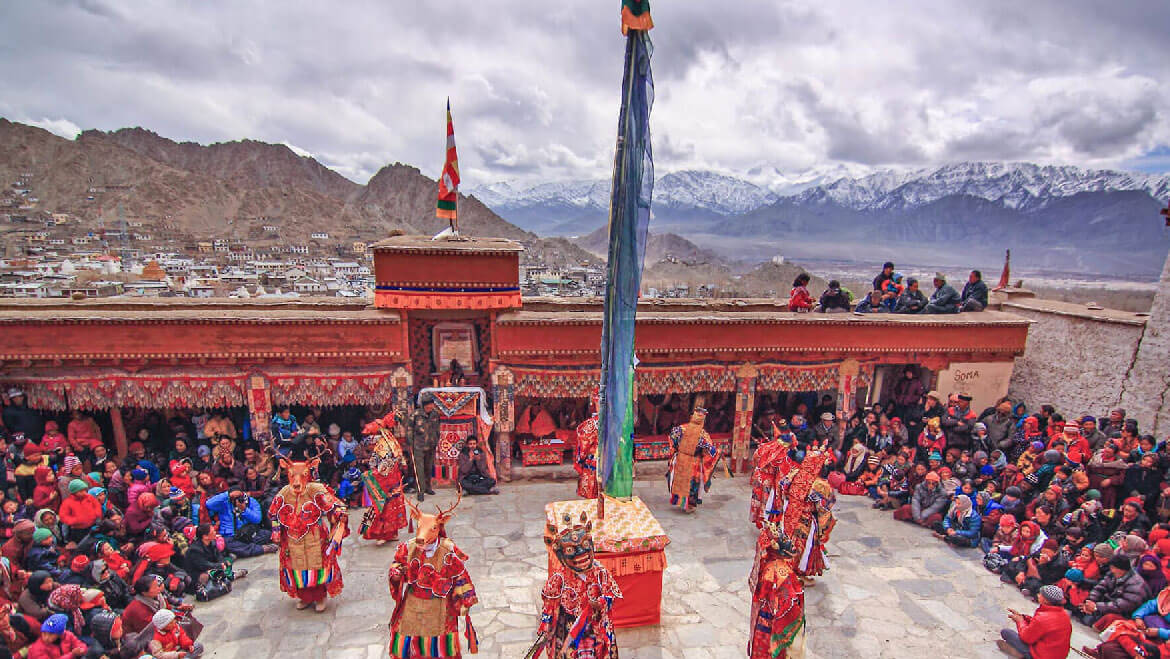
The Ladarcha Fair is listed with the Himalayan festivals, which is misleading, because it was never religious. It was a trade convergence, held in the one short window when the passes were open, where Tibetan salt met grain from the lower valleys and a household's winter got decided. That trade ended when the border closed in 1962, and what happens at Kaza now is the memory of it.
In Spiti, gatherings have rarely been about celebration. They have been about necessity. Ladarcha stands apart from almost every other Himalayan festival because it did not begin as a ritual or a religious observance. It began as a solution to a supply problem, in one of the least forgiving inhabited places on earth, and that origin is still visible in how the fair behaves.
An annual gathering in Spiti that began as a trans-Himalayan trade fair and now survives as a cultural one.
It is held in late summer, usually in August, near Kaza, the administrative centre of the valley at around 3,800 metres. Historically it was held higher up at Kibber before moving down.
The distinction from the rest of the Himalayan festival calendar is the whole point. Hemis marks the birth of a teacher. Losar turns the year. Ladarcha marked the arrival of salt.
That is not a lesser reason for a gathering. In a place where the wrong calculation in August meant a difficult February, it was the more urgent one.
Because Spiti could not produce what it needed and could not reach it for most of the year.
The valley sits high and dry in the rain shadow of the main Himalayan range. It grows barley and peas and not much else. There is no salt, no tea, no metal, and until recently no road that stayed open.
Everything Spiti could not grow had to come across a pass, and the passes were open for a matter of weeks.
So a fixed meeting point in a fixed window solved a problem that individual journeys could not. Traders came in from Ladakh, from Kinnaur, from Tibet across the border, and from Spiti's own scattered villages, and everything changed hands at once.
This is the terrain deciding the calendar as plainly as it happens anywhere in India. Nobody chose August. August chose itself.
Salt, grain, wool and the few manufactured things that could not be made locally.
Salt came from the Tibetan plateau, where it was collected from lake beds, and it moved on the backs of sheep, goats and yaks. Grain and barley came up from the lower valleys. Pashmina and coarser wool came from the Changthang herds. Tea came in compressed bricks. Iron tools, needles and cooking vessels came from wherever they were made.
None of this was commerce as we would recognise it. It was redistribution with a deadline.
A household that traded badly at Ladarcha did not lose margin. It went into a five-month winter short of something it could not obtain until the following August.
That is why the regional food of the high Himalaya looks the way it does. Barley, dairy, and everything dried and stored, because everything else arrived once a year and had to last.
The border closed, and it never reopened.
The Indo-China conflict of 1962 ended the trans-Himalayan trade route that Ladarcha existed to serve. Tibetan traders stopped coming. The salt stopped arriving over the pass. The single most important commodity in the whole exchange became something bought in a shop instead.
By then a road was being built, and over the following decades supply into Spiti stopped depending on the fair altogether. What could once only arrive in August could now arrive in June, or October, or by truck in a week.
The fair did not end. Its reason did.
This is the part almost every account of Ladarcha leaves out. Without it the modern fair looks like a quaint survival. What it actually is, is a gathering that outlived its own function and was kept anyway.
A cultural fair, smaller than it was, organised with the district administration involved.
There are performances, traditional dress, handicrafts, small-scale selling, and a large amount of people from across the valley being in the same place for a couple of days. Some of it is put on. Some of it is simply what happens when a dispersed population converges.
Traders still come from Kinnaur and from Lahaul. What does not come is anything from across the border.
It is worth going without expecting a marketplace. What you are watching is a community that decided a gathering was worth keeping after the economics that created it disappeared, which is a more interesting thing than a trade fair.
Because that is when Spiti is reachable, and it always was.
August offers open passes, stable weather, and enough time afterwards to prepare before the valley shuts. The window has not moved because the geography has not moved.
It also means Ladarcha and Losar sit at opposite ends of the Spiti year. One is the valley open and looking outward. The other is the valley closed and turned in on itself. Between them they describe how the place actually works.
That is why the fair feels purposeful rather than festive. The window is short, everybody knows it, and there is no surplus in a place like this to spend on excess.
Movement concentrates, and in Spiti that is noticeable.
Kaza becomes the focal point. Villages send people. Traffic on the road in rises. Homestays and the few small hotels fill faster than they otherwise would in a region where the total number of beds is small to begin with.
But this is not crowding as anywhere else in India would understand it. There is no crush. There is concentration, in a valley that is normally close to empty.
Everything a festival does to a destination happens here at a small scale and is therefore easier to see. Shops keep different hours. Local priorities shift. Shared taxis are harder to find because everybody wants the same one.
Yes, but plan the trip around Spiti and let the fair be one day of it.
Seven to nine days minimum. Spiti is not a place you arrive at. It is a place you climb to, over several days, through Kinnaur or over Kunzum, and the altitude does not care about your schedule. Kaza is at 3,800 metres and the villages above it are higher.
Book early. August is already peak season in Spiti and the accommodation base is thin, so the fair sits on top of pressure that exists anyway.
Build in buffer days. Roads in Spiti are weather-dependent in a way that no amount of planning solves, and a rigid itinerary is a plan waiting to fail.
If the timing works, our eleven-day Spiti and Ladarcha journey runs through Kinnaur and up to Kaza. It takes in Kibber, where the fair was originally held, along with Ki, Langza, Komik and Chicham. It is built around the pace the altitude requires rather than around the fair.
And if the dates do not work, come anyway. Spiti in Himachal Pradesh is worth the journey in any week of its short season, and when you arrive matters as much as where you go.
An annual gathering near Kaza in Spiti Valley that began as a trans-Himalayan trade fair. Traders from Spiti, Ladakh, Kinnaur and Tibet met in the short window when the passes were open and exchanged what the valley could not produce. It survives today as a cultural fair.
In late summer, most often in August. The exact dates vary each year with local conditions and administrative announcements, so they need confirming closer to the time rather than assumed from a previous year.
Near Kaza, the administrative centre of Spiti Valley, at around 3,800 metres. Historically the fair was held higher up at Kibber before it moved down to Kaza.
No, and this is what separates it from almost every other Himalayan festival. Its origins are in trade, seasonal access and winter preparation rather than ritual. Cultural and community elements are present now, but they were not the reason it began.
Salt from the Tibetan plateau, grain and barley from the lower valleys, pashmina and coarser wool from the Changthang herds, compressed brick tea, and iron tools and vessels. Salt was the critical one, since Spiti had no source of its own.
The border with Tibet closed after the 1962 conflict and the trans-Himalayan route the fair existed to serve was cut. Tibetan traders stopped coming and the salt stopped arriving. A road into Spiti and modern supply chains did the rest.
Usually one to two days. It remains a short and concentrated gathering rather than an extended celebration, which reflects its practical origins.
Three to four months. August is already peak season in Spiti and the accommodation base is small, so the fair adds pressure to a period that is busy regardless.
It tightens noticeably. Homestays and the few small hotels around Kaza fill quickly, and the total number of beds in the valley is limited compared with mainstream destinations. Book early and confirm directly.
Seven to nine at minimum. Spiti is reached over several days through Kinnaur or over Kunzum La, and the altitude sets the pace. Kaza sits at around 3,800 metres and the villages above it are higher, so acclimatisation time is not optional.
It can be, provided you are comfortable with basic infrastructure, limited services, long travel days and real altitude. Anybody expecting comfort-oriented travel will find the region difficult regardless of the fair.
Local administration notices in Kaza, Himachal Pradesh tourism updates, and homestay operators in the valley. Local hosts are usually the most reliable, since dates are set locally and confirmed late.
Yes. The Lavi Fair at Rampur in Kinnaur, held in November, has the same trans-Himalayan trading origin and is considerably larger. Both are remnants of a trade network that ran across these mountains for centuries before the border closed.