
Let’s help you
plan your journey
Explore responsibly, discover offbeat places, guided by locals, rooted in culture.
Let’s help you
plan your journey
Explore responsibly, discover offbeat places, guided by locals, rooted in culture.
Soumen Bhowmick
Soumen Bhowmick founded Pollen Dots in 2024 to plan journeys across India and Bhutan. He works in the Commercial Department of Indian Railways, where he has been since 2000. From 2016 to 2020 he was Head of Business Development and Partnerships at ScoutMyTrip, a community-driven road trip planning platform. There he built a nationwide network of local Scouts who helped travellers on the road, and grew the Road Trippers Club to 16 Indian cities. As a core member of Devil On Wheels, he helped travellers plan Himalayan trips and started Spreading Smiles. He has driven solo from Arunachal to Goa and from Himachal to Karnataka, and has run his own caravan for more than ten years. His photographs have won national and international salon awards, and his writing has appeared in Outlook Traveller.
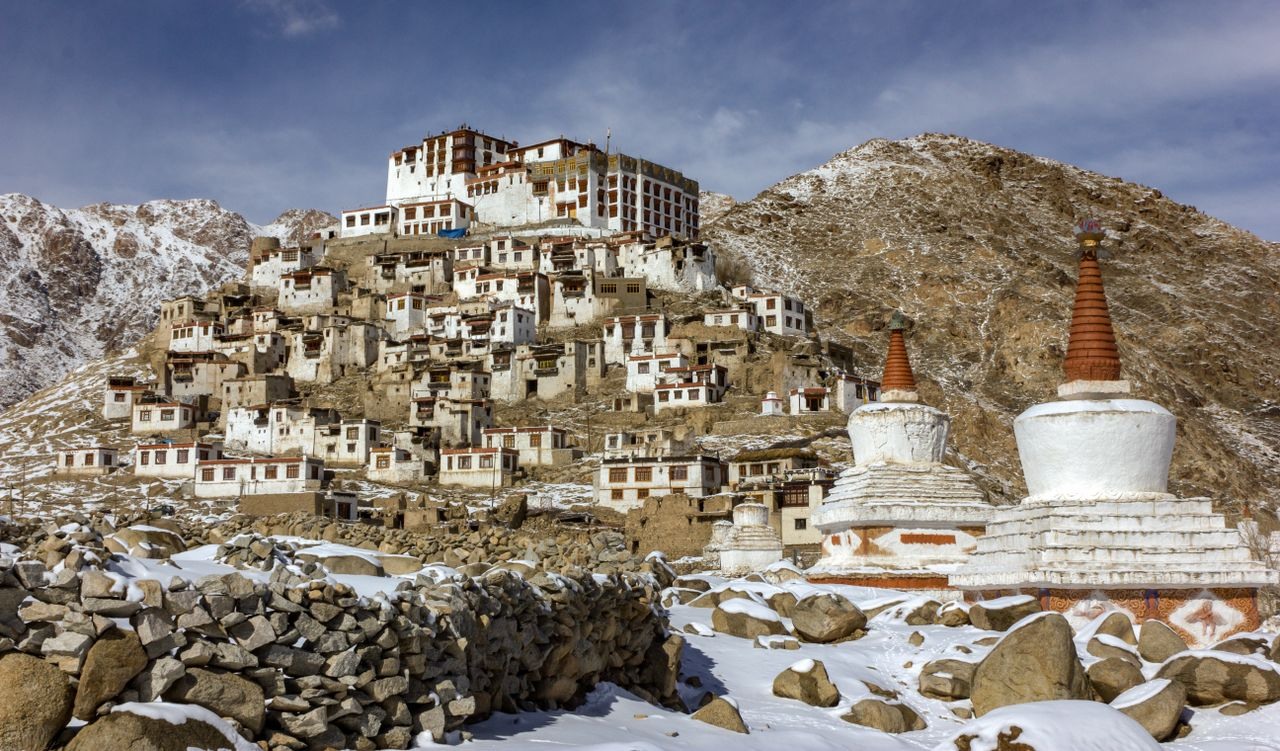
The places to visit in Ladakh sort into four groups, and which group you choose decides how high you sleep rather than how far you drive. The Indus valley monasteries sit near Leh's own altitude and can be done while acclimatising, while Nubra, Pangong and Tso Moriri all involve a pass and a night considerably higher. Start low, work up, and let the altitude set the order rather than the map.
Almost everything here is reached on one of three roads out of Leh. The general guide to preparing for travelling in India covers the acclimatisation side of that.
Grouped by what they ask of you.
The densest cluster in Ladakh and the only group you can see while your body is still adjusting. Most sit within an hour or two of Leh.
Morning prayers are the reason to arrive early and the reason not to arrive with a camera up.
North of Leh, over a pass most itineraries treat as the attraction. The valley itself is the better reason to go.
The lakes are the highest nights most itineraries include and the ones to put late rather than early.
The part of Ladakh that asks for a separate trip rather than a day out of Leh.
The reason some people come in winter, when the roads are shut and the flights are the only way in.
Our ten-day journey through Ladakh is built to go up gradually rather than to cover the most ground. If the places have to fit a fixed set of dates, customised tours is where that gets settled.
Thiksey or Hemis if you want the large and famous ones, and both sit close enough to Leh for an acclimatising day. Alchi is the one that rewards a second look, because it stands on flat ground rather than a hilltop and its wall paintings follow an early Indian idiom rather than a Tibetan one.
Yes, and the order matters more than the route. Nubra sits lower than Leh and makes a reasonable first trip out, while Pangong is higher and belongs later. Each wants its own day plus the driving, so a trip taking in both needs seven days at a minimum.
Fly in and go where the roads no longer reach. The snow leopard valleys in and around Hemis National Park are the main draw, the Zanskar river freezes hard enough to walk, and the monasteries are quiet. Expect far colder nights and a much shorter list of open places.
If you have the day, yes. It sits near the far end of Nubra, is Balti rather than Ladakhi in language and culture, and only opened to visitors in 2010. It is the one place on a standard Ladakh itinerary that feels like a different region rather than a further valley.