
Let’s help you
plan your journey
Explore responsibly, discover offbeat places, guided by locals, rooted in culture.
Let’s help you
plan your journey
Explore responsibly, discover offbeat places, guided by locals, rooted in culture.
Soumen Bhowmick
Soumen Bhowmick founded Pollen Dots in 2024 to plan journeys across India and Bhutan. He works in the Commercial Department of Indian Railways, where he has been since 2000. From 2016 to 2020 he was Head of Business Development and Partnerships at ScoutMyTrip, a community-driven road trip planning platform. There he built a nationwide network of local Scouts who helped travellers on the road, and grew the Road Trippers Club to 16 Indian cities. As a core member of Devil On Wheels, he helped travellers plan Himalayan trips and started Spreading Smiles. He has driven solo from Arunachal to Goa and from Himachal to Karnataka, and has run his own caravan for more than ten years. His photographs have won national and international salon awards, and his writing has appeared in Outlook Traveller.
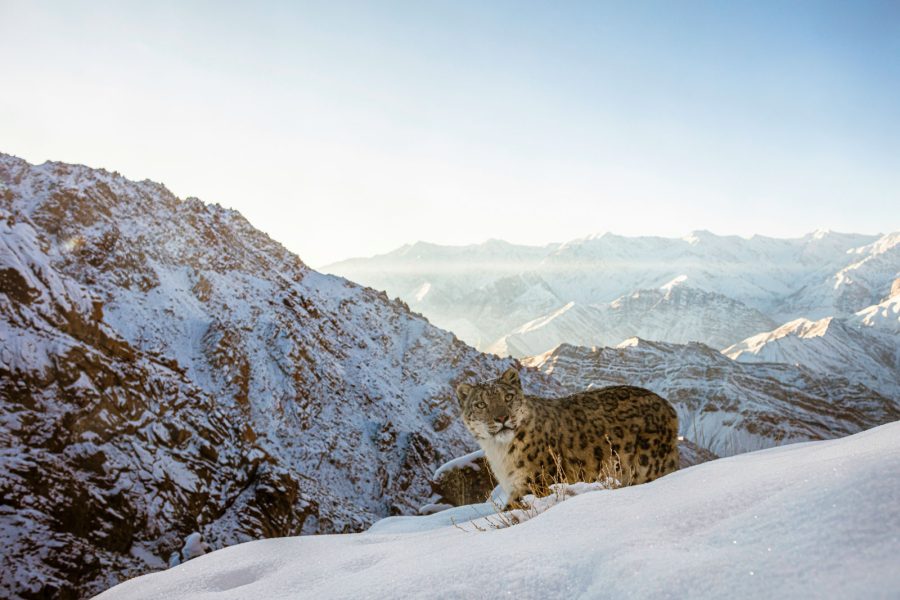
The snow leopard safari in Ladakh, approved in August 2026, will take tourists into the high wildlife valleys in open jeeps with local drivers. Long before the jeeps, in 2002, villages in Hemis National Park began hosting tourists at home so that herders who lose livestock to snow leopards could earn money. The safari will be responsible tourism only if each valley gets a fixed number of jeeps, guards enforce it, and the safari's money reaches those village families.
Ladakh is home to about 477 of India's estimated 718 snow leopards. Today, seeing one usually means a night in a village home, a start before dawn and a long wait for a local spotter's call. The new safari adds open jeeps to this. Ladakh is also fining tourists who drive off the road. Both changes matter to anyone planning a holiday, a corporate offsite, a leadership retreat or a brand drive in Ladakh.
On 6 August 2026, news came that Ladakh's Lieutenant Governor, Vinai Kumar Saxena, had approved India's first high-altitude wildlife safari. He approved it at the first meeting of a new society set up to protect snow leopards. Tourists will ride in open-back jeeps built for the purpose, with trained local drivers and guides. The plan names the jeep safaris of Kaziranga and Ranthambore as its model.
The routes will run through Hemis National Park, the Changthang and Karakoram wildlife sanctuaries, and parts of Nubra, Zanskar, Sham, Kargil and Drass. Twenty young people from Ladakh will be trained to find and name birds, and each will get a pair of binoculars. Ten bird hides will be built at the main bird sites. Everything is meant to be ready before winter, the snow leopard season.
The society's name uses a local word. It is the Snow Leopard and High-Altitude Nature Conservation Society, or SHAN, and shan is the Ladakhi word for snow leopard. Saxena said local people must be equal partners in protecting wildlife, and must also earn money from it. That promise is the right test for the safari. If the families in these valleys do not earn more, the plan has not worked.
Snow leopards are hard to see. In Ladakh, local people find them, not vehicles. Trained local spotters scan the slopes and ridges from before dawn. When one of them finds a snow leopard, the call goes out on the radio and the visitors set off. According to Outlook Traveller, the snow leopard is usually watched from 400 to 500 metres away.
Everyone first spends 48 hours in Leh, so the body can get used to the thin air. Then the visitors go up to villages such as Rumbak, inside Hemis National Park, or Shang. Hemis is India's largest national park, at 4,400 square kilometres. More than 1,600 people live inside it, most of them herders, and the snow leopards share those valleys with them and their animals.
This way of watching works. Lobzang Visuddha, who chairs the Wildlife Tour Operators Association in Leh, told Outlook Traveller that local spotters helped him see 33 snow leopards last winter. That is 33 snow leopards in one winter, found by local people without any safari jeep. The new jeeps will arrive in valleys where local spotters already do this work.
In 2002, the Snow Leopard Conservancy India Trust started Himalayan Homestays in Hemis National Park. The reason was painful and simple. Snow leopards kill livestock, and for a herding family every lost animal is lost money. The trust accepted that these losses would never fall to zero. So it helped the families earn from tourists instead, by hosting them in their own homes.
The same animal that takes a family's livestock now brings visitors who pay to sleep in that family's home. Ten per cent of the homestay money goes into a village conservation fund. The homestays have since spread to the Sham, Rong and Zanskar valleys, and in 2004 they won a Responsible Tourism Award. Village tourism built around the snow leopard began in Ladakh 24 years before the jeep safari.
A study from 2019 looked at seven villages, four in the Sham valley and three in the Rong valley. It found that people who hosted tourists felt more responsible for wildlife than people who did not. These homestays are one example in India of a village earning money from the wildlife it protects. Any new safari in these valleys should bring more guests to these homes, not fewer.
In Ranthambore and Kaziranga, the search happens from the jeep. Jeeps follow set tracks through the park, and tigers, rhinos and elephants are often seen from the seat. Those are the two parks Ladakh's plan names as its model. In Ladakh's snow leopard valleys, it works the other way round. The spotter searches, and the visitors come to the spotter.
So in Ladakh, a jeep's real job would be to carry people to a viewing point. The finding would still be done by a local person who knows those slopes. A driver who leaves the road to go looking for a snow leopard would break the same Wildlife Act under which a group of bikers was fined in July.
The government has a fair reason for the safari. Bikers and drivers already leave the roads in Ladakh's wildlife areas. Marked routes, local drivers and trained guides are meant to stop that. Whether they do depends on one number: how many jeeps each valley is allowed.
Not everyone is convinced. In an Outlook Traveller report dated 30 August 2026, two wildlife experts raised serious concerns. M.K. Ranjitsinh Jhala was India's first Director of Wildlife Preservation. He warned that damaged ground in Ladakh heals far more slowly than the forests of central and eastern India. He also said baiting, putting out food to pull an animal into view, is spreading from leopard tourism in the plains to snow leopards.
He also warned about dogs. Ladakh has an estimated 40,000 feral dogs, he said, and some of them now breed with wolves. He said feral dogs are already killing black-necked crane chicks near the lakes where the cranes breed.
Lobzang Visuddha, a founder member of the Wildlife Conservation and Birds Club of Ladakh, put it more simply. "What you need is a guard to say, 'Sir, it is not done. Sir, please drive slowly. Sir, don't go that close,'" he said. He also said local tour operators were not consulted before the plans were announced.
Both experts want the same safeguard: a fixed limit on vehicles in each valley, with guards to enforce it. None of the reports of the August approval mentions such a limit.
The problem the safari is meant to solve is real. On 4 July 2026, twelve bikers from Gurugram, riding on an organised tour, left the marked road near Tso Moriri, a Ramsar wetland inside the Changthang Wildlife Sanctuary. Each motorcycle was fined ₹10,000 under Section 54 of the Wildlife (Protection) Act, 1972. The fines for the group came to ₹1.2 lakh.
In a separate case, a driver from Meerut was fined ₹50,000 for taking an SUV off the road near the shore of Pangong. Ladakh now has about 100 trained former servicemen on patrol as its Environment Protection Force. Stopping off-road driving is the first aim listed for the safari. A tourist with a marked route, a local driver and a guide has much less reason to leave the road.
The safari is not only about snow leopards. Ladakh has about 340 kinds of birds, and the ten planned hides will let people watch them from behind cover instead of walking up close. That matters most in summer, when many birds are nesting and a person on foot can frighten a parent bird away from its eggs.
The black-necked crane is Ladakh's state bird. Every summer it nests beside the high lakes of Changthang, one of the few places in India where it lives. The Changthang Wildlife Sanctuary covers about 4,000 square kilometres. Those breeding lakes are where Ranjitsinh says feral dogs are killing crane chicks.
In summer, the road from Nubra runs along the Shyok river to Merak on the shore of Pangong. Nubra is on the safari list, and the Pangong shore is where the ₹50,000 SUV fine was handed out. From the road, you can watch the birds on that shore and leave the shore as you found it.
Bhutan decided long ago what kind of tourism it wanted. It opened to tourists in 1974, when 287 people came. Its policy was first called high value, low volume, and in 2008 it was renamed high value, low impact. The policy works through a Sustainable Development Fee that every adult visitor pays for every night in the country.
Since September 2023, visitors from most countries have paid 100 US dollars a night, down from 200 dollars in 2022. The lower rate is due to last until the end of August 2027. Indian visitors pay 1,200 ngultrum a night, which is ₹1,200. On a slow journey through Bhutan's valleys, that fee is part of the cost of every night.
A fee like this changes who comes, because every extra night costs more. A rule about routes changes where vehicles go. Ladakh's safari uses route rules, so it controls where tourists drive, not how many come.
Ladakh's Chief Secretary wants Ladakh to follow Bhutan. On 5 January 2026, Ashish Kundra told officers in Leh that Ladakh should become "a high-value, sustainable tourism destination on the lines of Bhutan". He said Ladakh should focus on high-spending visitors rather than mass tourism. He did not name a fee, a limit on visitors or a date.
On 23 April 2026, Ladakh made it easier to start a tourism business. A tour operator's registration now lasts five years instead of one, and needs four documents instead of seven. A new hotel can open on a temporary licence with just two documents. Homestays need fewer papers too, so more local families can register.
Easier rules help a village family open a homestay, and they help anyone else open a hotel. Leh already charges Indian tourists an environmental fee, a Red Cross fee and a wildlife fee, but none of these is a nightly fee like Bhutan's. So far, Ladakh has said it wants Bhutan's kind of tourism, but it has not added Bhutan's nightly fee.
One rule matters more than any other: a fixed limit on jeeps in each valley, enforced by guards. Without that limit, open jeeps on marked routes can still crowd a valley where snow leopards live. With it, tourists who now drive off the road can ride in a safari jeep instead.
Four more things decide whether the safari is responsible tourism. The spotters, drivers and guides should be from the valley. Tourists should sleep in village homestays, not drive in and out of Leh each day. Nobody should use bait or recorded animal calls to pull wildlife closer. And guards on patrol should be able to stop a vehicle and fine the driver.
If you are booking, ask what the guide will do to help you see a snow leopard. You want to hear that the guide will wait for the spotter's call and will not walk towards the animal. A company booking for a team can go one step further and ask who gets paid in each valley, and how much.
A corporate offsite in Ladakh has to fit two things: the season and the road rules. Between May and October the passes are open, and a group can drive the Indus road through the Sham valley and over Khardung La into Nubra. Every kilometre of that route is a marked road, and every vehicle in the group should stay on it.
Winter is different. The high passes close, but flights still land in Leh, and the snow leopard season begins. Visitors then stay in family homes in the villages, so small groups work far better than large ones. Everyone rests in Leh for 48 hours first. Planning each day around the altitude and the spotters' early start is what we have called Journey Architecture. The spotters are out before dawn, so the team's sessions go in the afternoon.
Planning a corporate retreat around responsible travel means deciding early who the team meets and who gets paid. In the safari areas, part of that is now decided for you: local drivers, local guides and marked routes. The rest is your choice. A small team can sleep in village homestays and pay the spotters for their mornings, and that money stays in the valley.
Keep the group small and the mornings empty. A snow leopard watch means waiting, and nobody can promise a time or even a sighting. The group waits in the cold beside local spotters until the call comes over the radio. Plan the retreat so that this waiting is expected, not a problem.
The most useful part may come later in the day. Herding families here lose livestock to snow leopards. The law protects snow leopards, so the families cannot kill them. Since 2002, homestay income has paid back part of that loss, and ten per cent of it goes into a village fund. It is a working example of a village earning money while living with a protected animal.
Spend an evening with a host family, if the family agrees and is paid for its time. Ask what a lost animal costs, what the homestay earns and what they expect from the new jeeps. The team will hear it straight from the people who live with the snow leopard.
Every vehicle on a brand drive or car launch in Ladakh has to stay on marked roads. The July fines were charged to bikers on an organised tour, at ₹10,000 a motorcycle. A shot of a car crossing open ground beside a lake is exactly the kind of driving Ladakh now fines inside its wildlife areas.
The story does not need that shot. A brand's road trip should be about something real in the place, not only about the brand. In Ladakh, that could be the spotters, the herders, the cranes or the new wildlife rules. A car launch media drive can plan every photo stop at a place the road already reaches.
I know this from our own work. On 16 July 2017, we held a meet for twenty bloggers at the top of Khardung La, 17,582 feet up, on the public road to Nubra. It was an on-ground brand activation for a hospitality brand. We ran it through ScoutMyTrip, a previous venture led by members of what is now the Pollen Dots leadership team.
The meet set two India Book of Records entries, and the bloggers' own write-ups are still online nine years later. All of it happened on a road every visitor uses.
Four questions show whether tourism in Ladakh is sustainable. Are herding families still earning from the people who come to see snow leopards? Are the spotters, drivers and guides from the valley? Does each valley have a vehicle limit, and do guards stop the people who break it? And is the wildlife doing well?
The signs for that last question are easy to check. Crane chicks should survive beside the breeding lakes. Fresh tyre tracks should stop appearing near Tso Moriri and Pangong. Water matters too, because every new bed in a village needs more of it. In Zanskar, one of the safari areas, Ladakh's first heritage village is already short of water.
When you book, choose a village homestay, a guide who waits for the spotter's call, and a driver who never leaves the road.
It can be, if three conditions are met. Each valley needs a fixed limit on jeeps, enforced by guards. Village homestays and spotters need to stay part of the trip. The safari's money needs to reach the families who live in the valleys.
SHAN stands for Snow Leopard and High-Altitude Nature. It is the short name of a conservation society that Ladakh set up on 16 June 2026. In the Ladakhi language, shan is also the word for snow leopard. The society's first governing body meeting approved the safari.
In Ladakh, late winter is the usual season. Visitors first rest for 48 hours in Leh to get used to the altitude. Then they stay in villages such as Rumbak, inside Hemis National Park, or Shang.
Usually 400 to 500 metres away. A local spotter finds the snow leopard, and visitors watch from where they stand. Walking or driving towards a resting snow leopard disturbs it.
About 477 of India's estimated 718 snow leopards live in Ladakh. That is roughly two out of every three. The numbers come from India's national count of snow leopards.
Homestays give herding families income from tourists. The income makes up for some of the livestock that snow leopards kill. The homestays started in Hemis National Park in 2002. Ten per cent of their income goes into a village conservation fund.
Not inside Ladakh's protected wildlife areas. Driving off marked roads there can be fined under Section 54 of the Wildlife (Protection) Act, 1972. On 4 July 2026, twelve bikers were fined ₹10,000 for each motorcycle near Tso Moriri. In a separate case, an SUV driver was fined ₹50,000 near Pangong.
It is a fee that every adult visitor to Bhutan pays for each night. Visitors from most countries pay 100 US dollars a night until the end of August 2027. Indian visitors pay 1,200 ngultrum a night, which equals ₹1,200.
Ladakh's Chief Secretary said in January 2026 that Ladakh should follow Bhutan's high-value model. He did not name a fee, a visitor limit or a date. Leh already charges Indian tourists an environmental fee, a Red Cross fee and a wildlife fee, but not a nightly fee like Bhutan's.
Yes, if the team is small and ready for cold and altitude. Flights land in Leh through the winter, but the high road passes close. Every member of the team needs 48 hours of rest in Leh before going higher.
A leadership team can see how herding families get paid back for a loss they cannot avoid. Snow leopards kill livestock, and the law protects snow leopards. Since 2002, homestay income has made up part of that loss. A paid evening with a host family, agreed in advance, lets the team hear about these losses from the family.
Not inside a protected wildlife area. Driving off marked roads there can be fined under the Wildlife (Protection) Act. Every photo stop should be at a place the road already reaches.