
Let’s help you
plan your journey
Explore responsibly, discover offbeat places, guided by locals, rooted in culture.
Let’s help you
plan your journey
Explore responsibly, discover offbeat places, guided by locals, rooted in culture.
Soumen Bhowmick
Soumen Bhowmick founded Pollen Dots in 2024 to plan journeys across India and Bhutan. He works in the Commercial Department of Indian Railways, where he has been since 2000. From 2016 to 2020 he was Head of Business Development and Partnerships at ScoutMyTrip, a community-driven road trip planning platform. There he built a nationwide network of local Scouts who helped travellers on the road, and grew the Road Trippers Club to 16 Indian cities. As a core member of Devil On Wheels, he helped travellers plan Himalayan trips and started Spreading Smiles. He has driven solo from Arunachal to Goa and from Himachal to Karnataka, and has run his own caravan for more than ten years. His photographs have won national and international salon awards, and his writing has appeared in Outlook Traveller.
Most cultural places to visit in India are already well known, and what they are famous for is often not the thing worth going for. About a thousand people a day walk through the synagogue at Mattancherry, and about five members of the community that built it are left. That gap turns up again and again, and what decides it is not distance but whether the work there still has a reason to go on.
This article covers eleven places. All of them are well known. Some are districts, two are inside cities, and several have won national tourism awards. None of them is a hidden gem and I am not going to pretend otherwise. What is missing is not the place. It is what is actually happening there now.
Look for whether the work is still being done, and whether it would still be done if nobody came to watch. That one question separates a place that is alive from a place that is being kept tidy.
Mattancherry in Kochi shows why the question is worth asking. The Paradesi Synagogue there was built in 1568 on land given by the Raja of Kochi. It is the oldest synagogue still in use anywhere in the Commonwealth. Six hundred to a thousand people walk through it every day.
The community it was built for is almost gone. Around five Jewish residents were left in Fort Kochi at the last available count. The woman who sells the tickets is the last Paradesi Jewish woman of childbearing age.
Nobody did anything wrong here. The building is in good repair. The visitors are respectful. But they came to see a synagogue, and the thing that was disappearing was a community, and a ticket cannot help with the second one.
So the building is being looked after and the practice inside it is not. That is one kind of place. There are others, and the rest of this article is about telling them apart.
More than most people expect. The ones that last are usually the ones that have changed what they make at least once, because the real inheritance is the skill and not the object.
Kumartuli in north Kolkata shows this clearly, and it is not a village at all. It is a neighbourhood inside the city. When the British laid out the northern part of Kolkata, they gave each trade its own area. Milkmen had one. Oil pressers had another. Carpenters, wine sellers and potters all had theirs. Kumartuli was the potters' area, put on the bank of the Hooghly because that is where the clay was.
All of those names are still on the map. Kumartuli is the only one where the trade is still being carried on. The others are just addresses now.
Here is the part that explains it. The potters of Kumartuli stopped making pots. Their workshops make idols instead, several hundred of them. The busy months run from about May until the idols go into the river after Durga Puja. The trade changed and the place held on, because what was handed down was not pot making. It was a way of working with clay, straw and bamboo that could be turned to something else when the pot market went.
There is one more thing about it. The idols are made to be put into the river at the end of the festival. Every year the work is destroyed and every year it has to be made again from nothing. That is why the skill is still in people's hands rather than in a book. Anybody on the Kolkata and coastal Odisha route is a short walk from those lanes, and this is what a festival does to a place seen from the side that makes it.
Raghurajpur in Odisha is twelve kilometres from Puri and is known for Pattachitra, a style of painting done on cloth. The more useful fact is what the village supplies. The painted cloth hangings used under the throne of Jagannath, and on the three chariots during Rath Yatra, are made here and nowhere else. Hundreds of thousands of people gather around those chariots every year. Almost none of them go to the village that made the cloth.
Raghurajpur also shows that survival is not automatic. By the middle of the last century Pattachitra was in real money trouble. An American woman living in Odisha, Halina Zealey, changed that in the 1950s. She started selling the paintings in Calcutta through the Bengal Industries Association, and then abroad. In August 1953 she and her husband sold work to the Governor of Odisha and, four days later, to the Chief Minister. In 2000 INTACH named Raghurajpur the first heritage crafts village in Odisha. Somebody had to go out and find buyers, or the craft would have stopped. The coastal and tribal route through Odisha runs past it.
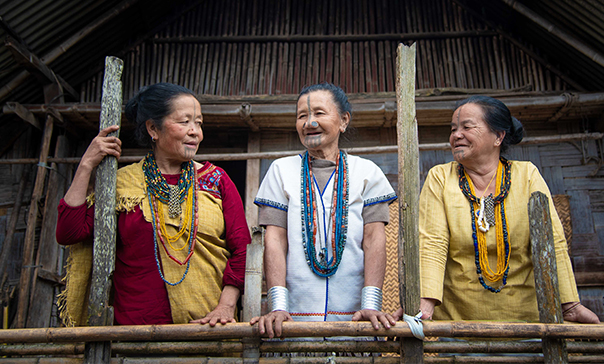
Kongthong in Meghalaya keeps something that has no object at all. Everyone in the village has three names. A written name for documents. A tune of about thirty seconds that their mother makes up for them within weeks of birth. And a shorter tune, about ten seconds, used to call them from close by. The custom is called jingrwai iawbei. No two tunes are the same, and when a person dies their tune is put away and never given to anyone else. The seven day root bridges route stays close enough to reach it.
A number of them, and in every case the protection started with a local problem rather than a government scheme. That is what makes them worth understanding. The rules had to be agreed by people who would have preferred not to follow them.
Khonoma in Nagaland is twenty kilometres from Kohima. It is called India's first green village almost everywhere, and that description leaves out the part that matters. In the early 1990s the village held a hunting competition that lasted a week. Around three hundred Blyth's tragopans were killed. The tragopan is an endangered bird. Hunting in Khonoma was not a bad habit. It was something the village was proud of.
Changing it took years. Village elders and forest officials talked to the village for more than eight years before anything stuck. In December 1998 the village council set aside twenty square kilometres of its land. They called it the Khonoma Nature Conservation and Tragopan Sanctuary. It was the first project of its kind in India run by a village itself. A full ban on hunting and cutting trees followed in 2001, and the protected area now covers around a hundred and twenty square kilometres.
Two details show that the villagers wrote the rules themselves. Trees are cut back at the top instead of being felled, so the branches give firewood and the tree keeps growing. And farmers can still get a three day permit when animals are eating their crops. A rule that ignored either of those would have broken within a season.
Phyang in Ladakh is ten kilometres from Leh, on a road that every Ladakh trip uses. About two thousand people live there and nearly all of them farm. Their problem is not that there is no water. It is that the water arrives at the wrong time. The glaciers melt in July. The fields need water in April and May.
Chewang Norphel started building artificial glaciers in Ladakh in 1987, freezing winter water so it would be there in spring. Sonam Wangchuk changed the shape of them. A cone has less surface facing the sun than a flat sheet, so it melts more slowly and lasts further into the season. The first one, called an ice stupa, was built between November 2013 and February 2014. It stood about seven metres high and held roughly 150,000 litres. It lasted until 18 May, much longer than the team expected. By 2020 there were ice stupas in twenty six villages, and the eight day cultural journey through Ladakh stops the night at Phyang.
It is not a simple success story and should not be told as one. Farmers further downstream have said that the water being frozen upstream is water they were already using. That belongs in the account.
Piplantri is in Rajsamand district in Rajasthan, in the middle of a marble mining belt. When Shyam Sundar Paliwal became sarpanch in 2005 the area had been in drought for seven years running. His daughter Kiran died of dehydration. After that the village started planting 111 saplings every time a girl was born, and opening a savings deposit in her name at the same time. There are now around three and a half lakh trees on land that used to be mining waste. Paliwal was given the Padma Shri in 2021. In December 2024 the Supreme Court pointed to the village as an example. It was telling the environment ministry to draw up a national policy for sacred groves.
Ziro in Arunachal Pradesh is the oldest example of this and the least planned. Most people know it for a music festival. It is on the UNESCO waiting list for something else, the Apatani Cultural Landscape, which is really a way of farming. The Apatani grow rice and fish together in the same flooded field, on the same ground, year after year, with millet on the raised edges between the fields. Goodness washes down from the hills, and what the harvest takes out is put back with crop waste and household waste.
They use no bullocks, no machines and no chemical fertiliser. They use no pesticide either, and the reason is simple. Pesticide would kill the fish.
The part almost nobody repeats is in UNESCO's own listing. Every community around the Apatani moves its fields every few years. The Apatani are the only ones farming the same ground permanently. They are the odd ones out in their own region, which is what happens when the ground a community lives on sets the rules and one community answers them differently.
The craft moves and the village moves with it. That sounds unlikely until you see a case where the work depends on something that only exists in one spot.
Ajrakh is a block printed cloth from Kutch. It is dyed and washed many times over, so the water it is made with changes how it turns out. Iron in the water leaves black marks on the cloth.
The Khatri family who print it came from Sindh, invited to Kutch by Rao Bharmal I. They had been in a village called Dhamadka since the sixteenth century, about nine generations. The Saran river beside the village gave them their water. After 1991 the river started drying up. Then the earthquake of 2001 destroyed the village and changed what was in the water that was left. The printing stopped working.
Ismail Mohammed Khatri and others went out and looked at other places to live, and the thing they were testing was the groundwater. They settled where the water was right and named the new village Ajrakhpur. It is fifteen kilometres from Bhuj and it is twenty five years old. Some families stayed behind in Dhamadka, so the community is now spread across two villages.
It is not finished. The iron and the salt have started rising in the new water too. That should be said before anyone calls this a story with an ending. Anybody on the Kutch to central Gujarat route passes right beside it.
Majuli in Assam has done the same thing for a different reason. Majuli is a river island in the Brahmaputra. On it are satras, which are monasteries that also hold Sattriya dance, Bhaona theatre, manuscript writing and mask making. There were once around sixty five of them. Twenty two are left, and several of those are not standing where they used to. They were physically moved as the river took the ground underneath them.
The scale is on record. In 2017 the government told Parliament that Majuli measured 733.79 square kilometres on the Survey of India map of 1940, and 502.21 square kilometres by 2004. Of 210 revenue villages, 141 still exist. The island also grows around a hundred kinds of rice without pesticide or artificial fertiliser. That is the kind of thing an ordinary plate tells you about a place faster than any monument does.
The part worth holding on to is not the satras themselves. It is that a monastery on Majuli can have an address that changes. The ten day Assam and Meghalaya journey crosses over to it.
Because a building only needs repairs, and a practice needs a reason to carry on. We are much better at paying for the first. A roof can be fixed by somebody who has never used the room under it.
Dhanushkodi in Tamil Nadu is the plainest case, and the usual story about it is wrong in a particular way. It is described as a ghost town at the end of a road, which makes it sound like a place people slowly left.
It was not. Before December 1964 Dhanushkodi was a working town. It had a railway station, a customs office, a post and telegraph office, two medical centres, a railway hospital, a school and port offices. It was where you crossed to Ceylon.
On the night of 22 December 1964 a cyclone came across the Palk Strait with winds of about 280 kilometres an hour. Train number 653, the Pamban to Dhanushkodi passenger service, left Pamban at 23:55 with 110 passengers and five railway staff. Nobody on it survived. Around 1,800 people died in all.
Then the Government of Madras declared the town unfit for living. That order is what ended Dhanushkodi. The town was not slowly abandoned. It was closed, and the road did not reach it again until 2016. What visitors see as a place cut off is the result of the decision, not the reason for it.
Mattancherry fails quietly instead. The building is looked after and the lane still carries the community's name. A visitor who sees a well kept synagogue would fairly assume something is being kept going. The coastal leg of the Kerala journey goes into that quarter, and it is worth walking in already knowing the difference.
Kongthong is the one where the outcome is still open, which is why it is the most useful of the three. The village has had plenty of attention. India put it forward for a United Nations tourism award in 2021. It won a national Best Tourism Village award in 2023. None of that touches the real risk, which is that young people leave for college and jobs. The tunes only continue if there are mothers in the village making new ones. Going to hear them is worth doing. It is not the same thing as the custom carrying on.
So the question to carry into any of these places is a small one. Not what is there to see, but what is still being done here, and who is doing it. We call that idea Destination Thinking. I have written about it mostly for companies choosing where to hold an offsite, and it works the same way for one person deciding where to spend a week.
Asking it changes the list. It is also the difference between passing through a place and understanding it, which is something the destinations we write about keep coming back to. We build our journeys around the second one, because the first is already very well served.
That depends on what you want to see happening. For craft, Raghurajpur and Kumartuli. For a naming custom, Kongthong. For farming, Ziro. For land and water protected by a village, Khonoma and Piplantri. A useful test before you go is whether the work there would still be done if visitors stopped coming.
The British gave each trade its own area in north Kolkata, including one for milkmen, one for oil pressers and Kumartuli for potters. All those names are still on the map, but Kumartuli is the only one where the trade is still carried on. Its workshops no longer make pots, they make idols, so what was handed down was skill with clay rather than one product.
Kongthong, in the East Khasi Hills, about fifty five kilometres from Shillong on a national highway. Everyone there has a tune made up by their mother within weeks of birth, used instead of a spoken name, and no two tunes are the same. The custom is called jingrwai iawbei, and the village won a national Best Tourism Village award in 2023.
A cyclone hit it on the night of 22 December 1964, with winds of about 280 kilometres an hour. Around 1,800 people died, including everyone on the Pamban to Dhanushkodi passenger train. The Government of Madras then declared the town unfit for living, and that order is what actually ended it. Before that it was a working port with a railway station, a customs office and a school, and it was where people crossed to Ceylon.
Pattachitra painting, and for supplying the painted cloth hangings used under the throne of Jagannath and on the three Rath Yatra chariots at Puri. INTACH named it the first heritage crafts village in Odisha in 2000. It is also the birthplace of the Odissi dancer Guru Kelucharan Mohapatra.
Because ajrakh dyeing depends on the water, and the water at their old village of Dhamadka stopped working. The river had been drying up since 1991, and the 2001 earthquake destroyed the village and changed what was in the water that remained. Iron in water marks the cloth, so the community looked for a site with better groundwater and built a new village there.
In the early 1990s a week long hunting competition in the village killed around three hundred Blyth's tragopans, an endangered bird. The village then spent more than eight years discussing it and banned hunting on its own land. In December 1998 the village council set aside twenty square kilometres as the Khonoma Nature Conservation and Tragopan Sanctuary, the first conservation project in India run by a village itself. A full ban on hunting and cutting trees followed in 2001, and the protected area now covers around a hundred and twenty square kilometres.
A way of farming that is on the UNESCO tentative list, in which rice and fish are grown together in the same flooded fields with millet on the raised edges. It uses no bullocks, no machines, no chemical fertiliser and no pesticide, because pesticide would kill the fish. Every community around the Apatani moves its fields every few years, and the Apatani are the only ones farming the same ground permanently.
A cone of ice built in winter to hold water until spring, when the fields need it and the glaciers have not melted yet. Water is piped downhill and sprayed into freezing air, and the cone shape has less surface facing the sun than a flat sheet, so it lasts longer. The first one was built at Phyang between November 2013 and February 2014 and held around 150,000 litres.
Twenty two, out of roughly sixty five historically. Several of the ones that remain are not on their original sites, because they were moved as the Brahmaputra ate away the ground beneath them. Government figures given to Parliament in 2017 show the island at 733.79 square kilometres in 1940 and 502.21 square kilometres by 2004.
Very few. The Paradesi Synagogue, built in 1568, is still the oldest synagogue in use in the Commonwealth and takes six hundred to a thousand visitors a day. The community around it is down to a handful of people. It is the clearest example in India of a building being kept up while the practice inside it was not.