
Let’s help you
plan your journey
Explore responsibly, discover offbeat places, guided by locals, rooted in culture.
Let’s help you
plan your journey
Explore responsibly, discover offbeat places, guided by locals, rooted in culture.
Soumen Bhowmick
Soumen Bhowmick founded Pollen Dots in 2024 to plan journeys across India and Bhutan. He works in the Commercial Department of Indian Railways, where he has been since 2000. From 2016 to 2020 he was Head of Business Development and Partnerships at ScoutMyTrip, a community-driven road trip planning platform. There he built a nationwide network of local Scouts who helped travellers on the road, and grew the Road Trippers Club to 16 Indian cities. As a core member of Devil On Wheels, he helped travellers plan Himalayan trips and started Spreading Smiles. He has driven solo from Arunachal to Goa and from Himachal to Karnataka, and has run his own caravan for more than ten years. His photographs have won national and international salon awards, and his writing has appeared in Outlook Traveller.
Deciding what to buy in Ladakh starts with one correction, because the region's most famous product is mostly not made here. The pashmina fibre comes off Changthangi goats on the Changthang plateau in Ladakh, but the combing, spinning and weaving are traditionally done by hand in Srinagar, which is where the industry sits. Buy the fibre's story in Ladakh and the finished shawl wherever it was actually woven, and ask which you are being sold.
The word itself is worth knowing about. It is not a protected labelling term, so a label reading pashmina guarantees nothing on its own. The general guide to preparing for travelling in India covers customs and baggage questions across the country.
Five things, in the order of how hard they are to find elsewhere.
From a goat that lives above 4,000 metres and grows the fleece to survive the winter. The Changpa, who are nomadic herders, keep the Changthangi goats on the Changthang plateau and comb the undercoat out in spring.
There is no single test that settles it in a shop, which is the first useful thing to know. Pashmina is not a labelling term recognised in law in several markets, so the word on a tag is a description rather than a guarantee.
The two things from the valleys that cost little, travel well and are genuinely local.
Buy these with your eyes open, because the range between a tourist print and a commissioned painting is enormous.
Leh market is the centre of it and the main bazaar is walkable in an afternoon.
Our ten-day journey through Ladakh moves slowly enough to reach the valleys where things are actually made. If the shopping has to fit a fixed route, customised tours is where that gets settled.
Either, once you know what you are being sold. Changthangi goats on the Changthang plateau grow the fibre and Changpa herders comb it out, while the major centre of fabric production is the old city of Srinagar. A piece sold in Leh may well carry Ladakhi fibre and Kashmiri weaving.
It proves fineness and not fibre, so a good blend passes it too. No single shop test settles the question. Price is the blunt check, because hand-spun and handwoven cloth is expensive everywhere, and asking who wove a piece tells you more than any label will.
Dried apricots, apricot kernel oil, and sea buckthorn juice or jam. All three are local, all three travel, and none needs a permit as personal baggage. Ask whether the apricots are sun-dried or sulphured, because the very pale bright ones usually are.
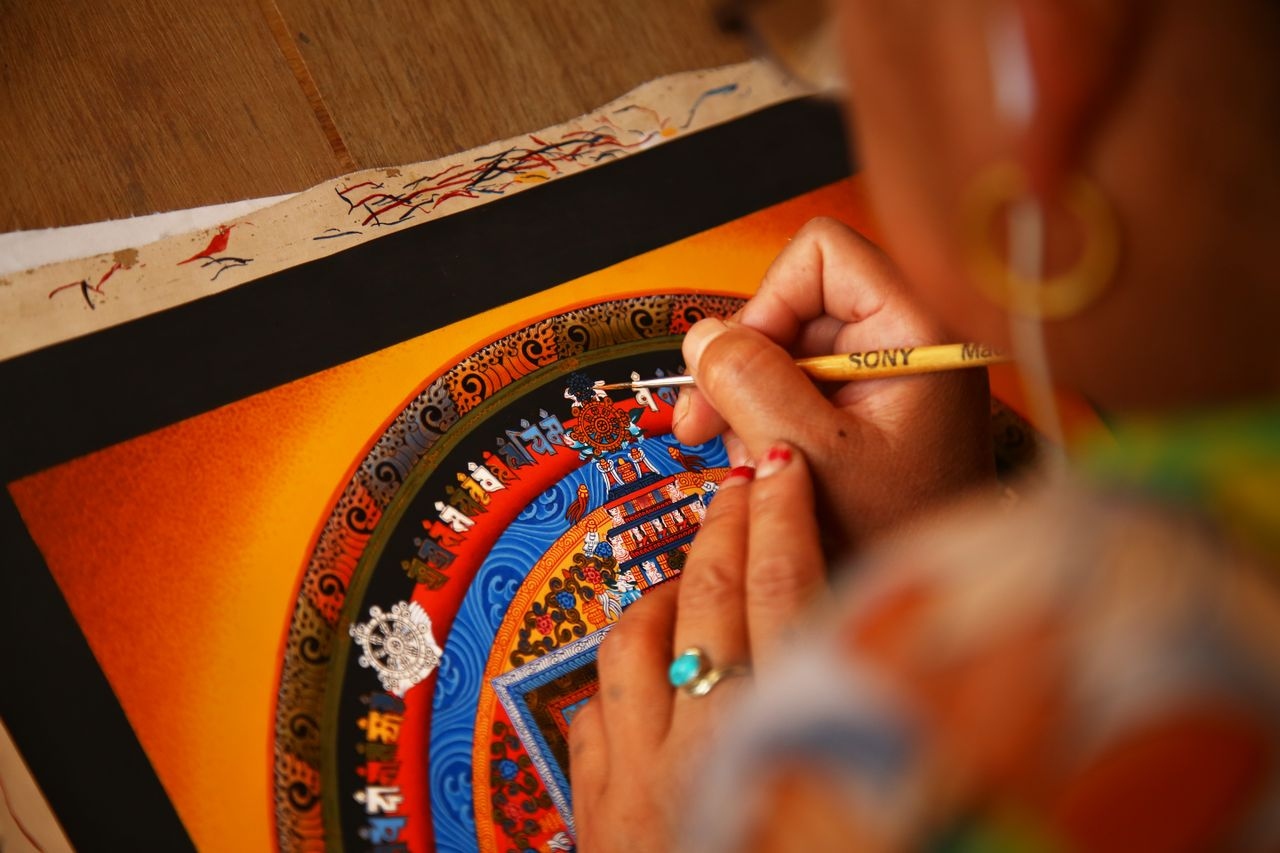
A religious scroll painting on cloth, used in Tibetan Buddhist practice. A hand-painted one takes months of work and costs what that implies. Printed and screen-printed versions are widely sold and are a different object, so ask which you are looking at.
The main bazaar for range and the cooperative or government emporia for confidence. Local producers sell directly in the alleys off the main street, and village homestays are often the only source for something made in that particular valley.