
Let’s help you
plan your journey
Explore responsibly, discover offbeat places, guided by locals, rooted in culture.
Let’s help you
plan your journey
Explore responsibly, discover offbeat places, guided by locals, rooted in culture.
Soumen Bhowmick
Soumen Bhowmick founded Pollen Dots in 2024 to plan journeys across India and Bhutan. He works in the Commercial Department of Indian Railways, where he has been since 2000. From 2016 to 2020 he was Head of Business Development and Partnerships at ScoutMyTrip, a community-driven road trip planning platform. There he built a nationwide network of local Scouts who helped travellers on the road, and grew the Road Trippers Club to 16 Indian cities. As a core member of Devil On Wheels, he helped travellers plan Himalayan trips and started Spreading Smiles. He has driven solo from Arunachal to Goa and from Himachal to Karnataka, and has run his own caravan for more than ten years. His photographs have won national and international salon awards, and his writing has appeared in Outlook Traveller.
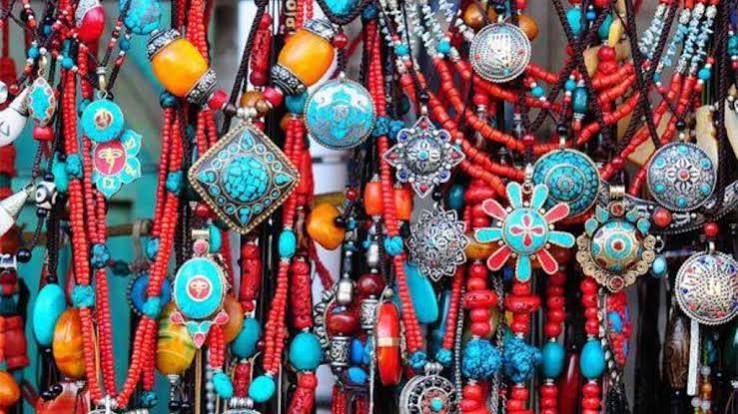
Fossils are the thing most people come looking for and the one thing to leave where it is, which makes what to buy in Spiti an unusual question. The Himachal Pradesh High Court directed the Centre and the state in December 2024 to ensure that nobody illegally extracts, collects, trades or exports fossils anywhere in the state, Langza included. Buy wool, seabuckthorn and barley instead, in Kaza or from the village collectives where the money stays.
Anything carried out of the valley travels two long days by road before it reaches a train or a flight. The guide to preparing for travelling in India sets out the luggage side of that, and the rest is about what is worth the space.
Grouped by what it is, and whether the money stays in the valley.
Wool is the valley's real craft and it is made for a winter rather than for a visitor. That is why a good pair of socks costs what it does and why it outlasts anything comparable.
Seabuckthorn grows wild along the Spiti river and is processed into juice, jam and tea by local units. Barley is the older crop and the more interesting purchase.
Buying the old grain is not sentimental. A crop with no market stops being planted, and in Spiti that process is well advanced and recent enough to be reversible.
Gompa shops sell incense, prayer flags and butter lamps, and the proceeds support the monastery rather than a trader. The quality is ordinary and the destination of the money is the point.
Kaza has almost all of it, and the villages have the things made where you are standing. The difference is between a shop and a household.
Short list, and the first one is a legal matter rather than a question of taste.
Buying a fossil at Langza has been the standard recommendation in Spiti writing for years, and the position changed in December 2024 without most of that writing changing with it. Our eleven day high-altitude journey through Spiti passes through Langza and the villages above Kaza, and customised tours is where the stops that put money with makers get built into a route. Whether a protected place actually benefits the people living in it is the longer argument.
You should not. In December 2024 the Himachal Pradesh High Court directed the Centre and the state to act on fossil extraction. The order covers anyone illegally extracting, collecting, trading or exporting fossils anywhere in the state, and it names Langza. Marine fossils are also found in the hills near Lalung, Mud, Komic and Hikkim. Buying one supports the extraction the order is aimed at.
It is processed into juice, jam and tea by local units, and the berry grows wild along the Spiti river. The juice is sharp and high in vitamin C and does not travel well in a bag. Dried leaf tea is the version that survives the journey home.
Hand knitted yak and sheep wool, seabuckthorn products, barley flour and local black peas. Wool bought from a village knitting collective puts the money with the person who made it. Black peas and older barley varieties are worth buying because the market for them has nearly disappeared.
Kaza's main bazaar holds the widest selection, and the village knitting collectives around it are the most direct way to buy wool. Monastery shops at Tabo and Key sell incense, prayer flags and books, and what you spend there stays with the institution. There is no craft emporium or fixed-price outlet in the valley.
No. Pashmina is a fine goat fibre from the Changthang plateau in Ladakh, and Spiti wool is yak and sheep, much coarser and much warmer. The two are different animals, different weights and different places. Anything sold as pashmina in Spiti has come in from somewhere else.