
Let’s help you
plan your journey
Explore responsibly, discover offbeat places, guided by locals, rooted in culture.
Let’s help you
plan your journey
Explore responsibly, discover offbeat places, guided by locals, rooted in culture.
Soumen Bhowmick
Soumen Bhowmick founded Pollen Dots in 2024 to plan journeys across India and Bhutan. He works in the Commercial Department of Indian Railways, where he has been since 2000. From 2016 to 2020 he was Head of Business Development and Partnerships at ScoutMyTrip, a community-driven road trip planning platform. There he built a nationwide network of local Scouts who helped travellers on the road, and grew the Road Trippers Club to 16 Indian cities. As a core member of Devil On Wheels, he helped travellers plan Himalayan trips and started Spreading Smiles. He has driven solo from Arunachal to Goa and from Himachal to Karnataka, and has run his own caravan for more than ten years. His photographs have won national and international salon awards, and his writing has appeared in Outlook Traveller.
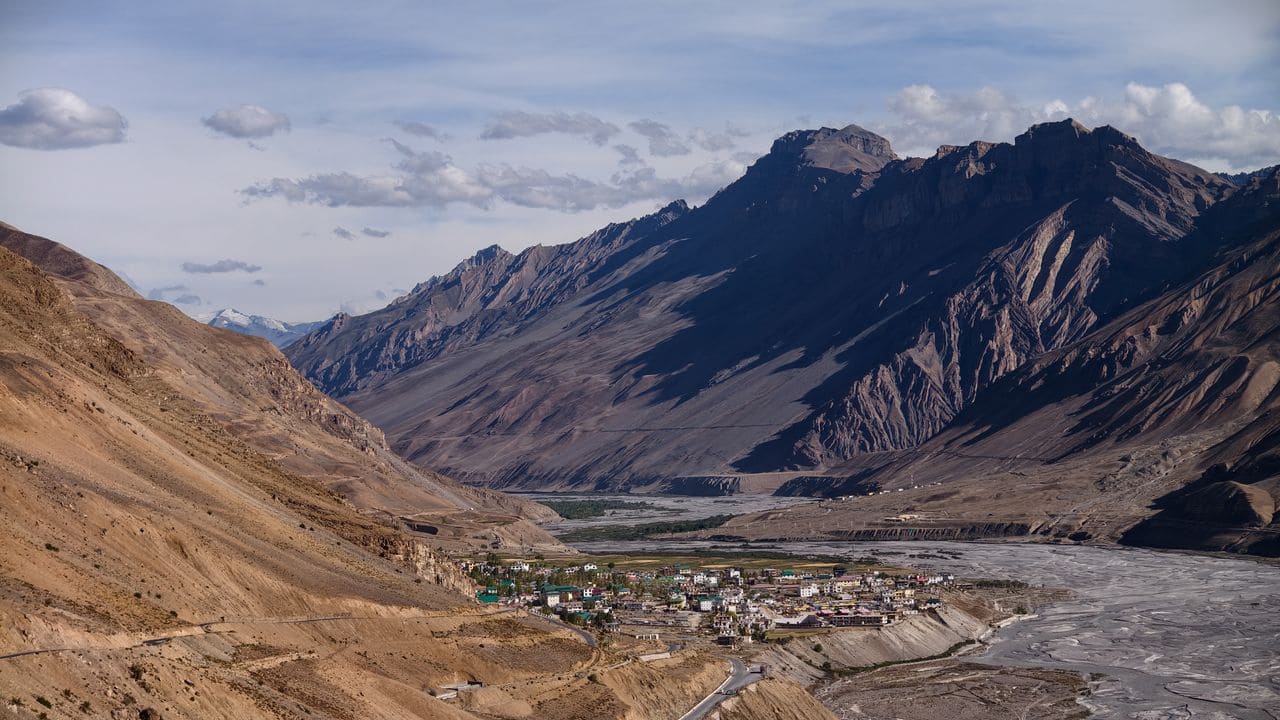
Monasteries and villages are the two things worth driving for, and the places to visit in Spiti sit along a single river in the order the road reaches them. Tabo was founded in 996 CE and is described as the oldest continuously operating Buddhist enclave in India and the Himalaya, which makes the valley's quietest building its oldest. Everything else sits between there and Chandratal, with Dhankar, Key and the high villages above Kaza along the way.
Each of these is reached from the one road along the Spiti river, with short climbs off it. The guide to preparing for travelling in India assumes the India side, and Spiti adds altitude to it rather than paperwork.
Grouped by where they sit along the river, west to east and then up.
Tabo was founded in 996 CE by the translator Rinchen Zangpo for Yeshe-O of the Guge kingdom, and it has operated since. The Archaeological Survey of India protects it as a national historic treasure.
Dhankar sits on a spur of eroded rock above the meeting of the Spiti and Pin rivers, and it was the valley's old capital. The Pin valley runs south from there into a national park.
Key is the largest monastery in Spiti and the building that appears in most photographs of the valley. Kibber and Chicham sit above it on the plateau.
The survey is worth knowing about for a reason beyond the number. Who does the fieldwork decides who holds the knowledge, and whether a protected place benefits the people in it usually turns on exactly that.
The three villages above Kaza, all over 4,000 metres, usually done as one loop. The record claims attached to them are looser than the signage suggests.
Komic and Hikkim are each sold as the highest something in the world, and the careful sources say one of the highest rather than the highest. The claims are real and they are shared, which is a different thing from what the boards say.
Chandratal sits at around 4,250 metres on the Manali side of Kunzum La, which puts it outside Spiti proper and inside most Spiti itineraries. It is reachable only when the pass is open.
Everything above sits within a day of Kaza except the lake, which is why the valley rewards a base rather than a convoy. Our eleven day high-altitude journey through Spiti takes in Kibber, Key, Langza, Komic and Chicham at the pace the altitude requires. Customised tours is where Tabo, the Pin valley and Chandratal get added or left out. The August fair at Kaza is the one week when the valley fills.
Tabo, founded in 996 CE by the translator Rinchen Zangpo for Yeshe-O of the Guge kingdom. It is described as the oldest continuously operating Buddhist enclave in India and the Himalaya, and the Archaeological Survey of India protects it as a national historic treasure. Its wall paintings survived because the temples have almost no windows.
Not provably. Komic sits at 4,587 metres and careful sources call it one of the world's highest villages with a motorable road rather than the highest. Hikkim nearby makes a similar claim about its post office. Both claims are real and both are shared rather than sole.
Sometimes, and almost always in winter, when the animals come lower and the ground is bare. Himachal announced an estimated 83 adult snow leopards statewide in October 2025, with Spiti and the Pin valley among the highest densities in the state. Kibber is the usual base and sightings are never guaranteed.
Monasteries, altitude and the cold desert. Tabo and Key are the two best-known buildings, the villages above Kaza sit over 4,000 metres, and the whole valley lies in the rain shadow of the main Himalayan range. It is also one of the more reliable places in India to look for snow leopards in winter.