
Let’s help you
plan your journey
Explore responsibly, discover offbeat places, guided by locals, rooted in culture.
Let’s help you
plan your journey
Explore responsibly, discover offbeat places, guided by locals, rooted in culture.
Soumen Bhowmick
Soumen Bhowmick founded Pollen Dots in 2024 to plan journeys across India and Bhutan. He works in the Commercial Department of Indian Railways, where he has been since 2000. From 2016 to 2020 he was Head of Business Development and Partnerships at ScoutMyTrip, a community-driven road trip planning platform. There he built a nationwide network of local Scouts who helped travellers on the road, and grew the Road Trippers Club to 16 Indian cities. As a core member of Devil On Wheels, he helped travellers plan Himalayan trips and started Spreading Smiles. He has driven solo from Arunachal to Goa and from Himachal to Karnataka, and has run his own caravan for more than ten years. His photographs have won national and international salon awards, and his writing has appeared in Outlook Traveller.
Ecotourism in India is supposed to help the people who live beside the wildlife, but you rarely see where your money goes. Families left Kuno National Park to make room for lions that never came, Nagaland's hunters stopped trapping Amur falcons, and Odisha's fishermen stay off the sea near nesting beaches for seven months. Some of them now earn from visitors as trackers, guides, guards and hosts, and who you hire decides how much of your money reaches them.
The cheetah, the Amur falcon and the olive ridley turtle now draw visitors to three parts of India. The cheetahs live at Kuno National Park in Madhya Pradesh. The falcons stop in Nagaland every autumn on their way to Africa. The turtles come ashore in lakhs on the Odisha coast. Each of the three now has a new tourism plan built around it.
Ecotourism in India is meant to do two things: protect wild places, and bring money to the people who live beside them. Two of the newest government plans repeat that promise. Project Cheetah is the government's plan to bring cheetahs back to India. Its summary of December 2025 says 5% of the ecotourism revenue at Kuno has been set aside for local communities.
In Nagaland, the Ministry of Tourism has sanctioned ₹10 crore for ecotourism at the lake where the Amur falcons gather. The ministry says it chooses such projects partly on how the local community is involved. On the coast, the Union Budget of February 2026 proposed turtle trails along nesting beaches in Odisha, Karnataka and Kerala.
None of the three plans says how the money will reach local people, or which people it will reach. That gap matters, because in all three places, local families have already given something up.
Jobs are the easiest benefit to count. The government counts 380 local jobs linked to Project Cheetah at Kuno National Park in Madhya Pradesh. Most of India's cheetahs live there. Eighty are cheetah trackers, who follow the cheetahs and report where they are, and two hundred work on patrol.
The cheetahs came back to India on 17 September 2022, when eight from Namibia were let out into Kuno. India had declared the cheetah extinct seventy years earlier, in 1952. By 18 September 2026, India had 56 cheetahs, and 36 of them had been born in India.
Visitors have been able to see them since 1 October 2025, when a cheetah safari opened at Kuno. In its first season, a jeep for up to six people cost ₹4,500 a ride. The guides on those safaris include young people from the villages around Kuno, trained for the work.
Between 1998 and 2003, 24 villages moved out of Kuno, 1,545 families in all. They moved to make room for lions, about twenty years before any cheetah came. Most of those families were Sahariya, a tribe the government counts among India's most vulnerable.
The lions were to come from Gujarat. Wild Asiatic lions survive in only one place, the Gir forest and the land around it. Wildlife scientists wanted a second home for them, so that one outbreak of disease could not kill them all, and Kuno was chosen.
The lions never came. In 2004, Gujarat refused to send them. In 2013, the Supreme Court ordered that some be moved to Kuno anyway. No lion has been moved. Twenty years after the families left, a different animal came, and the Prime Minister released the first cheetahs into Kuno himself.
Each family that left Kuno got ₹36,000 and two hectares of land for every adult member. Many also lost the money they had earned in the forest, where they collected gum to sell. When the cheetahs arrived in 2022, 440 of the relocated families, in six villages, still had no papers for the land they had been given.
I find the Kuno relocation hard to set aside. Families gave up their villages to make room for an animal that never arrived. Twenty years later, some were still waiting for their land papers.
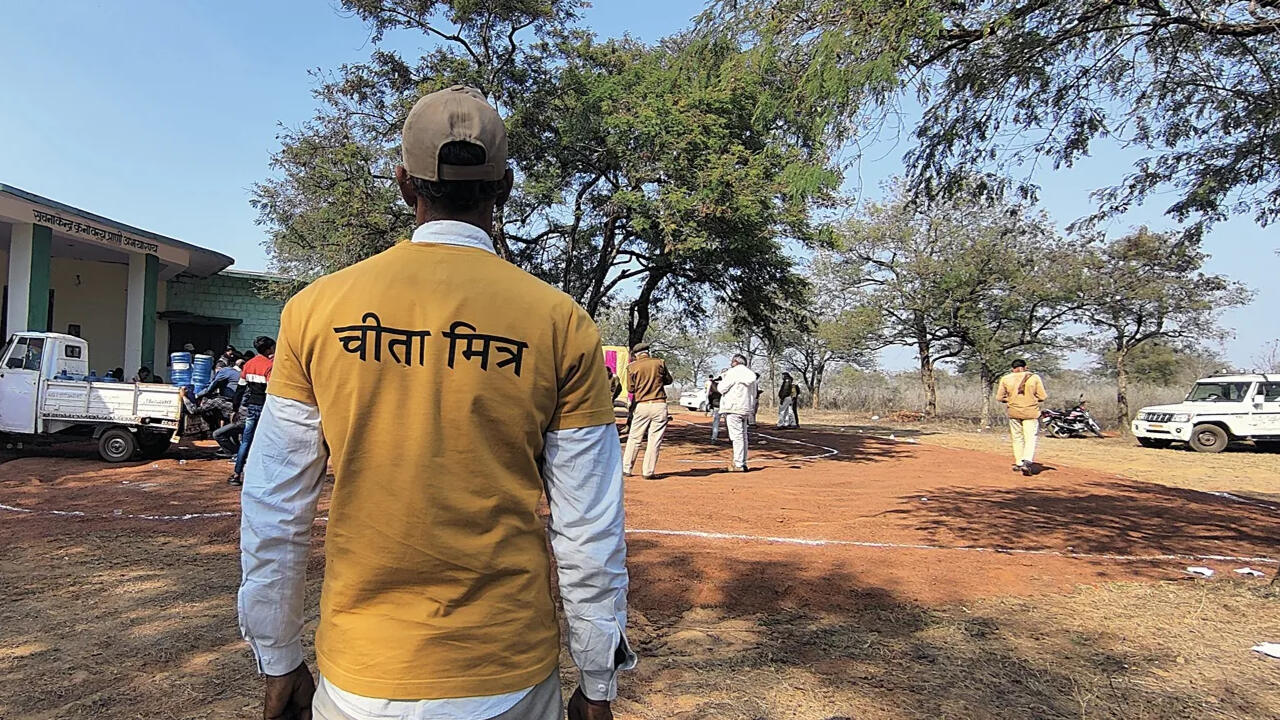
More than 450 people from 80 villages around Kuno protect the cheetahs as volunteers. They are called Cheetah Mitras, which means friends of the cheetah. When a cheetah strays out of the park, a Cheetah Mitra tells the forest staff where it is, and teaches neighbours how to stay safe near one.
The government calls them volunteers. News reports in 2022 and 2023 found that they were not paid at all. In 2023, one Cheetah Mitra told the news site ThePrint that some of them could not even afford petrol to make their rounds of the villages. In 2024, more than 350 Cheetah Mitras were given bicycles.
In June 2026, President Droupadi Murmu met Sahariya Cheetah Mitras at Kuno. When I read about that meeting, I think about the petrol. A tracker and a Cheetah Mitra can live in the same village and do similar work, and only one of them is paid.
Revenue sharing gives villages part of what a park earns from visitors, whether or not anyone in them works there. At Kuno, the government's December 2025 summary says 5% of ecotourism revenue has been set aside for local communities.
The summary does not say which villages receive it, who decides how it is spent, or how much has been paid so far. Five per cent is a small share, but it is written in a government record, so the villages around Kuno can ask what their share has come to.
In 2013, the village of Pangti in Nagaland gave up hunting Amur falcons, which its hunters had trapped in lakhs. Two researchers who studied the hunt, Sahila Kudalkar and Diogo Veríssimo, found out what it paid. One season could bring a hunter up to ten times their monthly income. A 2018 report by the environmental news site Mongabay put a hunter's earnings at about ₹50,000 in a season of 45 to 50 days.
The Amur falcon is a small bird of prey, about the size of a pigeon. Every year it flies from eastern Asia to southern Africa, about 13,000 kilometres, and stops in Nagaland to feed on winged termites. From late October into November, the falcons gather around the Doyang reservoir in Wokha district. Estimates for those sleeping near Pangti run to about a million.
In October 2012, a team from the conservation group Conservation India went to the reservoir. The team estimated that 120,000 to 140,000 falcons were caught there in ten days. That was about a tenth of all the adult Amur falcons in the world. The birds were trapped in fishing nets hung between trees, then eaten or sold in local markets, where four falcons fetched ₹100.
In 2013, two months before the falcons were due, the Pangti village council banned the hunt. The Nagaland government had warned that it would stop funding development projects in the village if the hunting went on. Many villagers were against the ban, and the councils of Pangti and two nearby villages, Ashaa and Sungro, set a fine of ₹5,000 for anyone who broke it.
A squad of former hunters patrolled with the forest department's staff to stop anyone from hunting. In November 2013, not a single falcon was reported killed at the Doyang reservoir. The people who had set the nets a year earlier were now guarding the birds.
Pangti was not the first Naga village to give up a hunt. Around three hundred Blyth's tragopans, the state bird of Nagaland, were killed in a single week of hunting at Khonoma, near Kohima, in the early 1990s. In 1998, Khonoma set aside twenty square kilometres of its own land as a sanctuary, where no one could hunt.
Pangti now earns from the falcons through homestays and village guides. When a visitor pays for a room in a family's home, or for a guide from the village, the money goes to the family that earned it. The village council also owns a guest house, which the Wildlife Trust of India handed over in 2017 to house visitors in the falcon season.
By 2018, the squad of former hunters was being paid by the Nagaland government and the Wildlife Trust of India. One estimate put Pangti's visitors in 2017 at more than 2,000. That count took in the falcon weeks and Nagaland's Hornbill Festival, held near Kohima in the first ten days of December. A visitor who sleeps in the guest house pays the council that banned the hunt.
Homestays like these have worked elsewhere in India. In Ladakh, herding families who lose animals to the snow leopard have earned from its visitors since 2002. At Pangti, the homestays still need visitors who can get there, and the two researchers who studied the ban found that poor roads were keeping numbers down.
The Ministry of Tourism funds ecotourism projects through its schemes, and the lake at Pangti now has one of them. In 2024-25, the ministry sanctioned ₹10 crore for a project at the Doyang reservoir called Wings over Doyang: An Eco-Tourism Haven. It was one of 36 projects chosen under the ministry's Challenge Based Destination Development scheme, worth about ₹648 crore in all.
Under that scheme, states send in proposals and the ministry picks the ones to fund. The ministry says it looks at how ready a place is, its tourism potential, its environment and how the local community is involved. Its list of chosen projects does not say what the Doyang money will build, or who will run it.
Pangti already has a council guest house, homestays and guides who know where the falcons sleep. I hope the ₹10 crore reaches the families who gave up the hunt.
Fishing families on the Odisha coast give up seven months of fishing near home every year, so that nesting turtles are not killed. From 1 November to 31 May, boats may not fish within 20 kilometres of the coast at the mouths of the Dhamra, Devi and Rushikulya rivers. At Gahirmatha, a marine sanctuary, fishing is banned all year.
The ban is there because turtles in these waters get caught in fishing nets and hit by the propellers of trawlers. Odisha has the largest known nesting grounds for olive ridleys in the world. The females often come ashore together, in what is called an arribada, Spanish for arrival. In February 2025, close to seven lakh turtles nested at Rushikulya in about ten days, the largest arribada there in at least 20 years.
In 2026, erosion had narrowed the beach, and the mass nesting lasted only four days, with about two lakh turtles. Mass nesting usually comes in February or March, and the hatchlings come out of the sand in late April and May. Visitors reach Rushikulya from Ganjam town, about six kilometres away, on the coast north of Gopalpur-on-Sea, where a ten-day journey through Odisha spends its sixth day.
Those visitors come to a coast where about 11,000 fishing families live with the ban. For the 2025-26 season, the Odisha government offered each family a one-time payment of ₹15,000. Spread over seven months, that is about ₹2,100 a month.
The families' union, the Odisha Traditional Fish Workers Union, asked for ₹30,000 instead, a ban of five months, and a limit of five kilometres. At Rushikulya, the nesting beach lies right beside fishing villages such as Purunabandha and Gokharkuda. A family there lives beside a sea it may not fish for more than half the year.
The Union Budget of 1 February 2026 proposed turtle trails along nesting sites in Odisha, Karnataka and Kerala, alongside mountain trails and birdwatching trails. For the turtles, it named only the states, and said nothing about the villages beside the nesting sites. It named no beaches, and set no dates or rules for visitors.
Turtle experts answered within weeks. B.C. Choudhury, a sea turtle expert, told Mongabay in February 2026 that tourism plans assume nesting numbers stay steady. He said they no longer do. Rushikulya's four days of mass nesting in 2026 fit what he said. Biswajit Mohanty, a conservationist in Odisha, said tourism money cannot replace long-term funding to protect turtles.
Karnataka and Kerala see far fewer nesting olive ridleys than Odisha. In Karnataka, they nest on beaches in Udupi and Uttara Kannada districts, and a slow week along the Karnataka coast passes through both, from Malpe near Udupi to Gokarna. In Kerala, village volunteers have protected nesting turtles for more than thirty years, with no tourism plan at all.
In Kerala, much of the work of protecting nesting sea turtles is paid for by the villagers who do it. The state's village turtle groups run on volunteers, donations and occasional help from charities. At Kolavipalam in Kozhikode district, the work started in 1992, when young people from the village read about olive ridleys in a newspaper.
Twelve of them formed the Theeram Prakriti Samrakshana Samiti, which means the coastal nature conservation committee. Jackals can smell turtle eggs as soon as they are laid, so the eggs are moved into a hatchery, a patch of sand fenced about seven feet high. The members earned their living in the daytime and took turns to stay awake at night, guarding the eggs.
The money for guarding the eggs came from the members themselves and from the village. Further north, in Kasaragod district, a group called Naythal has run a hatchery since 2001 and released thousands of hatchlings into the sea. In February 2026, Naythal was caring for four injured turtles, at about ₹10,000 a month each just for food.
At Kolavipalam, sand mining, erosion and new seawalls have cut the number of turtles nesting on the beach. The group's hatchery is also a care centre for injured turtles, run under the Kerala forest department. In February 2026, the group's members were feeding fish three times a day to a large turtle that had lost a flipper in an accident.
They were paying for the fish themselves, because the forest department had given the centre no regular funds for five years. T. Satheesan, the group's vice-president, said they want to save the centre and turn it into a place where visitors learn about the turtles. Thirty-four years after that newspaper story, the Kolavipalam volunteers are still paying to protect turtles.
At Kuno, Pangti, Rushikulya and Kolavipalam, local people do much of the work of protecting the wildlife. Cheetah Mitras tell the forest staff when a cheetah strays, and local trackers follow the cheetahs. Former hunters patrolled Pangti to stop the falcon hunt. Fishing families stay off the sea near nesting beaches, and Kerala's volunteers guard turtle eggs at night.
Indian travellers say they want their trips to help local people. In a 2026 survey, the result that mattered most to Indian travellers was travel money that helps local communities. It was chosen by 39%, against 33% for protecting nature and wildlife. In these places, the local people and the people protecting the wildlife are the same families.
The benefits are uneven because each kind of payment reaches different people. A wage or a guide's fee goes to the person who did the work, and homestay rent goes to the family whose room it is. A revenue share goes to the village as a whole. A one-time payment helps a family through one season, and then it is gone.
At Kuno, 380 local people have jobs linked to the cheetahs, while more than 450 Cheetah Mitras work without pay. The promised 5% has no stated recipient. At Pangti, the researchers who studied the ban warned in 2024 that tourism may not reach the families who lost their hunting income.
On the Odisha coast, the fishing families were offered ₹15,000 for one season, which is support from the state, not tourism income. In Kerala, the volunteers who guard the eggs pay for much of the work themselves. The people who give up the most are not always the people a visitor's money reaches.
Choose a trip by who it hires. At Kuno, young people from the nearby villages have been trained as guides for the cheetah safari, and the cheetah trackers come from those villages too. At Pangti, hiring locally means a room in the council's guest house or a homestay, and a guide from the village rather than one brought in from outside.
On the Kerala coast, the local choice is a donation to the hatchery the village runs. Ask whoever is planning your trip where your guide lives and who owns the room you will sleep in. Building a wildlife trip so that the guide and the host both come from the village beside the animal is part of what we call Care-Based Travel.
Of everyone in these stories, the people I think about most are the fishing families at Rushikulya. For seven months of every year, they stay off the sea closest to home so that the turtles reach the beach alive. For the 2025-26 season, each family was offered ₹15,000. The simplest test of a wildlife trip in India is whether anyone you pay lives beside the animal you came to see.
A trip counts as ecotourism when it takes you to wild places in a way that helps protect them and brings money to the people who live there. Watching cheetahs at Kuno National Park, Amur falcons in Nagaland or nesting turtles in Odisha can be ecotourism. Whether it works that way depends on who is paid for the visit.
It can, when the money reaches local people as wages, guide fees, homestay rent or a village fund. At Kuno National Park, 380 local people have jobs linked to the cheetahs, while Cheetah Mitras volunteer without pay. At Pangti in Nagaland, former falcon hunters have worked as paid guards and guides.
The conservation that comes with it can cost local people a great deal. At Kuno National Park, 1,545 families moved out between 1998 and 2003 to make room for lions that never came. On the Odisha coast, about 11,000 fishing families may not fish near nesting beaches for seven months a year.
India had 56 cheetahs on 18 September 2026, after a female born at Kuno National Park in Madhya Pradesh had four cubs. Of the 56, 36 were born in India. Most live at Kuno, and a few at Gandhi Sagar Wildlife Sanctuary, also in Madhya Pradesh.
In its first season, from October 2025, a jeep safari at Kuno National Park cost ₹4,500 a ride for up to six people. Safaris leave from the Ahera and Pipalbawdi gates. Madhya Pradesh Tourism names October to March as the best months to go.
A Cheetah Mitra, which means friend of the cheetah, is a volunteer from one of the villages around Kuno National Park in Madhya Pradesh. More than 450 have been trained, from 80 villages. They tell the forest staff when a cheetah strays, and teach their neighbours how to stay safe near one. News reports from 2022 and 2023 found that they were not paid.
To make room for Asiatic lions from the Gir forest in Gujarat. Between 1998 and 2003, 24 villages inside Kuno moved out, 1,545 families in all, most of them Sahariya. Gujarat refused to send the lions, and none has been moved, even after a Supreme Court order in 2013. The cheetahs came to Kuno instead, in 2022.
The best time is late October to November, when the falcons stop at the Doyang reservoir in Wokha district on their way from eastern Asia to southern Africa. Estimates for the birds sleeping near Pangti village run to about a million. Nagaland's Hornbill Festival follows in the first ten days of December, near Kohima.
In October 2012, hunters at the Doyang reservoir near Pangti, a village in Nagaland, caught an estimated 120,000 to 140,000 Amur falcons in ten days. In 2013, after the Nagaland government warned it would stop funding development projects in the village, the Pangti village council banned the hunt. That season, not a single falcon was reported killed.
Mass nesting on the Odisha coast usually comes in February or March, and the dates change every year. The hatchlings come out of the sand about two months later, in late April and May. In 2025, close to seven lakh turtles nested at Rushikulya over about ten days in February.
To stop olive ridley turtles from getting caught in nets or hit by boat propellers near their nesting beaches. From 1 November to 31 May, boats may not fish within 20 kilometres of the coast at the Dhamra, Devi and Rushikulya river mouths. At Gahirmatha, a marine sanctuary, fishing is banned all year. For the 2025-26 season, the Odisha government offered about 11,000 fishing families ₹15,000 each.
The Union Budget of 1 February 2026 named Odisha, Karnataka and Kerala. It proposed turtle trails along key nesting sites in their coastal areas, but named no beaches and set no dates or rules for visitors. Turtle experts warned that nesting numbers are no longer steady, and that tourism money cannot replace long-term funding for protecting turtles.