
Let’s help you
plan your journey
Explore responsibly, discover offbeat places, guided by locals, rooted in culture.
Let’s help you
plan your journey
Explore responsibly, discover offbeat places, guided by locals, rooted in culture.
Soumen Bhowmick
Soumen Bhowmick founded Pollen Dots in 2024 to plan journeys across India and Bhutan. He works in the Commercial Department of Indian Railways, where he has been since 2000. From 2016 to 2020 he was Head of Business Development and Partnerships at ScoutMyTrip, a community-driven road trip planning platform. There he built a nationwide network of local Scouts who helped travellers on the road, and grew the Road Trippers Club to 16 Indian cities. As a core member of Devil On Wheels, he helped travellers plan Himalayan trips and started Spreading Smiles. He has driven solo from Arunachal to Goa and from Himachal to Karnataka, and has run his own caravan for more than ten years. His photographs have won national and international salon awards, and his writing has appeared in Outlook Traveller.
Traditional festivals of India get described by how they look, which tells you almost nothing about when to go or what you are watching. At Sarhul in Jharkhand, the village priest leaves a pot of water in the grove overnight and reads the level the next morning to forecast the monsoon. The oldest ones carry working rules, and knowing which rule you are watching is the difference between attending a festival and understanding it.
Twelve festivals follow. All of them are old, all are still kept, and none was invented for visitors. Some you can join. Some you can watch from the edge and should not do more than that. Each one is here because something in it still does a job, and because that job can be shown rather than guessed at.
The ones with a rule inside them that people still keep. A date nobody may plant before. A tree nobody may cut. A day the animals do not work. Those rules are the reason the festival exists, and they are also the reason it is still worth the journey.
Here is the problem with most festival writing. It describes colour and crowd, and gives you a month rather than a date. Almost none of these festivals sit on a fixed calendar day. They move with the moon, the rain or the harvest, and that is not an inconvenience. It is the whole point. A festival that moves is a festival still tied to the thing it was built around.
Not all of this is for visitors. Some of these are village rites where an outsider changes what happens simply by standing there. Where that is the case it is said, and the article does not explain how to get closer. Being able to reach something is not the same as being welcome at it, and the difference between passing through a place and understanding it usually shows up right there.
Sarhul is the spring festival of Jharkhand, kept by the Oraon, Munda, Ho, Santal, Bhumij and Kharia, and by more than thirty communities in all. It runs three days, from the third day of Chaitra to the full moon, so late March or April.
What you see is sal flowers. They are carried in procession, worn, offered, and finally handed to every household by the priest, who is called the Pahan. In Ranchi the procession runs to thousands of people in red and white. Gumla, Khunti and Simdega each hold their own, smaller and closer to the older shape.
It happens in a sarna, a grove of sal trees kept as the village's sacred ground. Cutting a tree inside a sarna is not allowed. The grove is standing because the festival needs somewhere to happen.
Two more rules hold on the day. Ploughing is forbidden, because the earth is held to be in a condition that must not be broken. And sowing does not begin until the festival is finished. The farming year has a starting line and Sarhul is it.
The Pahan also places a pot of water in the grove and leaves it there overnight. The next morning he reads the water level and forecasts the coming year's rain and harvest.
That is a measurement. Same place, same time of year, same office holder, read against last year, used to decide what a village puts in the ground. It sits inside a religious rite and it has never stopped running. Nobody has to call it science for it to work as one, and it is a plain case of the ground a community lives on deciding how it lives. The drums get photographed every year. The pot almost never does.
One honest complication. In the towns, Sarhul has been taken up as an identity and environment festival, with stages and speeches. In the villages it is still worship at the grove. Those are two different events sharing a name, and the one you buy a ticket to travel for is worth choosing on purpose. The five day Jharkhand journey works the sal country these groves sit in.
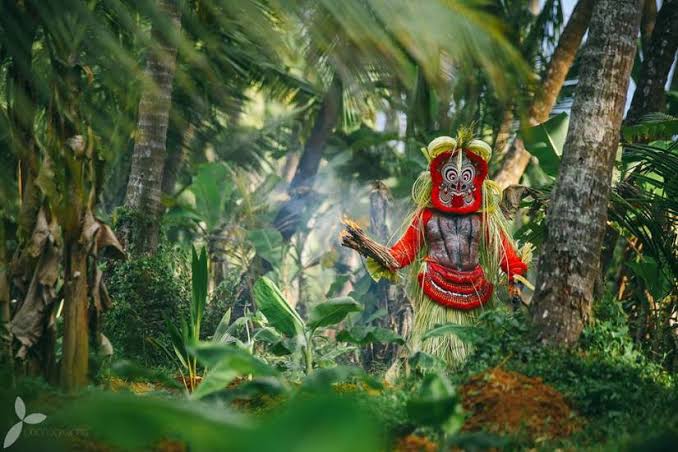
Theyyam runs through the cool months in north Kerala, roughly December to April, in Kannur and Kasaragod. A performer takes on the form of a deity, in headdress and paint and sometimes fire, and while it lasts he is not performing the god. He is received as the god. People bring him their troubles and he answers.
It is held in a kavu, a grove kept as a temple. A traditional kavu is a patch of forest with a stone deity and a lit stone lamp inside it, and nothing built over it. There are close to a thousand kavus in Kannur and Kasaragod alone.
Where a proper temple was built on a kavu, the forest around it went. Where the grove itself stayed the place of worship, the trees stayed too. The kavus of north Kerala are the ones that resisted that, and they are measurably denser and richer in species than the rest.
So the forest is not a nice setting for Theyyam. The forest is there because Theyyam kept needing it. A ritual that must happen among trees is a rule about trees, whether or not anybody wrote it down that way.
Neeliyar Kottam near Parassinikadavu in Kannur is one to know about. Twenty acres of grove, held by a family rather than a board. Families who have had a wish answered pay for a Theyyam to be held there in thanks, which is how the grove is funded.
None of this has legal protection. A kavu survives on belief and on whoever holds the land. That is a fragile arrangement for a thousand forest patches.
You can attend. Theyyam is public, people stand close, and the blessing is given to whoever is there. Ask before you photograph and accept a no. And if you do photograph, the headdress is not the rare picture. The tree line behind it is. The coastal leg of the Kerala journey reaches this country.
Medaram is in the forest of Mulugu district in Telangana, and the jatara held there is one of the largest gatherings of people anywhere in India. It happens once every two years, over four days, usually in February.
It is held for Sammakka and Saralamma, a mother and daughter remembered as having fought a ruler and lost.
Here is what makes it different from almost any other gathering of that size. There is no idol and no temple building. The deities are brought from the forest at the start, as marked poles and vermilion, and returned to the forest at the end. For most of the two years there is nothing at the site to visit.
The offering is jaggery, given in weight. People bring their own weight in it, or a share of it, and it is called bangaram, gold.
You are not going to see a building. You are going to see several million people in a forest clearing for four days around something that is not there the rest of the time. That is a rarer thing to witness than any temple. The clearing in an off year, with nothing in it, is the photograph almost nobody has.
Bhoota Kola is performed at night through the dry months on the Tulu-speaking coast of Karnataka, around Dakshina Kannada and Udupi. A performer takes on a bhuta, a guardian spirit, and while he does he holds authority. Disputes are put to him. He answers as the spirit, and the answer stands.
Several of the bhutas are animals. Panjurli is the boar. Pilichamundi is the tiger. These are not decorations. They are the shapes the guardians of fields and forest edges take. In that landscape a boar in the crop and a tiger at the treeline were the two facts a village organised itself around.
A guardian spirit with jurisdiction over a boundary is a boundary that gets respected. A shrine at the edge of a field is a rule about where the field ends.
This is the same coast whose food was almost never written down, and the notebook that carried it to Mumbai belongs to the same communities.
It is a rite, not a show. People attend, outsiders are usually welcome at the public ones, and you should ask rather than assume. Watch where the shrine stands in relation to the fields, because that is the argument in one glance. The coastal Karnataka and Western Ghats journey works this coast.
Behdeinkhlam is kept by the Pnar in the Jaintia Hills of Meghalaya, in July, at the start of the wet season.
The name is the point. It means driving away the plague, or the demon of disease.
July in those hills is when water-borne illness arrives. So a festival held at the exact moment the rain begins, whose stated purpose is driving out sickness, puts the most serious rite of the year at its most dangerous point. Whether they described it as sanitation or as a demon does not change when it falls.
What you see is tall carved wooden posts, called rots, brought through the village and finally taken to water and left to break up. They are made to be destroyed, which is why they are worth looking at properly on the way rather than at the end. And men in mud, a great deal of it, in a pool.
We have written the full account of it separately, including what happens on each day and who does what, at Behdeinkhlam and the monsoon.
You can attend the public days. The seven day journey through the Meghalaya hills crosses this country.
Ali Ai Ligang is the Mising sowing festival in Assam, held in February or March. The name breaks down almost literally into roots, seeds and the first sowing.
It is a starting gun. The first furrow is ceremonial, and the season opens with it. Sowing before the festival is not done.
That is a rule about timing, and timing is the whole difficulty of farming a floodplain. The Brahmaputra decides when land is workable. A festival that fixes the start date is a village agreeing not to gamble individually on a river that has beaten better guesses than theirs.
What you see is the Gumrag dance, done in the fields, and apong, the rice beer, offered and drunk.
A note worth having. There is a staged version performed at cultural events, and there is the one done in a field by people who are about to plant. They are not the same evening, and the field the morning after tells you more than either. Our full account is at Ali Ai Ligang and the Mising sowing ritual. The ten day Assam and Meghalaya journey runs through Mising country.
Nuakhai is western Odisha's new rice festival, kept in Sambalpur, Bargarh, Bolangir, Kalahandi and around them. It falls the day after Ganesh Chaturthi, in August or September.
The rule is the festival. Nobody eats from the new harvest until the first grain has been offered. Not the household head, not a guest, nobody. The rice is offered, then it is shared, then it is eaten, and the order does not change.
This is a rationing rule with a god attached to it. A harvest eaten the moment it comes in is a harvest gone early. A fixed day, held by everybody at once, puts the whole district on the same clock and stops the first person breaking ranks.
What you see is not spectacular. A household offering, a shared meal, people going to see elders and settle quarrels before eating. That is most of it.
It is a family occasion more than a public one. If you are not invited into a house you will see very little, and that is the correct outcome rather than a failure. If you are invited, the thing worth watching is the order of who eats when. The ten day Odisha journey works this state, though the western districts are their own country.
Khejarli is a village in Jodhpur district, Rajasthan. In 1730 the Maharaja's men came to fell khejri trees for a lime kiln. The Bishnoi refused, and villagers put themselves between the axes and the trees. A great many were killed before the felling was stopped.
The Bishnoi keep twenty-nine rules laid down in the fifteenth century, and among them are not felling green trees and not killing animals. They still keep them. This is why blackbuck and chinkara stand in Bishnoi farmland in numbers you will not see elsewhere in Rajasthan. It is also why the khejri, which fixes nitrogen and holds soil, is still standing in fields rather than cut for fuel.
A fair is held at Khejarli in September in memory of it.
The rule here is not implied, not reconstructed and not inferred. It is written, it is dated, and people died enforcing it three centuries ago. If you want a single piece of evidence that Indian communities made deliberate ecological law, this is it.
On any ordinary day, not only at the fair, you see animals grazing beside people in open farmland, unbothered. And khejri trees left standing in the middle of ploughed fields. That is what the rule looks like from a distance. The route through Marwar and the Thar crosses this country.
Phool Dei falls at the start of Chaitra in Kumaon and Garhwal, so mid-March, and it marks the arrival of spring in the hills.
Children do it. They go from door to door at first light with plates of flowers and rice and jaggery, scatter the flowers on the threshold, and are given sweet dough in return. That dough is also called phool dei. The thresholds after they have gone are the part worth stopping at.
The flowers are the calendar. The festival is held when particular hill flowers come out, which is a way of tying a date to what the mountain is actually doing rather than to a printed almanac. In a place where altitude moves spring by weeks between one village and the next, a flower is a better instrument than a number.
Giving it to children puts the seasonal knowledge into the youngest people in the village and repeats it annually until they cannot forget it.
Our full account is at Phool Dei and the Kumaon spring, and the eight day Kumaon spring journey is built around this time of year.
Pola is kept in Maharashtra, Chhattisgarh and parts of Madhya Pradesh, at the end of the sowing season, on the new moon of Shravan, so August or September.
The bullocks are the festival. They are washed, their horns painted, their nose ropes taken off, they are fed properly, decorated, and paraded. And they do no work that day. The nose rope comes off, which happens on no other day of the year.
Sowing is the hardest stretch of the year for draught animals. A fixed day at the end of it, when the animal is rested and fed and publicly honoured, is a maintenance rule for the most valuable machine a farming household owns.
It is also a piece of accounting nobody writes down. A bullock that is worked through without rest is a bullock replaced sooner, and a replacement is the largest single expense a small farm faces.
Children are given clay bullocks so that the practice is learned before the animal is.
Aadi Perukku falls on the eighteenth day of the Tamil month of Aadi, so around the start of August, and it is kept along the Cauvery and its channels.
The date is not symbolic. It is set to the point in the year when the river runs high with the south-west monsoon coming off the Western Ghats upstream. Perukku means rising. The festival is named after a water level.
People go to the bank, offer to the river, float small lamps and leaves, and eat by the water. Newly married couples are taken there. It is the day the irrigation year is at its most certain, and the water line is the only reason the date exists.
Delta farming lives on water that falls somewhere else entirely, hundreds of kilometres upstream, in hills the farmer will never see. A festival that marks the arrival of that water is a community keeping a public record of a thing it cannot control and cannot do without.
Losar is the Tibetan new year, kept across the Himalayan Buddhist world. In Ladakh it is kept roughly two months earlier than in Tibet.
The usual explanation is a fifteenth-century king who moved it forward so his army could keep the festival before leaving on a winter campaign. Whether that is exactly how it happened, the displacement is real and it has held for centuries.
A calendar that can be moved and then stays moved tells you something. It shows a festival being adjusted to fit the practical life of the place rather than the other way round, and then that adjustment becoming the tradition. Ladakh's version is now the older-looking one.
What you see is house-by-house observance, ibex-shaped dough figures, and processions with fire. Much of it happens indoors and in family groups, and the dough figures are worth seeing before they are put out rather than after.
Our full account is at Losar across the Himalayan Buddhist world. Getting there in deep winter is the difficulty and the ten day Ladakh journey works the same valleys in kinder months.
The rule, not the crowd. Every festival above has one, and the rule is what tells you when to be there.
Sarhul is before sowing. Ali Ai Ligang is the sowing. Pola is after it. Nuakhai is the first of the harvest and Aadi Perukku is the water that made the harvest possible. Behdeinkhlam is the first week of the rain. Phool Dei is the flowers. Losar is a winter that had to be worked around. Theyyam and Bhoota Kola run in the dry months when a village can gather at night.
Put together, that is a farming and weather calendar with gods in it. Not one community's, and not one region's. The same instinct in twelve places, arriving at twelve different answers because the ground was different in each.
None of these were designed to be watched. That is exactly why they are worth travelling for, and why what a festival does to a place is a better question than what it looks like.
Go for the rule. Stand where you are welcome and not a step further. And if the priest walks into the grove with a pot of water, follow that rather than the drums.
Sarhul in Jharkhand, Theyyam in north Kerala and Bhoota Kola in coastal Karnataka. Behdeinkhlam in Meghalaya, Ali Ai Ligang in Assam and Nuakhai in western Odisha. Phool Dei in Uttarakhand, Pola in Maharashtra and Chhattisgarh, Aadi Perukku in Tamil Nadu and Losar across the Himalaya. All are long established and still kept. Very few have a founding date, because most predate any record. Their age shows instead in what the ritual still requires, such as a grove, a river level or a flowering.
Sarhul runs for three days from the third day of Chaitra to the full moon, so late March or April. Ranchi holds the largest procession, with thousands in red and white. Gumla, Khunti and Simdega hold smaller village observances that are closer to the older form.
Because the grove, called a kavu, is the temple. A traditional kavu is a patch of forest with a stone deity and a lamp and no building over it, and there are close to a thousand in Kannur and Kasaragod. Where a built temple replaced the grove, the surrounding forest was usually lost, and the groves of north Kerala that resisted that are measurably richer in species.
Through the cool season, roughly December to April, in Kannur and Kasaragod districts. Performances are usually paid for by families whose prayers have been answered, so the calendar builds up locally rather than being published far in advance. Asking in the area a few days ahead works better than planning it a year out.
A gathering in the forest of Mulugu district, Telangana, for the goddesses Sammakka and Saralamma. It is held once every two years, over four days, usually in February. It is among the largest gatherings of people in India. There is no temple building and no idol, the deities are brought from the forest at the start and returned at the end, and the offering is jaggery given by weight.
Bhoota Kola is a night ritual on the Tulu-speaking coast of Karnataka. A performer takes on a guardian spirit, and while he does he holds authority, including the settling of disputes. It is related to Theyyam in form but separate in tradition, language and deity. Several of the spirits are animals, including a boar and a tiger, and are tied to the boundaries of fields and forest.
Because July is when the monsoon and water-borne illness arrive together in the Jaintia Hills. The name means driving away the plague or the demon of disease, and the festival sits at the most dangerous point of the year rather than at a convenient one.
No. The festival opens the sowing season for the Mising community in Assam, with a ceremonial first furrow, and planting before it is not done. Fixing a start date matters on a floodplain, because the Brahmaputra decides when the land is workable and a shared date stops households gambling separately.
Western Odisha's new rice festival, held the day after Ganesh Chaturthi in August or September, in Sambalpur, Bargarh, Bolangir, Kalahandi and around them. Nobody eats from the new harvest until the first grain has been offered, and the order of offering, sharing and eating does not change. It is largely a household occasion rather than a public spectacle.
The Maharaja of Jodhpur's men came to fell khejri trees for a lime kiln, and Bishnoi villagers put themselves between the axes and the trees rather than allow it. Many were killed before the felling was stopped. The Bishnoi keep twenty-nine rules laid down in the fifteenth century. Two of them are not felling green trees and not killing animals. A fair is held at Khejarli each September in memory.
Because the festival marks the arrival of spring in the Kumaon and Garhwal hills, and children carry it door to door with flowers, rice and jaggery at first light. The timing follows particular hill flowers rather than a printed date, which matters where altitude moves spring by weeks between neighbouring villages. Giving the task to children puts the seasonal knowledge into the youngest people in the village every year.
Pola honours working bullocks at the end of the sowing season. It falls on the new moon of Shravan, in August or September, in Maharashtra, Chhattisgarh and parts of Madhya Pradesh. The animals are washed, decorated, fed and paraded, their nose ropes are taken off, and they do no work that day. Children are given clay bullocks so the practice is learned early.
Aadi Perukku falls on the eighteenth day of the Tamil month of Aadi, around the start of August, and is kept on the banks of the Cauvery and its channels. Perukku means rising, and the date marks the point when the river runs high with monsoon water coming off the Western Ghats far upstream. It is effectively a festival named after a water level.