
Let’s help you
plan your journey
Explore responsibly, discover offbeat places, guided by locals, rooted in culture.
Let’s help you
plan your journey
Explore responsibly, discover offbeat places, guided by locals, rooted in culture.
Soumen Bhowmick
Soumen Bhowmick founded Pollen Dots in 2024 to plan journeys across India and Bhutan. He works in the Commercial Department of Indian Railways, where he has been since 2000. From 2016 to 2020 he was Head of Business Development and Partnerships at ScoutMyTrip, a community-driven road trip planning platform. There he built a nationwide network of local Scouts who helped travellers on the road, and grew the Road Trippers Club to 16 Indian cities. As a core member of Devil On Wheels, he helped travellers plan Himalayan trips and started Spreading Smiles. He has driven solo from Arunachal to Goa and from Himachal to Karnataka, and has run his own caravan for more than ten years. His photographs have won national and international salon awards, and his writing has appeared in Outlook Traveller.
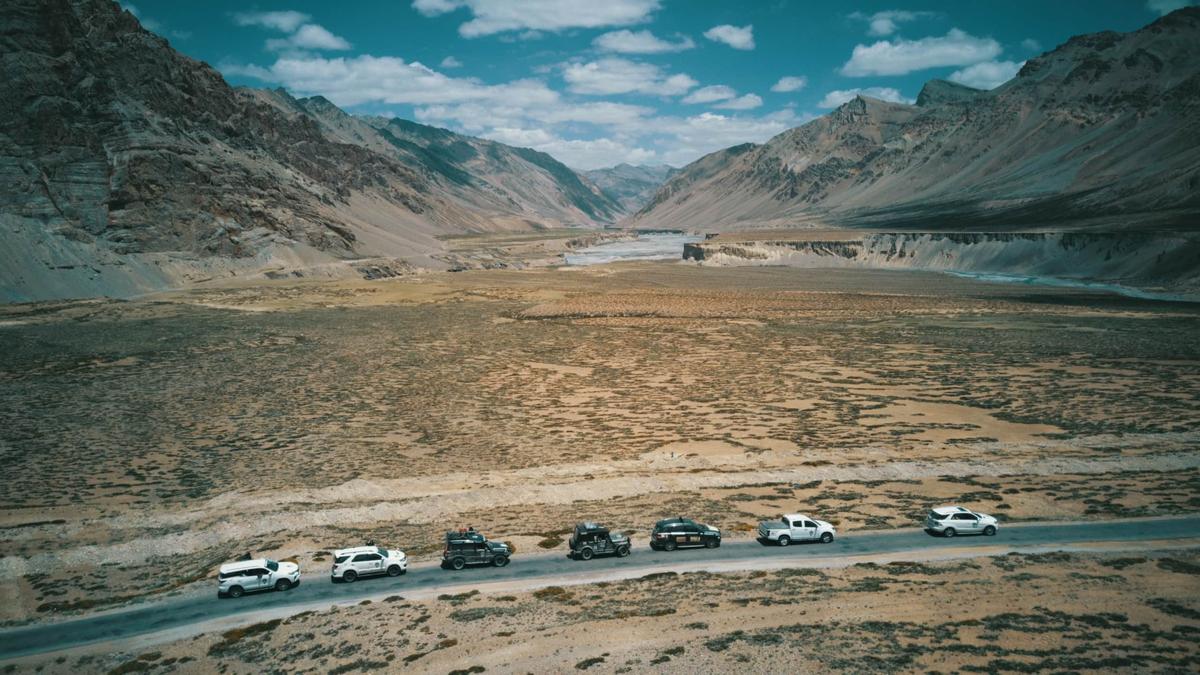
Most brands answer this by looking at what they sell, which is why so many road campaigns end up as demonstrations with a route attached. A road trip earns coverage when it is about something that exists in the world whether the brand is involved or not, and the brand's job is to have a legitimate reason to be interested in it. Working out what that something is takes longer than planning the journey itself, and it is the part almost nobody gets help with.
The confusion is understandable. A brand commissions a journey, so it seems reasonable that the journey should be about the brand. But that reasoning produces an idea nobody outside the company can find a use for, and by the time this becomes obvious the route is booked and the invitations have gone out. What follows are the questions worth putting to an idea before any of that happens.
Because they start from the product and work outwards.
A tyre company decides the journey should demonstrate tyres. A paint company decides it should showcase weather resistance. A food brand decides it should feature the food. Each of these is a reasonable instinct and each produces the same result, which is a journey whose only content is the thing the company already advertises.
The problem is not that the product appears. It is that nothing else does. A journalist invited on that trip is being asked to write about a product with a road behind it, which is an advertisement they are expected to produce for free. Most will be polite. None will be interested.
The correct starting point sits one step back from the product, and it is a harder question. What does this brand have any standing to be curious about, given what it makes and who buys it. That question rarely produces the product as its answer.
Something that exists independently of the brand, that the brand has an honest reason to care about, and that a road can physically reach.
Three conditions. Most ideas that come out of an internal brainstorm satisfy the third and fail the first two. An idea that satisfies all three is usually not the first one anybody suggested, and often not the tenth.
The rest of this article is those three conditions turned into tests, in the order they are worth applying.
Take the company out of the sentence and see whether anything is left.
This is the strictest test and the fastest. Write the journey down in one line as though it were happening anyway, funded by nobody. A group travelling to find out whether something is true. A route following something that has never been followed end to end. People being visited whose work has not been documented. If the line still holds attention with no company attached, there is something there. If it collapses into nothing, there was never an idea, only a plan.
Almost every internally generated concept fails this. That is not a criticism of marketing teams. It is a consequence of the brief they were given, which was to produce something for the brand rather than something the brand could join.
The failure is easy to spot once you know to look. If the sentence needs the company's name to make sense, the company is the only thing in it.
The first test finds ideas worth travelling for. This one finds the ones worth this brand travelling for.
Plenty of causes are genuinely interesting and have no connection to the company considering them. A bank could fund a journey documenting disappearing crafts and it would be a good journey, and afterwards nobody would remember who paid for it. The coverage happens, the participants publish, and the brand appears in the credits like a sponsor logo on a jersey.
What makes the connection hold is a line back to what the company makes, who buys it, or where it operates. Not a slogan. An actual link somebody could explain in a sentence without sounding like they were reaching. A brand whose product is used on the road has standing to be curious about roads. A brand that sells into small towns has standing to be interested in what is happening in them. A brand whose supply chain begins somewhere specific has standing to go and look at it.
This is also where Care-Based Travel becomes practical rather than philosophical. A brand arriving somewhere with no reason to be there is a visitor at best. A brand arriving with a genuine connection to what happens in that place is participating in something, and the difference is visible to everyone involved, including the people being visited.
An idea can pass both tests above and still be unroutable.
This is the test only someone who plans journeys thinks to apply, and it kills more good ideas than either of the others. What the road needs is specific. Something to arrive at, which means a place, a person, an event or a thing that exists physically. More than one of them, because a single destination is a trip rather than a journey. Spaced along a line a convoy can actually cover in the days available. And people at each stop with their own reason to take part, because a stop where nobody local is involved produces photographs and nothing else.
An idea about something dispersed and invisible fails here. An idea about something concentrated in one city fails too, because there is no second stop. An idea requiring stops eight hundred kilometres apart fails on time, and one requiring roads that are impassable in the season available fails on weather.
None of this is a reason to abandon a good idea. It is a reason to test it against a map early, before the concept has been presented internally and become difficult to change. What a place makes possible that another place does not is the question Destination Thinking exists to ask, and here it is being asked of an idea rather than of a destination.
The practical work of turning that into a route, with recce, surfaces, distances and support, is a separate discipline. But it begins here, with whether the idea has anywhere to go.
Because an idea that is fully explained on the first morning has nothing left for the fourth day.
This is the quality that separates ideas which sustain a journey from ideas which merely start one, and it is worth understanding before committing to a length.
Ideas with a question inside them last longer than ideas with a statement inside them. A journey that sets out to find whether something is true has somewhere to go each day. A journey that sets out to show that something is true has said everything by lunchtime on day one, and the remaining days are repetition with different backgrounds.
Ideas that change as the geography changes last longer than ideas that stay constant. If what you are looking at is different in the second state from the first, the journey has an internal argument and the participants have something new to write each evening. If it is identical everywhere, the fifth stop produces the same post as the second, and people stop bothering.
Ideas that get more interesting further from cities last longer than ideas that thin out. This is the one most often got backwards. A concept built around urban participation weakens as the route moves into places with fewer people, which is exactly where the journey becomes visually and narratively strongest. A concept that gets richer the further out you go is carrying the route rather than fighting it.
And ideas with people in them last longer than ideas with only places in them. A landscape is photographed once. A person who is doing something specific gives every participant a different conversation and therefore a different account.
It looks fine, which is the difficulty.
Everybody arrives. The vehicles are clean. The photographs are taken, and some of them are good. The first city produces coverage and everybody is pleased. Then the second city produces coverage that reads almost identically, and by the fourth the participants are posting once a day out of obligation rather than three times out of interest. The material stops appearing within a week of the journey ending.
Nothing failed. That is what makes it hard to diagnose afterwards and easy to repeat. The organisers conclude that road trips generate a certain amount of coverage and budget accordingly next time.
What actually happened is that the idea ran out on the second day and the remaining days were logistics. No amount of execution repairs this. It has to be caught while the idea is still a sentence in a document, which is why the tests above are worth applying before anything is booked.
Not the marketing department alone, and this is not a criticism of marketing departments.
Finding an idea that passes all three tests requires knowing what is actually out there. Which crafts are still practised and where. Which routes have never been documented end to end. Who is doing something worth visiting in a district nobody covers. Which roads are passable in which months, and what sits along them. That is not knowledge a brand has any reason to hold, and it is not the kind of thing that can be researched from a desk in a fortnight, because most of it has never been written down.
It is, however, exactly what accumulates in a company that spends its years on those roads. The brand brings the reason to care. The knowledge of what there is to care about, and where it can be reached, has to come from somewhere else.
That division is worth being honest about at the start. A brand that expects to arrive at the idea alone will usually arrive at the product, and by then the route is already being planned around the wrong thing. The brands that get this right are the ones who treat the idea as something to be found rather than something to be decided, and who bring in the people who already know where to look.
Something that exists in the world independently of the brand, that the brand has an honest reason to care about, and that a road can physically reach. Ideas built around the product itself produce demonstrations rather than journeys, and demonstrations do not generate coverage because there is nothing in them for anyone else to write about.
Longer than planning the route. Finding an idea that holds up requires knowing what exists along Indian roads, most of which has never been documented, so it cannot be researched from a desk in a fortnight. Campaigns that go wrong are almost always ones where the dates were fixed before anyone had settled what the journey was for.
The product can appear, and often should, but it cannot be the subject. A journey whose only content is the thing the company already advertises asks journalists to produce an advertisement without being paid for it. The product works best when it is doing something useful inside a story about something else.
Write the journey in one line with the company's name removed and see whether anything remains that a stranger would find interesting. If the sentence needs the brand to make sense, the brand is the only thing in it. Then check whether that brand has a real connection to the subject, and whether the idea has physical places a convoy can actually reach.
An idea built on a statement rather than a question. A journey that sets out to prove something has said everything by the first afternoon, and the remaining days become repetition against different backgrounds. Ideas that change as the geography changes, and that get more interesting further from cities, sustain a longer route.
It needs a genuine subject, which is not the same as a cause in the CSR sense. A question worth answering, a route worth documenting, or people worth visiting all work. What matters is that the subject would still be interesting if no company were funding it.
Long enough for the idea to keep developing, which depends on the idea rather than on a standard length. An idea that is fully explained on day one should not be given four days. One that gets richer the further the route goes can carry considerably more.
The brand brings the reason to care, since only they can say what the company has standing to be interested in. The knowledge of what actually exists along a route, and where it can be reached, has to come from people who spend their time on those roads. A brand working alone usually arrives back at the product.
A launch drive is built around a vehicle or product that has to be experienced, and the route is chosen to demonstrate a specific claim. A brand road trip campaign is built around a subject the company has a reason to explore, and the product's role is incidental to what gets written. The planning disciplines overlap. The starting question does not.
Change the idea rather than the route, and do it before the concept has been presented internally. An idea about something dispersed, invisible, or concentrated in a single city cannot be rescued by better logistics. Testing against a map early is considerably cheaper than discovering it after the invitations have gone out.