
Let’s help you
plan your journey
Explore responsibly, discover offbeat places, guided by locals, rooted in culture.
Let’s help you
plan your journey
Explore responsibly, discover offbeat places, guided by locals, rooted in culture.
Soumen Bhowmick
Soumen Bhowmick founded Pollen Dots in 2024 to plan journeys across India and Bhutan. He works in the Commercial Department of Indian Railways, where he has been since 2000. From 2016 to 2020 he was Head of Business Development and Partnerships at ScoutMyTrip, a community-driven road trip planning platform. There he built a nationwide network of local Scouts who helped travellers on the road, and grew the Road Trippers Club to 16 Indian cities. As a core member of Devil On Wheels, he helped travellers plan Himalayan trips and started Spreading Smiles. He has driven solo from Arunachal to Goa and from Himachal to Karnataka, and has run his own caravan for more than ten years. His photographs have won national and international salon awards, and his writing has appeared in Outlook Traveller.
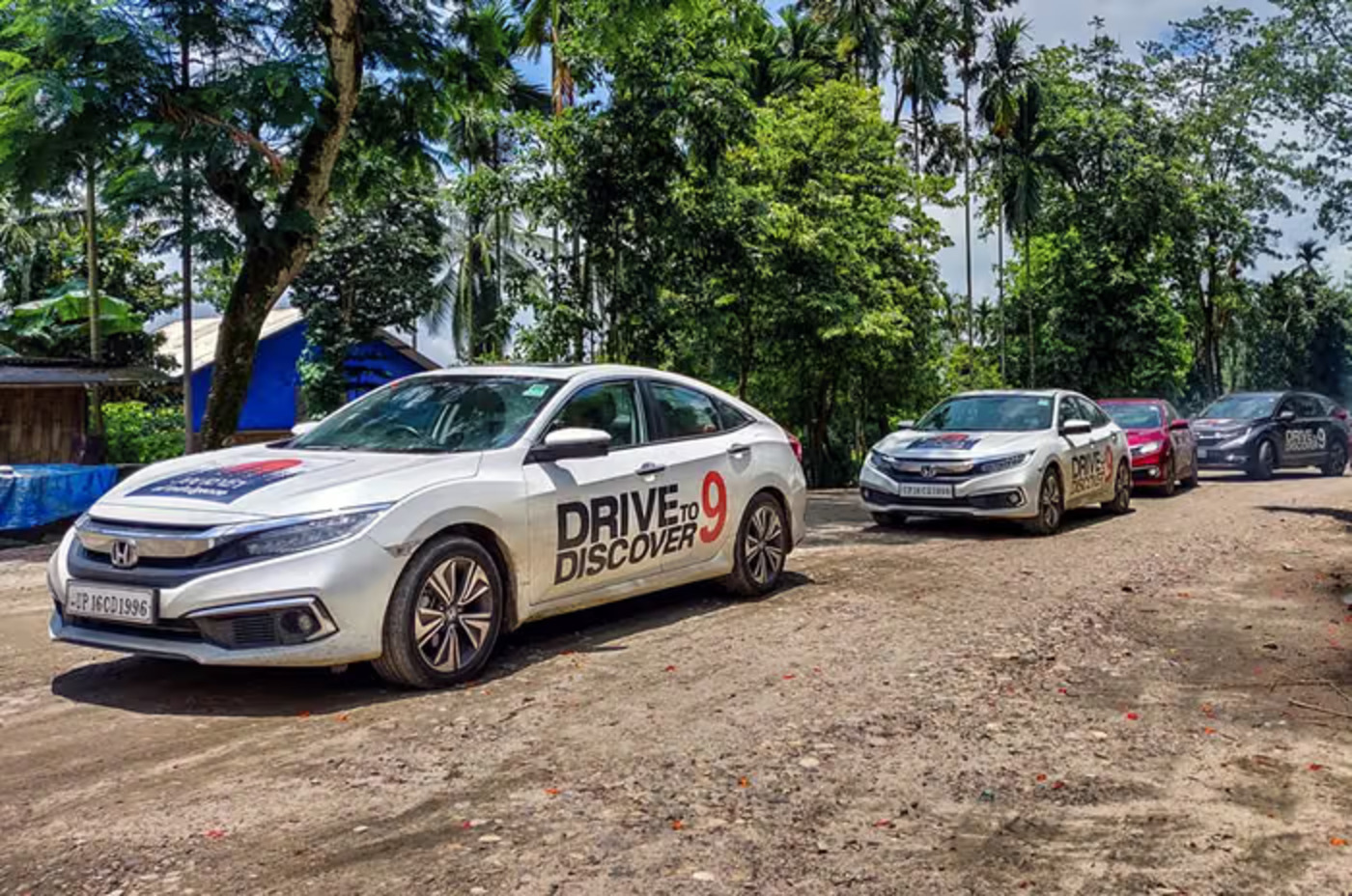
A car launch media drive in India is planned backwards from what the vehicle has to prove, not forwards from the launch date. The claim decides the roads, the roads decide how far the convoy can honestly move in a day, and that decides the halts, the night stops and everything a camera will ever get. Fix the dates first, which is how most drives begin, and everything after that is a compromise wearing the clothes of a plan.
Most drives get commissioned in the wrong order, and the order is always the same. The reveal is on the fourteenth. So the drive runs the ninth to the eleventh. So the route has to be within four hours of an airport. So the roads are whichever roads happen to be lying around near that airport. By the time anyone asks what the car is supposed to demonstrate, a calendar has already answered it. Then the coverage comes in, and it reads like it was written to a brief, and nobody can quite say why.
What follows is the order these decisions actually want to come in, and what each one takes away from the next.
One thing. Whatever the launch is really resting on. Write it down as a plain sentence before anyone opens a map, then keep asking of every road you are offered whether that road earns the sentence.
Most stretches will not. They are on the map because someone thought they looked pretty, or because a hotel happens to sit at the end of them.
What gets misunderstood here is the idea that a claim needs a matching road for its whole length. It does not. A day that is nothing but highway teaches a journalist about the seat and very little else. A day that is nothing but broken surface has everyone worn out by two in the afternoon, and after that they stop noticing anything at all. The work is in the mix, and in the order.
A day that runs well usually opens with a stretch of open road, when people are fresh and happy to push a little. Somewhere in the middle, a section that asks something of the car, and it does not need to be long. Seven or eight kilometres of genuinely bad surface will tell a journalist more than fifty. Then country roads that wander, where the landscape keeps changing, the driving is unhurried and people start actually talking to each other. Perhaps a short piece of unpaved village track, where a low car has to be placed carefully and the person driving has to think about it.
And running underneath all of that, a consideration that gets treated as decoration and is not. The route has to give them things they will want to photograph. Not scenery in general. Specific places where a journalist looks up, sees the car sitting in front of something worth looking at, and stops without anyone suggesting it. A bend with the valley opening behind it. A ferry. A road running between fields where the light does something. Their own faces in it too, because they are on this drive as much as the car is.
That instinct is the whole engine of the thing. When journalists stop on a broken stretch or an earthen track to shoot the car and the road together, they are not doing the brand a favour. They are collecting something they are proud of. That material goes up on their own accounts while the drive is still running, and it keeps going up long after the launch, because it belongs to them. No agency can commission that. A route can create the conditions for it, or fail to.
I have seen a low sedan taken onto patchy roads and earthen village tracks that nobody would ever put in a brochure, and the journalists wrote about the suspension afterwards without being asked to. Nobody told them the car was composed. They found out with their own hands on the wheel, and then they stopped and photographed it. That is the only version of a claim a reader has ever believed.
Electric cars turn this on its head. The charging map draws the route, and the route then decides how much of the claim you can show at all. Pretending otherwise means spending the best light of the day in a car park watching a percentage climb.
There is a second question worth settling in the same conversation, and hardly anyone does. What is this drive supposed to leave behind when it is over. That answer changes where the content crew sits, which halts exist for filming rather than for the group, and whether any of the material still means something in three years. It is worth understanding why a campaign and the evidence it leaves behind behave very differently before signing off a route, because that is the difference between a drive that produces coverage and one that produces a record.
Because the road on the map and the road you will drive are not always the same road, and it is better to find that out now.
A recce tells you the surface as it is this year. Where the width drops so two vehicles cannot pass. Where a convoy can turn around and, more usefully, the long stretches where it cannot. But the most valuable things a recce produces are the small ones nobody puts on a form. Which pump actually has stock. Where the phone goes dead and for how many kilometres. How far the nearest hospital is from every stage of the route, a number somebody in the brand's legal team will eventually ask for and nobody can reconstruct from memory once everyone is home.
A recce is also when you find the photograph stops, which will not come off a map either. You are looking for the places where the car will sit well against what is behind it, and where a convoy can actually pull over without blocking a road.
Then there is time. Every mapping tool calculates for one car, driving normally, on a day when nothing happens. A media convoy is none of those things. It stops more, it spreads out across kilometres, it waits while people walk back for a photograph, and it arrives at the night halt in pieces over the better part of an hour. Ask someone who moves groups on those roads what the day takes and use their number, not the app's. It is the same reason a destination is better judged by how a group actually moves through it than by what an itinerary promises.
And do the recce in the season you will drive in. April and July are not the same road across most of this country. Sometimes the difference is comfort. Often it is whether the road is there.
Less than the map suggests. Almost always less than the brand hopes.
The way to build a day is backwards, from whatever cannot move. A ferry with a last sailing in the afternoon. A checkpoint that shuts. A forest stretch nobody is permitted to enter after dark. A ghat road where driving at night is a bad idea whatever the permit says. Those points are fixed, and everything else fits around them. Miss one and you have not lost an hour. You have lost the night halt.
Then take out what the drive is for. Nine hours behind a wheel gives a journalist a firm opinion about the seat. The halts are where the coverage comes from, the places people get out, swap cars, look at something, take photographs and talk to each other over tea. Those belong in the plan from the start, not squeezed in later if the schedule allows, because the schedule never allows.
One more thing here that has nothing to do with efficiency. A convoy going through a village changes that village's morning. Forty vehicles is a great deal of noise and dust arriving at once in a place where people are walking children to school. How the convoy behaves through those stretches is a decision, and somebody has to make it and brief it. Slow well before the houses rather than at them. Do not treat people on the road as obstacles. It matters in itself, and it also decides whether you are welcome on that route next year. This is what care based travel looks like when there is nothing philosophical about it at all.
Everything a city was quietly doing for you without being asked.
We found this out one evening in Guwahati. The city was full. Every venue we wanted for the opening night was gone, including the hotel the group was staying in, and we had come to the search too late to argue. So we took a property about fifteen kilometres out, a lovely place in a rural setting with its own grounds and an indoor hall, which mattered because it was the rainy season and the rain was not negotiable.
The evening itself was good. There was a live band, rock and contemporary, and the journalists and vloggers and the client team all sang and danced and stayed far later than any of them had planned to.
What I remember is the ice.
There was none out there. No supply, no shop, no way to make it appear at nine at night. We sent people to the dhabas and small restaurants nearby and borrowed what they had, and it was not enough, and it went on not being enough for the rest of the evening. Nobody said anything. It did not need saying. We knew, and it did not look like the work of people who knew what they were doing.
Nothing about that would have shown up on a recce sheet. A recce checks the road, the venue, the power, the access. It does not check the hundred invisible things a city hands over without being asked. Ice. Cold storage. A microphone at short notice. A chemist at eleven at night. A mechanic willing to look at something before morning instead of after breakfast.
So now, at any remote halt, the question is not whether the place is beautiful, because it usually is. It is what this place cannot get hold of inside an hour, and which of those things we are carrying in ourselves.
The press fleet is not really the planning question. The brand sets that from the guest list, usually two journalists to a car who swap the driving between legs so both get proper time behind the wheel. That number arrives already decided.
What has to be built is everything moving alongside it, and this is where budgets tend to run out.
You need a lead vehicle with someone in it who has driven the route, not someone reading the same app as everyone else. You need a sweep at the back that leaves each halt only when the last press car has gone, because without it a group stretches across sixty kilometres and you discover somebody is missing at the night stop rather than at the halt where they stopped. You need spare capacity, because a puncture on a road with no shoulder eats an hour, and a journalist standing on a verge for an hour is already writing something in his head that you would rather he was not.
Then the vehicles nobody puts in the announcement. Manufacturer service support, carrying parts for cars so new that no workshop on that road will have seen one. Fuel, tools, water. The content crew, who cannot sit in press cars because they need to be ahead of the group to film it arriving. The medical vehicle. The client team's own cars, running their own errands all day. On one four day route we ran, the total came to forty two cars once everything was counted, though that figure means little on its own. A short drive close to a city needs a fraction of it. A long one through remote country needs proportionally more, because the further you go from a town the more of your own world you have to bring with you.
The number that matters on a given morning is never the size of the fleet anyway. It is how many vehicles are not carrying press, because those are the only ones free the moment something goes wrong.
The road decides that, not the invitation list.
An open highway with proper laybys will absorb a group that a hill road with three passing places in forty kilometres simply cannot. The honest limit is set by where the group can stop safely, where it can turn, and how easily a local truck can get past it. Push beyond that and the convoy stops being a convoy and becomes a blockage, which is a safety problem and, in the places you are driving through, a reputation problem too.
When the list is bigger than the road, run waves on consecutive days instead of forcing one large group onto it. It costs more and it works, and that conversation belongs in the planning meeting rather than on a ghat section.
One small decision changes the coverage more than almost anything else it costs. Decide the pairings. Left alone in a car park, people get in with whoever they already know, and if the same two share a car for four days you end up with two points of view. Change the pairs at each leg and the same group gives you six or seven, because every combination has a different conversation and notices different things. It costs nothing. It is also the plainest example of what Journey Architecture means once it stops being a phrase, which is designing the pace, the movement and who ends up talking to whom, rather than only the schedule.
Wherever the road allows, which is the opposite of how every other corporate programme gets planned. Normally the hotel is chosen and the days are built around it. On a drive the road has already been chosen, and the road decides what is available.
We put a night on Majuli into an itinerary for Honda's Drive to Discover, and we did it deliberately. It gave us the Brahmaputra crossing with the whole convoy loaded onto ferries, which was not a photograph anyone else was going to have that year. It gave us the patchy sections and the earthen village tracks the cars needed. And it gave the journalists a night most of them had never had, on an island in the middle of a river that behaves like a sea.
Majuli also floods, erodes and moves. There is not much accommodation, and none of it was built for a group that size. We used two properties for rooms and brought everyone together at one of them to eat. The rooms had no air conditioning. There was no refrigeration anywhere, so there was no ice.
The journalists loved it. Several of them wrote about those traditional rooms by the river as one of the best parts of the trip.
The client team were not happy at all, and it came close to a serious argument that night.
Both of those reactions were correct. Working out why is the most useful thing in this article.
Because they are on the same drive for opposite reasons.
A journalist is gathering material. A night in an odd old building on an island in the Brahmaputra is material. A bit of discomfort in a genuinely interesting place turns into authenticity by the time it reaches the page. It is the thing they remember, and the thing that makes this drive different from the last four they were invited on.
The brand team are gathering nothing. They are hosting. They are responsible, and every gap between what a guest expected and what a guest got lands on them personally, usually in a conversation with someone who was not there. To the person hosting, no ice is not local colour. It is a failure with their name on it.
So one decision produces a good outcome and a bad one at the same moment, and the bad one is what you hear about that night. That is not a client being unreasonable. It is what carrying responsibility for other people's comfort does to how you see a room. Anyone who has ever hosted anything recognises it straight away.
Which means the accommodation question is never only whether a property suits the route. It is whether the brand team have genuinely taken on board, in advance and in detail, what the property will and will not have.
One named person, in writing, who has replied to you.
We had told them about Majuli. That was never in question. What we had not understood is that telling a team is not the same as telling a person. On a launch of that size you are speaking to several people at once, each holding a different piece of it, each buried under a hundred other things that week. A detail mentioned to one of them halfway through a long call about something else does not reliably reach the other four. Nobody hides it. It gets covered over by everything else moving at the same time.
Then there is the word basic, which all of us used and each of us heard differently. To one person basic means no room service. To another it means no air conditioning. To a third it means the bathroom is down a corridor. Nobody finds out how far apart those meanings are until they are standing in the room with a suitcase in their hand.
So the fix is dull and it works. Anything that will land below what the client would reasonably assume gets written down as a specific fact rather than a general warning. No air conditioning. No refrigeration on the property, so no ice. Rooms across two buildings. Dining at one of them. That list goes to one named person on the brand side, and it is not agreed until that person has replied. Not nodded at in a meeting. Replied to.
It reads like paperwork. It is the difference between a client who knew and a client who feels they were not told, and at nine o'clock on the night in question those are two entirely different people.
Anyone who gives you a per person figure before seeing the route is guessing, and they will be wrong in one direction or the other.
Accommodation on its own swings by several thousand rupees a room a night inside what everyone agrees to call the same category. On a remote route it swings further, because some nights you are paying city rates and other nights there is exactly one property and its price is simply its price. Meals move with the menu. Drinks move with the brands on the table, and the gap between a sensible bar and an open one will redraw a budget by itself.
Then the things that never appear in a hotel comparison. The recce, which is a whole separate journey with its own vehicles and days and people. Fuel across the entire convoy, not the press cars. Permits and permissions, which in restricted areas cost time as much as money. Local authority coordination, which in some districts is unavoidable and in others is the only reason a ferry is still sitting there when you arrive. Convoy management, meaning the people whose only job all day is knowing where every vehicle is. The on road support team, and the backup team behind them. Entertainment and activities, which is where an evening either works or teaches you something about ice.
And the medical team, with their equipment, travelling with the group the whole way.
That last one surprises most people commissioning their first drive. It should not. On a road three hours from a hospital, with journalists driving cars they have never driven, over surfaces they have not seen, at a pace they are enjoying rather than pacing, the doctor is not an extra. The doctor is the reason the rest of the plan is allowed to exist.
So the question to put to a partner is not what it costs a head. It is what is inside that number and what has been left out, because the difference between two quotes for the same drive is almost always the recce, the backup vehicles and the medical cover. Those three are the easiest to remove quietly, and removing them is exactly what makes the cheaper quote look sharper on the page.
The route will change anyway. A pass closes, a bridge goes, a ferry does not run, a car stops somewhere with no signal and no shade. The plan was never the route. The plan is what happens when the route fails, and that is the thing to test a partner on before signing anything. Not whether they can produce a convincing itinerary, because most people can. Whether they can tell you, in specific terms, what happens on the second day when the road ahead is gone and the whole convoy is already committed to it.
If they cannot answer that in a meeting, they will not answer it on the road.
Long enough for the car to be driven on the kind of roads the claim depends on, which for most launches means three to four days. A four-day route through mixed terrain can comfortably cover more than a thousand kilometres without anyone feeling hurried. Shorter drives work when the roads are close to a city, and the claim is narrow. Under two days, you will get coverage that reads as a first impression, because that is all anyone had time to form.
It depends on the route, how remote it is, and how long the convoy will be away from a town. The press fleet itself is set by the brand from the guest list, usually two journalists to a car swapping the driving between legs. What gets added is the lead vehicle, the sweep, spare capacity, manufacturer service support, fuel and tools, the content crew, the medical vehicle and the client team's own cars. On a long remote route the total can run past forty. Near a city it is a fraction of that.
A launch event controls the story. A media drive deliberately gives that control away, because a journalist who has driven the car will write something no press release can. The consequence is that the route becomes the brief. Once the narrative has been handed over, the roads chosen are the only influence left over what gets written.
Before the dates are confirmed, and in the same season the drive will run. A recce establishes surface, fuel reliability, signal gaps, turning points for a large convoy, hospital distance at every stage, and the places worth stopping for photographs. Done in a different season, it answers questions about a road that will not exist in that form on the day.
By building the stops into the route rather than hoping for them. Journalists post what they are proud of, and they are proud of images where the car sits well against something worth looking at, taken on their own time with their own phone. The route needs those places, with room for a convoy to pull over safely, and the schedule needs enough slack that stopping does not put the day behind. That material goes up while the drive is still running and keeps going up long after the launch, because it belongs to them rather than to the brand.
Answer this before leaving, not on the morning it happens. It needs a vehicle that can peel off without stranding anyone else, a route back to the nearest town or airport that somebody has actually driven rather than looked up, and a named person whose job is to go with them. If a proposal does not describe this, that part of the drive has not been thought about.
On any route where the group will be more than an hour from a hospital, yes, with a vehicle and equipment for the full duration. It is one of the first lines removed when a quote is being tidied up to look competitive, and one of the few whose absence only becomes obvious at the moment it is needed.
Responsibility sits with the brand, which is why the arrangements matter more than the itinerary. The split that works is this. The brand owns the relationship with the journalists. The communications agency owns the coverage. The travel partner owns everything that could interrupt either one, which means route, vehicles, medical cover and contingency. Agree that in writing before departure and you avoid the usual mess where three people are looking after one journalist and nobody is looking after the fuel stop.
Anything that will fall below what the client would reasonably assume, written as a specific fact rather than a general caution, sent to one named person on the brand side, and treated as agreed only once that person has replied. Words like basic mean something different to everyone who hears them, and on a large launch a detail given to one member of a team does not reliably reach the rest of it.
Honda's Drive to Discover is an annual series run by Honda Cars India. The edition referenced here was executed in 2019 under ScoutMyTrip, a previous venture led by members of what is now the Pollen Dots leadership team. This account is presented as a record of our team's experience. Honda® and Drive to Discover® are trademarks of their respective owners.