
Let’s help you
plan your journey
Explore responsibly, discover offbeat places, guided by locals, rooted in culture.
Let’s help you
plan your journey
Explore responsibly, discover offbeat places, guided by locals, rooted in culture.
Soumen Bhowmick
Soumen Bhowmick founded Pollen Dots in 2024 to plan journeys across India and Bhutan. He works in the Commercial Department of Indian Railways, where he has been since 2000. From 2016 to 2020 he was Head of Business Development and Partnerships at ScoutMyTrip, a community-driven road trip planning platform. There he built a nationwide network of local Scouts who helped travellers on the road, and grew the Road Trippers Club to 16 Indian cities. As a core member of Devil On Wheels, he helped travellers plan Himalayan trips and started Spreading Smiles. He has driven solo from Arunachal to Goa and from Himachal to Karnataka, and has run his own caravan for more than ten years. His photographs have won national and international salon awards, and his writing has appeared in Outlook Traveller.
Most organisations plan a corporate retreat as a venue plus an agenda, then wonder why the org chart looks identical a month later. The research on organisational interventions is blunt about why: anything running under two weeks produces no measurable effect on its own, which makes the retreat a trigger rather than the intervention. Journey Architecture is the discipline of designing the retreat, and the fortnight that follows it, as one thing.
Nobody plans a retreat badly. The venue is inspected, the agenda is built, the sessions are timed to the minute and somebody has thought carefully about dietary requirements. Then the group arrives, and within two hours the room reorganises itself into the shape it had in the office. The same people find each other first. The same tables form at every meal. Three days later everybody flies home and nothing about how the organisation works has changed. Eleven months after that the same programme runs in a different state, and the industry calls this an agenda problem. It is not an agenda problem. The agenda was never the thing doing the work.
Because the format carries the office inside it. Watch the first evening of any large corporate gathering and the reporting structure declares itself without anybody mentioning it.
None of the individual decisions is a mistake. A stage at one end of a room is a device for deciding who speaks. A tight schedule is a device for deciding where attention goes. Short breaks are a device for keeping people with the colleagues they arrived with, because unfamiliar surroundings make familiar company the path of least resistance. Put those three together and you have reproduced the social map of the office in a nicer building.
This is why changing the destination so rarely changes the outcome. People arrive with the colleagues they work with, spend the retreat with the colleagues they work with, and leave knowing almost nothing new about anyone outside that circle. The office travelled with them because nothing in the design gave anyone a reason to leave it.
Three nights and four days, if the objective involves relationships. Two nights and three days is the practical minimum. Anything shorter is an event, and events are fine, but they end before the thing you wanted starts.
The reason is behavioural and fairly consistent. The first day is spent performing, because everybody is still surrounded by people who influence their career and a change of venue does not switch that off. Something loosens on the second day, usually away from the formal programme, when conversations get less guarded and people drift outside their usual groups. By the third day those new relationships have had enough time to become real rather than polite.
If the objective is only to communicate strategy, launch something or recognise performance, a short programme is adequate and a long one is waste. The mistake is running the short programme and expecting the long programme's outcomes. Productivity and relationship building do not share a timetable. One rewards a full agenda. The other rewards space.
Every retreat runs two programmes at once. One is printed on the agenda. The other is created by the decisions nobody writes down. Who travels with whom. How far the rooms are from each other. How long the walk to dinner is, whether the vehicle seats two or twelve, and how much time exists between one thing and the next. The second programme is usually the one people remember.
That second programme is what we call Journey Architecture. It is the methodology we developed at Pollen Dots for designing the pace, the environment, the movement and the interactions of a journey deliberately. The aim is that trust and candour become more likely to appear on their own, rather than being scheduled into a slot and hoped for.
It builds on the Journey Environment Principle, which holds that the environment around a journey shapes the conversations inside it. The principle explains why journeys change how people behave. Journey Architecture turns that into decisions somebody can actually make on a planning call, weeks before anyone travels.
Those decisions are easiest to see side by side.
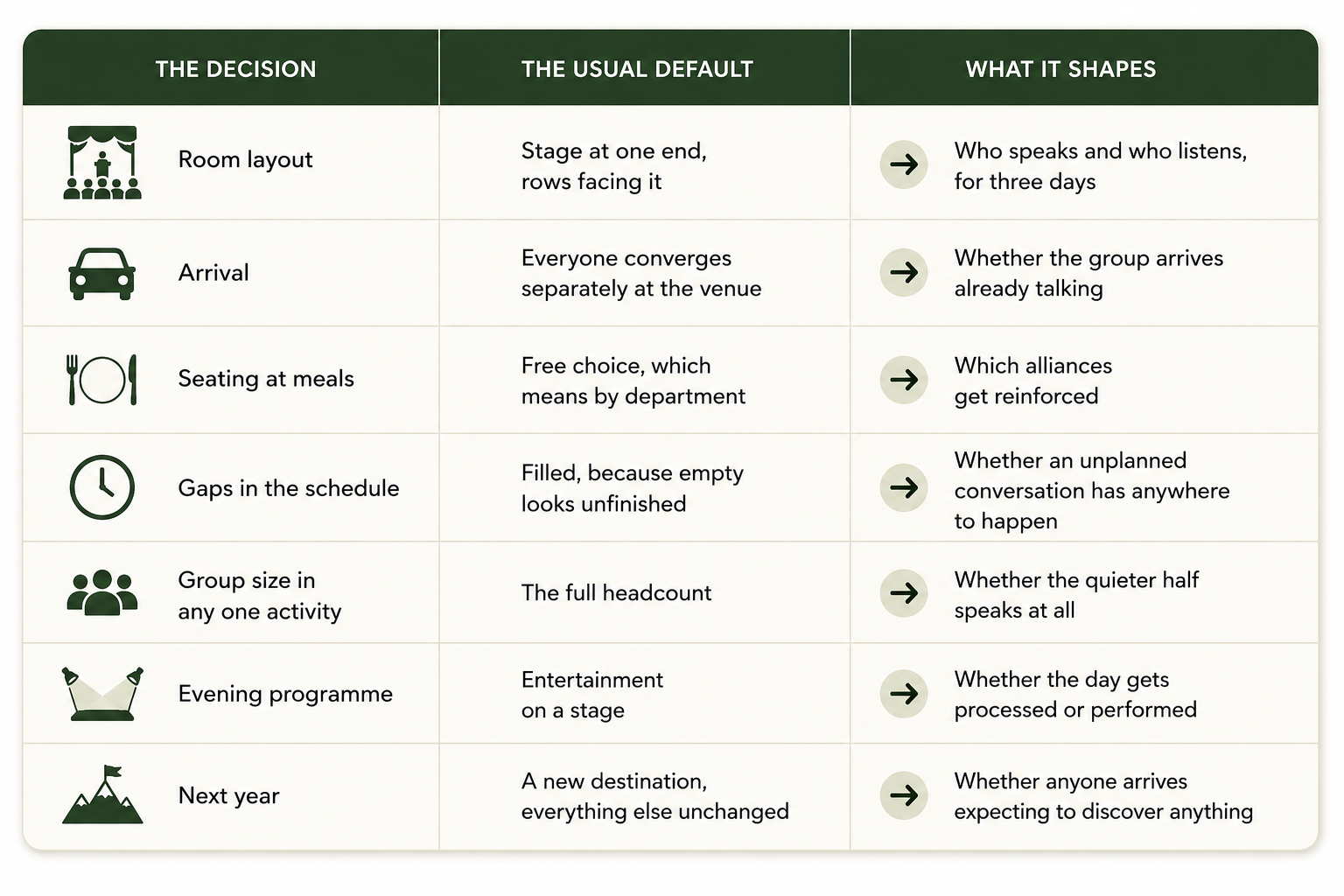
None of the defaults in the middle column is a mistake. Each one is efficient, easy to brief and simple to organise, which is exactly why most organisations arrive at it. The point is not that the default is wrong. The point is that it is not neutral. Leaving the format unchanged is itself a design decision, and it produces a predictable result.
Across a three-night, four-day retreat, four to five hours of structured discussion is usually enough. Financial performance, business priorities and decisions that genuinely need everybody in one room deserve dedicated time. Everything else has to earn its place.
The instinct runs the other way. People have flown across the country, so every hour feels as though it should be justified, and an agenda with gaps in it looks unfinished to whoever approves it. Presentations follow workshops, workshops lead into activities, the evening gets a programme of its own. On paper it reads as productive. In practice it removes the only conditions under which the stated objective could have been met.
Organisations do not run retreats because they want more presentations. They run them because something about how people work together needs to change. A strategy needs wider ownership. Two functions need to understand each other. A leadership team needs conversations the office does not permit. None of those things happens while everyone is seated facing the same direction. They happen while travelling, walking, waiting for lunch, sharing a table with somebody unexpected, or staying at the table after the formal part has ended. You cannot run a workshop on trust between people who have never heard each other speak informally.
Before signing off the agenda, run one test. Count the minutes in each day when a participant could have an unplanned conversation with somebody outside their usual circle. If it comes to less than three hours, the retreat will reproduce the office at considerably greater expense.
The strongest objection to a light agenda is financial and it deserves a real answer. Somebody is paying for flights, rooms, venues and several working days. An afternoon with nothing scheduled looks like a programme somebody forgot to finish.
The answer is that those hours are not empty, they are handed over to the destination. A well-chosen place does not offer scenery, it offers invitations. A riverside path invites a walk. A market rewards curiosity. A tea estate, a craft village, a forest trail or a quiet café each creates a different reason to move, stop or explore, and none of it has to be compulsory.
People do not bond because they were given time together. They bond because they were given interesting choices to make together. Two colleagues who decide to take the longer trail, wander into a village or stop at a roadside tea stall have already done something they would not have done at work. Shared choices produce shared experiences, and shared experiences produce the stories that keep circulating months later. Relationships grow through shared choices, not shared schedules.
Which means these hours need as much design as the sessions do. The work is not leaving time empty. It is filling the environment with enough possibilities that people move without being told to.
More than almost any other decision on the sheet, and it is usually made by whoever is booking transport. A twelve-seater produces one conversation with an audience. Two seven-seaters produce two. Four cars produce four, and they produce different ones, because the group composition changes what people are willing to say.
The same logic runs through the whole itinerary. Rooming decides who bumps into whom at seven in the morning. Table size at dinner decides whether the conversation is general or specific. A walk of four hundred metres between two points is a conversation. A shuttle bus is not.
None of this needs to be heavy-handed and it should never be visible to participants. Nobody enjoys being told they have been assigned a car for developmental reasons. The design sits underneath the experience, and the participant simply notices that they ended up talking to somebody they had never spoken to properly before.
Start with the sentence that describes what should be different afterwards, and make it specific enough to be wrong. Not "improve collaboration". Something closer to: the sales and product teams currently escalate to me instead of to each other, and that should stop.
Then work backwards. That sentence tells you the length, because relationship objectives need three nights. It tells you the group, because it names who has to be in the room. It tells you how much of the agenda is structured, because it tells you what genuinely needs everyone facing the same way. It tells you what kind of destination, because it tells you what people need to do together. It tells you the vehicle sizes, the rooming and the table plan.
The reason most retreats fail this test is that the brief arrives as a destination and a headcount, and every subsequent decision gets made downstream of a place somebody liked. The order is reversible only at the start. Once the venue is booked, the retreat is largely designed, whether or not anyone intended to design it. This is the same failure that turns journeys into an events line rather than a strategic brand initiative, and it happens for the same reason: nobody wrote the objective down first.
Because the venue governs four or five hours a day and the destination governs the rest. A property can be excellent and still sit in a place that offers nothing to walk to. When that happens the unstructured hours collapse back into the bar, and the group re-forms exactly as it would have at home.
The questions that matter about a destination are not the ones on a venue checklist. What is within walking distance. Whether there is anything worth doing that costs nothing and needs no booking. Whether local life is visible and approachable, or fenced off behind a resort boundary. Whether the road in is itself worth something, since the road between two places is frequently the part people remember. Whether a group of thirty urban professionals will be a curiosity, a nuisance or a welcome presence. That last one is a question about how a visiting group is expected to behave as much as about the place.
Season is part of the same decision and it is where most planning goes conservative for no good reason. The months the industry has agreed are unsellable are sometimes the months a place is at its most interesting. Behdeinkhlam in the Jaintia Hills is held deliberately in the middle of the monsoon, in the window every operator writes off. Choosing on merit rather than on the standard calendar is most of what separates a considered destination decision from a default one. It is worth going through the destinations that actually suit a corporate group in India with that in mind.
This is the part almost nobody plans and it is where the outcome is decided. The research on organisational interventions is consistent on the point: an intervention shorter than about two weeks produces no measurable effect on its own. Three days, however well designed, is not long enough to change behaviour by itself.
That does not make the retreat pointless. It makes it a trigger. The retreat creates a set of new relationships and a shared reference point, and the fortnight afterwards is when those either get used or decay. If the two people who finally understood each other on day three have no reason to speak again until the next quarterly review, the retreat has produced a pleasant memory and nothing else.
So the design has to extend past the return flight. Something has to be scheduled inside the fortnight that requires the new pairings to work together, and it has to be real work rather than a follow-up call about the retreat. The photographs and the group chat help, but they are not the mechanism. The mechanism is giving the new relationship a job to do while it is still warm.
Treated that way, a retreat behaves like any other campaign that either leaves something behind or does not. It is the same question worth asking about what a marketing investment produces once it ends.
An offsite moves a business objective out of the office. Strategy planning, a review, a workshop that needs uninterrupted time. The location is a convenience and the output is a document.
A retreat is designed around what happens between people rather than what gets produced. Every retreat is technically an offsite. Very few offsites are designed as retreats, and the confusion is expensive, because organisations frequently commission the first and are disappointed when it does not deliver the second.
The practical difference shows up in the agenda. An offsite is judged on whether the work got done. A retreat is judged on whether the relationships changed, which is why an offsite can succeed with a full schedule and a retreat cannot.
Not HR alone, though HR usually ends up carrying it. Leadership has to define what should be different afterwards, because nobody else can. HR holds the group knowledge, the sensitivities and the history. Whoever designs the experience holds the translation between those two things.
The failure mode is a brief that arrives as logistics. When the request to a partner is thirty people, four days, somewhere in the hills, budget attached, the design decisions get made by default and the outcome is whatever the defaults produce. When the request starts with what should be different afterwards, the same budget buys a different retreat.
There also has to be an owner for the fortnight after, and this is almost never assigned. Somebody has to be responsible for the follow-through, or the retreat ends when the flight lands.
Not from the feedback forms, which measure execution and are usually excellent regardless. The honest measures all take time to surface.
Do people who went want to go again, and are they the ones recruiting colleagues for the next one. Have any of the new pairings worked together since without being asked to. Has anything from the retreat entered the organisation's own vocabulary, a phrase or a story people repeat. Have escalations between the two functions you were worried about gone down. Does anybody mention it unprompted six months later.
The strongest single signal is the first one. A retreat that people volunteer for, and talk colleagues into joining, has done something a well-reviewed programme has not. That is the point at which it stops being an annual line item and becomes something the organisation builds on. It is the whole argument behind designing journeys with care rather than booking them, and the reason the journeys we design begin with the objective rather than the destination.
A corporate retreat takes a group away from the workplace for several days with the explicit purpose of changing something about how they work together. It differs from a conference in that the sessions are not the point, and from a holiday in that there is a stated objective. The measure of one is what people do differently afterwards.
An annual cycle suits most budgets and planning calendars, and it works if each retreat builds on the last rather than restarting. The frequency that matters less than whether anything carries forward. A retreat that begins every year with the same introductions is running as a recurring event rather than as a programme.
Between twelve and forty is where the format works most reliably. Below twelve you get a good trip but limited new pairings. Above forty the group fragments into subgroups that mirror the org chart, and the design has to work much harder to prevent it. Above about a hundred, it is a conference with better scenery.
It is arguably where the format earns the most, because a distributed team has no accumulated informal contact to fall back on. The first retreat for a remote team should be longer rather than shorter, and lighter on structure than the leadership will be comfortable with, since the entire value is in the unstructured contact.
It depends entirely on the objective and the two versions are different products. A family retreat builds loyalty and goodwill and is measured on retention. A working retreat builds relationships between colleagues and needs people available in the evenings. Trying to run both at once usually produces a holiday with meetings in it.
October to March covers most of the country and is what most planning defaults to. The default is worth questioning, because several regions are at their best in exactly the months operators avoid, and rates and crowding are better then too. The question to ask is what a place is like in a given month, rather than what the season is called.
The whole thing, or the retreat is telling everyone something about priority. A leader who arrives for the strategy session and leaves before dinner has attended a meeting, and the group will read the schedule accurately. The informal hours are where a leadership presence does the most and they are the hours most often skipped.
Take the reason seriously rather than treating it as reluctance. Caring responsibilities, health, dietary or religious constraints and simple exhaustion are all common and all solvable if raised early. Compulsory attendance produces a participant who is physically present and contributing nothing, which is worse for the group than an absence.
Three to four months for a domestic retreat of moderate size is comfortable. The constraint is rarely availability. It is getting the objective agreed at leadership level, which routinely takes longer than booking anything, and which every downstream decision depends on. Compressed timelines produce venue-first planning by default.
Only for the structured hours, and only if those hours involve a conversation the group cannot have on its own. A facilitator is useful for conflict, for strategy where the leader needs to participate rather than chair, and for feedback. Bringing one in to run team-building exercises during the unstructured time defeats the purpose of leaving it unstructured.
A shared activity with a real purpose works. A manufactured exercise usually does not, because adults recognise it as an exercise and perform accordingly. Cooking a meal together, a long walk, or anything where the group has to solve something that genuinely needs solving produces the same effect without anyone feeling managed.
One paragraph on what should be different when everyone gets home, then the constraints: group size, dates, budget, physical limitations and anything sensitive about the group. Not a destination, and not an itinerary. A partner who receives an objective can design towards it. A partner who receives a destination can only book it.