
Let’s help you
plan your journey
Explore responsibly, discover offbeat places, guided by locals, rooted in culture.
Let’s help you
plan your journey
Explore responsibly, discover offbeat places, guided by locals, rooted in culture.
Soumen Bhowmick
Soumen Bhowmick founded Pollen Dots in 2024 to plan journeys across India and Bhutan. He works in the Commercial Department of Indian Railways, where he has been since 2000. From 2016 to 2020 he was Head of Business Development and Partnerships at ScoutMyTrip, a community-driven road trip planning platform. There he built a nationwide network of local Scouts who helped travellers on the road, and grew the Road Trippers Club to 16 Indian cities. As a core member of Devil On Wheels, he helped travellers plan Himalayan trips and started Spreading Smiles. He has driven solo from Arunachal to Goa and from Himachal to Karnataka, and has run his own caravan for more than ten years. His photographs have won national and international salon awards, and his writing has appeared in Outlook Traveller.
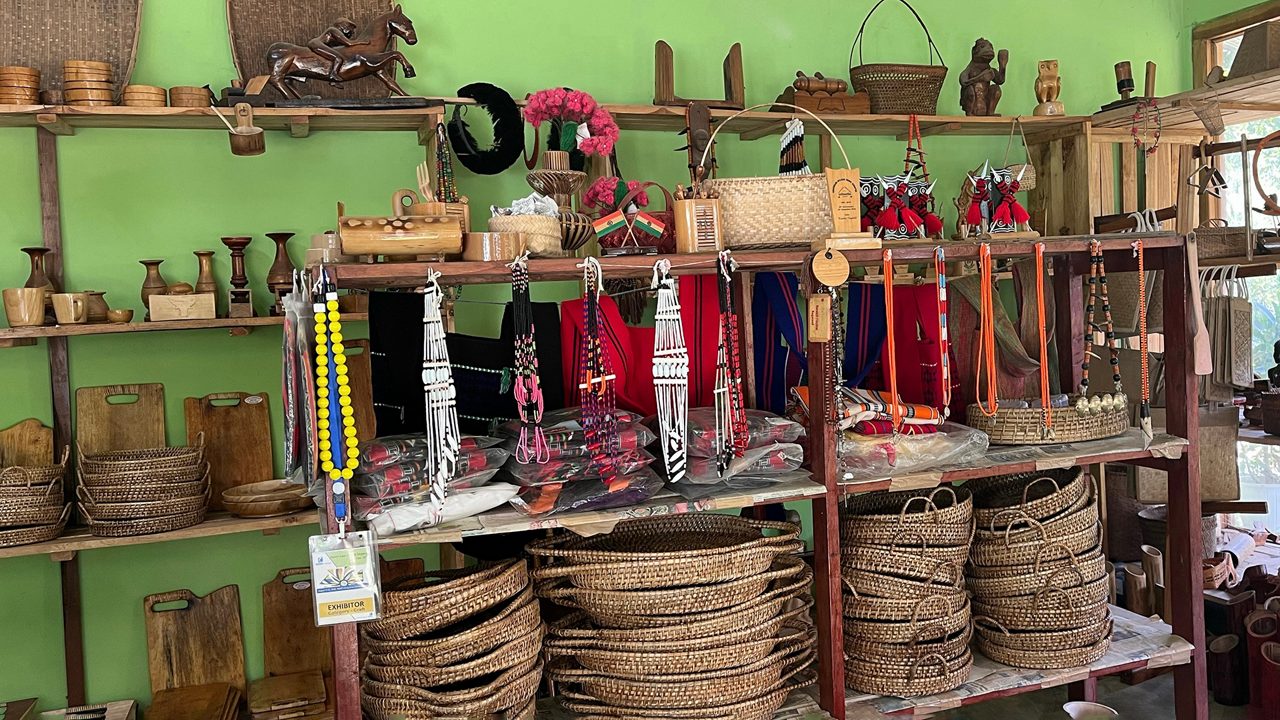
What to buy in Nagaland is a short list, and three of the four protected products on it are food rather than craft. Naga Mircha, the king chilli, was the first thing from the state to get a geographical indication, and the Chakhesang shawl is the only Nagaland craft that holds one. Shawls, chillies, smoked food and cane work are what leave the state in a bag.
Nagaland is a weaving and carving economy rather than a shop economy. Most of what is worth buying is made in a village and sold in Kohima, Dimapur or at a festival stall. During Hornbill the stalls at Kisama put most of it in one place for ten days, which is the easiest week of the year to buy and the most crowded.
Shawls, the king chilli, cane and bamboo work, wood carving, and bead and brass work from the eastern districts. Each belongs to a tribe and a district rather than to the state as a whole.
| What | Where it comes from |
|---|---|
| Chakhesang shawl | Phek district |
| Ao and Angami shawls | Mokokchung and Kohima districts |
| Naga Mircha, the king chilli | Across the state, sold dried and as paste |
| Cane and bamboo baskets | Most districts, widely woven |
| Wood carving | Konyak country in Mon district |
| Bead and brass work | Mon and the eastern districts |
| Naga Tree Tomato and Naga Cucumber | Kohima and Phek districts |
Four. Naga Mircha came first, then the Naga Tree Tomato, then the Chakhesang Shawl, then the Naga Cucumber.
Three of the four are agricultural and the shawl is the only handicraft. That is the reverse of a state like Kashmir, where seven of eight registered products are crafts. It tells you something real about Nagaland, which is that the weaving is held within tribes rather than organised into a registered trade.
A GI means the name is protected, not that every shawl in a shop carries it. Ask which tribe a shawl belongs to and who wove it, and buy from a cooperative or the weaver where you can.
The pattern says which tribe it belongs to, and some shawls say more than that. Nagaland has many tribes and each has its own weave, colours and bands.
Certain shawls are not general-purpose cloth. Some were traditionally earned, through feats or through the giving of feasts, and were worn only by people entitled to them. Others are everyday wear and are made for sale without any difficulty. The distinction matters when buying, because a shop will not always explain it.
The Chakhesang shawl from Phek district is the one with a registration behind it. Its patterns and motifs are what the GI describes, and it is a handloom product rather than a mill one.
Around a million Scoville heat units, which puts it among the hottest chillies grown anywhere. Locally it is called Naga Mircha, raja mircha or king chilli.
It is sold dried whole, as flakes, as a paste and in pickles and chutneys. Dried and sealed is the form that travels, and it is also the form that behaves itself in a suitcase. Handle it with the same respect a cook in Nagaland does, which means washing your hands before touching your face.
Smoked pork with king chilli is the dish it turns up in on a menu. The chilli itself is a better souvenir than the dish, which does not travel.
In Mon district for Konyak work and around Mokokchung for Ao work, or at the Kisama stalls during Hornbill if you are there in December.
Konyak carving, beadwork and brass are made in the villages of Mon in the far north. The district is a long drive, and the work is more often seen at a festival stall than at the source. Mokokchung is the Ao centre and is easier to reach.
One caution worth stating plainly. Do not buy anything made from animal parts, horn, bone, feather or skin. Much of it cannot legally leave India and some of it cannot legally be sold at all. Reproductions in wood and brass are sold openly and are the sensible thing to carry home.
Dried king chilli, bamboo shoot, smoked and dried meat, and the local teas and honey. All of them are sold dried or sealed and all of them survive a flight.
Axone, which is fermented soybean, is the famous one and the one that announces itself in a bag, so seal it twice. What a region preserves and ferments says a good deal about it, which is the subject of our piece on regional food culture across India. Bamboo shoot comes dried or in jars. Dried meat is sold in strips. None of it is delicate. Our guide to getting ready for a trip in India covers what can and cannot be carried or posted home, which matters more here than in most states.
Nagaland is dry by law, so there is no bottle to bring back. That is the one gap on this list and it is a legal one.
Naga shawls, the king chilli, cane and bamboo baskets, wood carving from Mon and bead and brass work from the eastern districts. Dried king chilli, bamboo shoot and smoked meat are the food items that travel. The Hornbill Festival stalls at Kisama put most of it in one place for ten days in December.
Four. Naga Mircha, the Naga Tree Tomato, the Chakhesang Shawl and the Naga Cucumber. Three are agricultural and the shawl is the only handicraft.
Some shawls are everyday wear and are made for sale without any restriction. Others were traditionally earned through feats or feast-giving and were worn only by people entitled to them. Ask which tribe a shawl belongs to and what it is before buying.
Around a million Scoville heat units, which puts it among the hottest chillies grown anywhere. It is sold dried whole, as flakes, as a paste and in pickles. Dried and sealed is the form that travels well.
Anything made from animal parts, including horn, bone, feather and skin. Much of it cannot legally leave India and some of it cannot legally be sold. Wood and brass reproductions are sold openly and are the sensible thing to carry home.