
Let’s help you
plan your journey
Explore responsibly, discover offbeat places, guided by locals, rooted in culture.
Let’s help you
plan your journey
Explore responsibly, discover offbeat places, guided by locals, rooted in culture.
Soumen Bhowmick
Soumen Bhowmick founded Pollen Dots in 2024 to plan journeys across India and Bhutan. He works in the Commercial Department of Indian Railways, where he has been since 2000. From 2016 to 2020 he was Head of Business Development and Partnerships at ScoutMyTrip, a community-driven road trip planning platform. There he built a nationwide network of local Scouts who helped travellers on the road, and grew the Road Trippers Club to 16 Indian cities. As a core member of Devil On Wheels, he helped travellers plan Himalayan trips and started Spreading Smiles. He has driven solo from Arunachal to Goa and from Himachal to Karnataka, and has run his own caravan for more than ten years. His photographs have won national and international salon awards, and his writing has appeared in Outlook Traveller.
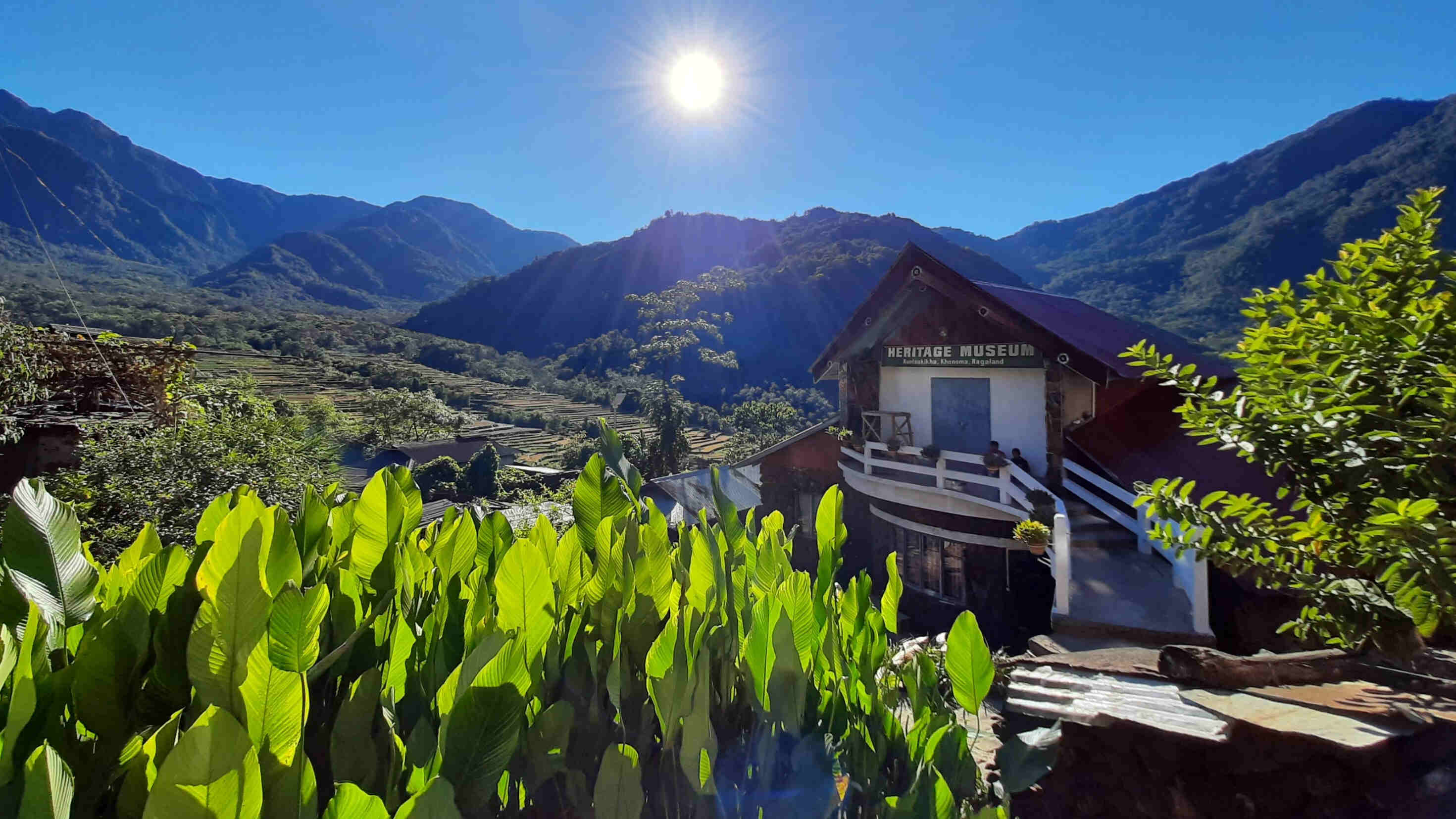
The places to visit in Nagaland take longer to reach than the distances suggest, because the roads follow ridges rather than straight lines. About a million Amur falcons roost beside the Doyang reservoir in Wokha district every autumn, which is the largest gathering of the species recorded anywhere on earth. Kohima, Khonoma, Dzukou Valley, Doyang and Mon carry a first visit, and each is a different kind of day.
Kohima is the base for the south, Mokokchung for the centre, and Mon for the far north. Wokha sits between Kohima and Mokokchung and is the falcon district. Nothing here is a long drive on a map and everything is a long drive in practice, so three or four nights in one place beats a night in each.
Kohima, Khonoma, Dzukou Valley, Kisama, Doyang in Wokha district, Mokokchung, and Mon with Longwa on the Myanmar border.
| Place | District | What it is |
|---|---|---|
| Kohima | Kohima | The capital, and the war cemetery |
| Kisama | Kohima | The Naga Heritage Village, and the Hornbill site |
| Khonoma | Kohima | An Angami village that banned hunting in 1998 |
| Dzukou Valley | Kohima | A high valley trekked from Viswema or Jakhama |
| Doyang reservoir | Wokha | The Amur falcon roost |
| Mokokchung | Mokokchung | The Ao heartland |
| Mon and Longwa | Mon | Konyak country, on the Myanmar border |
Kohima to Mon is a full day of driving. Nobody should plan both ends of the state in a short trip. Where the stops get decided while the drive is happening rather than weeks before it, that is what our road trip planning does, with the night's stay settled around lunchtime each day.
The war cemetery, the state museum, and the Hornbill site at Kisama 12 kilometres out. The cemetery is the reason many visitors come and it earns the visit.
The Battle of Kohima ran from 4 April to 22 June 1944 and it stopped the Japanese advance into India. At one point the two sides were separated by the width of the Deputy Commissioner's tennis court, which is now marked inside the cemetery grounds. The site holds 1,420 Commonwealth graves on terraced ground above the town.
In 2013 the National Army Museum in Britain held a public vote on Britain's greatest battle. Imphal and Kohima, taken together, beat Waterloo and D-Day. That result is checkable and it is still not widely known in India.
Because the village council banned hunting and logging across its forest and has run the ban itself ever since. The decision came in December 1998 and it was taken by the villagers, not by the state.
What prompted it was a count. Around 300 Blyth's tragopans, a pheasant that is the state bird and is on the IUCN vulnerable list, were killed in a single week during a hunting competition. The council responded by demarcating an area where hunting was forbidden and setting up the Khonoma Nature Conservation and Tragopan Sanctuary. The ban was later extended to the community forests around it.
Khonoma is an Angami village about twenty kilometres from Kohima, with terraced rice fields, stone paths and a fort. The walk through it is the point, and local guides take visitors through the terraces and the forest.
From the middle of October to the third week of November. They arrive at the Doyang reservoir in Wokha district, roost for a few weeks, and then leave.
The numbers are the story. Roughly a million Amur falcons use this roost, which ornithologists have recorded as the largest congregation of the species anywhere in the world. From here they fly on across the Arabian Sea to southern Africa, which is one of the longest migrations of any bird of prey.
The second part of the story is harder. In 2012 conservationists documented mass trapping and killing of the birds at Pangti village, and the pictures went around the world. The village stopped the hunting almost entirely within a year, through its own union and awareness work, and it now protects the roost and guides visitors to it. On 6 November 2013 Nagaland was given the title Falcon Capital of the World.
Pangti is in Wokha district and is reached from Wokha town. Go in the window and you see the roost. Go outside it and there is nothing to see, which is the one mistake visitors make here.
A climb rather than a walk, starting from Viswema or Jakhama, both about twenty to twenty five kilometres from Kohima. Allow a full day, or stay overnight in the rest house at the top.
The valley flowers between June and September, which is the monsoon, so the season for the flowers and the season for wet ground are the same one. The rest of the dry year it is cold, open and empty. The valley sits on the Nagaland and Manipur boundary, and both states claim it.
Carry water, food and a torch, and start early enough to get down in daylight. There is no shop and no signal on the way up.
Konyak villages, carved houses, and the border running through Longwa. Mon district is the far north of the state and the drive there is long from any direction.
Longwa is the village the international boundary passes through. The headman's house sits on the line, so part of it is in India and part in Myanmar. The arrangement that let villagers cross freely within sixteen kilometres was scrapped on 8 February 2024, and crossing now needs a biometric border pass within ten kilometres. Anyone planning to go should check the current position with the district administration before setting out.
The Konyak were the last Naga group to give up head-taking, and the tattooed men of that last generation are now very old and very few. They are often photographed and rarely asked. Visit with a local guide, pay for photographs if they are offered, and take the village on its own terms. That approach is the whole of what we mean by responsible travel in India.
If you want the state across several districts rather than one base, that is the kind of route we build on Journeys, Just for You. For the wider region, our guide to ecotourism in India covers community-run conservation of the kind Khonoma and Pangti are known for.
The Hornbill Festival, held from 1 to 10 December at Kisama near Kohima, and the Amur falcon roost at the Doyang reservoir in Wokha district. The Kohima war cemetery and the Konyak villages of Mon district are the other reasons people come.
From the middle of October to the third week of November, at the Doyang reservoir in Wokha district. Around a million birds use the roost, which is the largest recorded congregation of the species anywhere. Outside that window there is nothing to see.
Five to seven for the south, which covers Kohima, Kisama, Khonoma and Dzukou Valley. Mon and Longwa in the far north need two or three days of their own, because the drive is long from everywhere. Trying to fit both ends into a short trip means spending it in a vehicle.
Yes. The village council banned hunting and logging across its forest in December 1998 and has managed the ban itself since, after 300 Blyth's tragopans were killed in one week. It is about twenty kilometres from Kohima and the walk through its terraces and stone paths is the visit.