
Let’s help you
plan your journey
Explore responsibly, discover offbeat places, guided by locals, rooted in culture.
Let’s help you
plan your journey
Explore responsibly, discover offbeat places, guided by locals, rooted in culture.
Soumen Bhowmick
Soumen Bhowmick founded Pollen Dots in 2024 to plan journeys across India and Bhutan. He works in the Commercial Department of Indian Railways, where he has been since 2000. From 2016 to 2020 he was Head of Business Development and Partnerships at ScoutMyTrip, a community-driven road trip planning platform. There he built a nationwide network of local Scouts who helped travellers on the road, and grew the Road Trippers Club to 16 Indian cities. As a core member of Devil On Wheels, he helped travellers plan Himalayan trips and started Spreading Smiles. He has driven solo from Arunachal to Goa and from Himachal to Karnataka, and has run his own caravan for more than ten years. His photographs have won national and international salon awards, and his writing has appeared in Outlook Traveller.
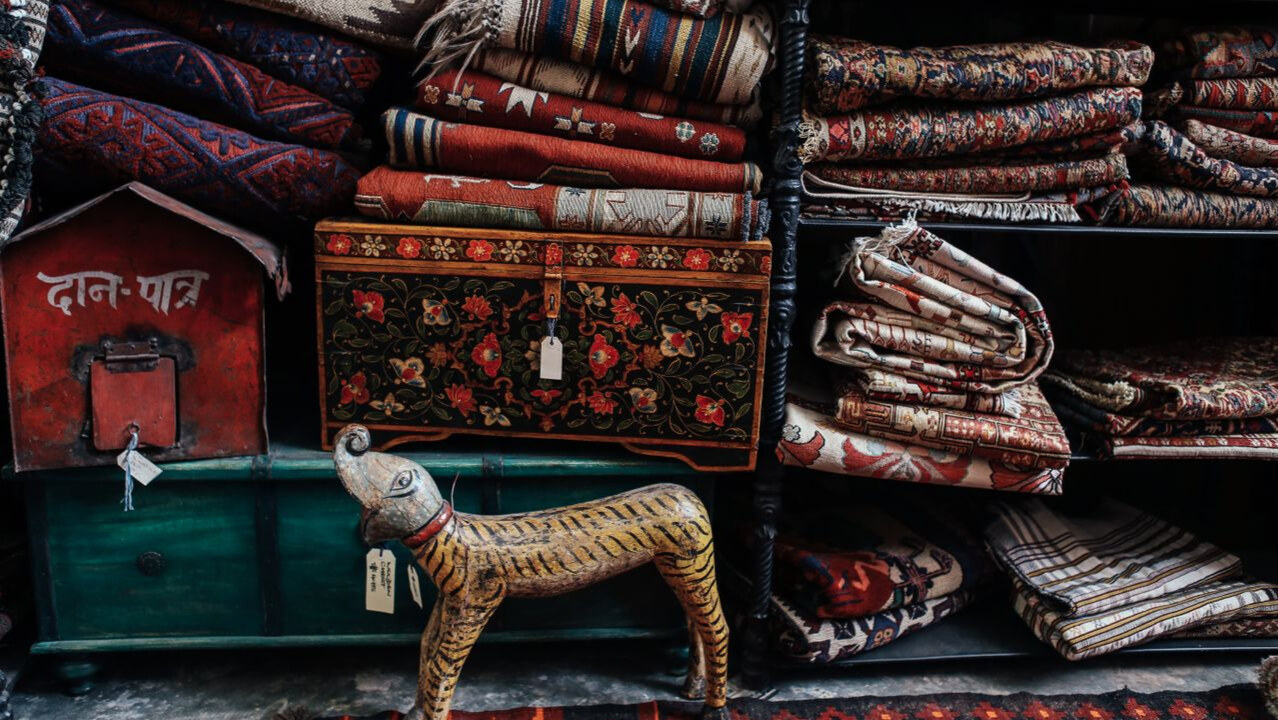
Anybody working out what to buy in Gujarat is choosing from twenty-one protected crafts, and most shops never say which ones. Patola is two different cloths from two different towns, and the tie and dye called bandhani in Kutch is called bandhej across the border in Rajasthan. Ask for the town, because the town is what the protection is tied to.
A Geographical Indication is a legal record that ties a product to a place and a method. It is a public record, and it is the only way to check a claim in a shop without taking the seller's word. Gujarat's twenty-nine entries break down as twenty-one handicrafts, four agricultural products, one natural and one manufactured. The wider preparation guide for travelling in India deals with the rest of what to settle before you go.
Twenty-one handicrafts, spread across cloth, metal, stone and paint. These are the protected names, and a craft not on the list is not protected.
They are two separate protected names for two different cloths. Patan Patola comes from Patan in north Gujarat and Rajkot Patola from Rajkot in Saurashtra.
Two towns hold two registrations, and the word patola alone does not tell you which one you are being sold. A seller who says patola without naming the town is leaving out the part that decides the price.
Ask for the town. If the answer is vague, the cloth is probably neither.
Both, and the register settles it with three separate entries under two different names.
Same family of tie and dye, two vocabularies, three protected names. In Gujarat it is bandhani and in Rajasthan it is bandhej, and the two words describe work that is close kin. The Rajasthan craft guide covers the Jodhpur side of that pair.
A resist-printed cotton from Kutch, protected under the name Kutch Ajrakh. It is one of the oldest crafts in the state and one of the most copied.
The registration matters more here than usual, because ajrakh is widely reproduced in screen print. The protected name attaches to Kutch and to the method, so a screen-printed imitation cannot carry it legally, whatever the label says.
Hand-printed ajrakh is dyed and washed many times over. A piece that came off a screen in an afternoon is a different product sold under a borrowed name.
Each protected name carries its own place, so the register doubles as a map. Kutch holds four of the twenty-one on its own.
No single market holds all of them. A craft trip in Gujarat is a road trip.
An ajrakh or a bandhani length from Kutch. One district holds four of the twenty-one protected crafts, the cloth folds flat into a bag, and you can watch it being printed or tied before you buy it.
If you want something other than Kutch cloth, these are the named options and the town each belongs to.
Ask for the town in every case, because the town is the word the protection is attached to. Our eleven day journey from Kutch to central Gujarat runs from the Kutch craft villages through to Sankheda country, which puts several of these on one road rather than four separate trips. Journeys Just for You builds the same route around your own dates.
Twenty-nine registered entries in all. Twenty-one are handicrafts, four are agricultural, one is a natural product and one is manufactured. No other state in western India has more protected crafts.
Gir Kesar mango and Kachchhi Kharek, which is the Kutch date. Bhalia wheat and Amalsad chikoo make up the other two agricultural entries. Ambaji white marble and Surat cut diamonds are registered under separate classes.
Yes. The protected name is Kutch Embroidery and it names Kutch specifically. Embroidery sold elsewhere in Gujarat is not covered by it, which is why the village matters more than the shop.
Yes, as Kutch Rogan Craft. It is a painted craft rather than a woven or printed one, and it is registered to Kutch in the same way the embroidery and the bandhani are. Ask whether the piece is protected, because the name alone is not protection.
Because it is checkable. A registration ties a name to a place and a method, and it sits in a public register you can look up afterwards. Without one, a craft name is a description that anybody can print on a label.