
Let’s help you
plan your journey
Explore responsibly, discover offbeat places, guided by locals, rooted in culture.
Let’s help you
plan your journey
Explore responsibly, discover offbeat places, guided by locals, rooted in culture.
Soumen Bhowmick
Soumen Bhowmick founded Pollen Dots in 2024 to plan journeys across India and Bhutan. He works in the Commercial Department of Indian Railways, where he has been since 2000. From 2016 to 2020 he was Head of Business Development and Partnerships at ScoutMyTrip, a community-driven road trip planning platform. There he built a nationwide network of local Scouts who helped travellers on the road, and grew the Road Trippers Club to 16 Indian cities. As a core member of Devil On Wheels, he helped travellers plan Himalayan trips and started Spreading Smiles. He has driven solo from Arunachal to Goa and from Himachal to Karnataka, and has run his own caravan for more than ten years. His photographs have won national and international salon awards, and his writing has appeared in Outlook Traveller.
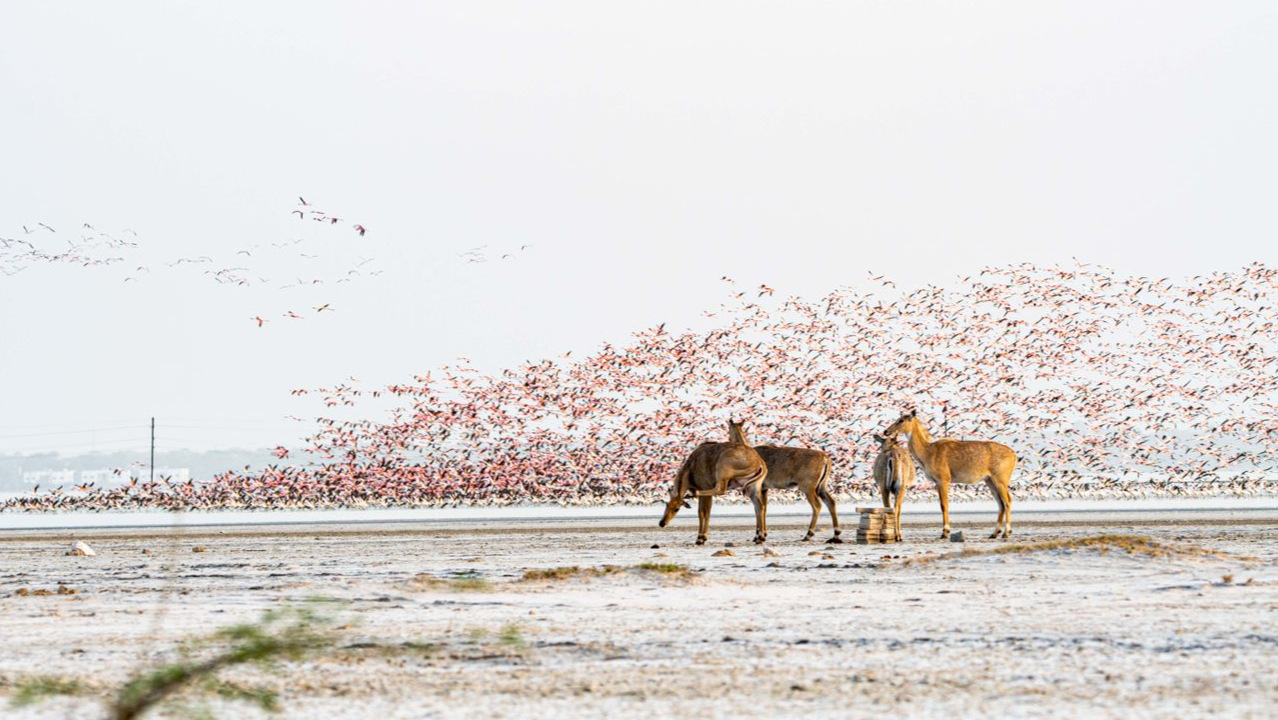
Most lists of places to visit in Gujarat call Gir the last home of the Asiatic lion, and the state's own count says otherwise. The 2025 census found 507 of Gujarat's 891 lions outside Gir National Park and Wildlife Sanctuary, against 384 inside it. Four UNESCO sites, the temples at Somnath and Dwarka, the world's tallest statue and a salt desert that floods every monsoon sit in districts that do not join up.
Gujarat does not arrange itself into a loop. Kutch is in the far northwest, Gir and the coastal temples are down in Saurashtra, and the heritage sites sit in four separate districts between them. The preparation guide for travelling in India lists the permits and bookings that decide which of these you can actually reach in one trip.
Four, and each one is in a different district, which is why they are hard to combine.
Ahmedabad was the first Indian city to be listed as a World Heritage City, which is a different kind of listing from a monument or a park. Dholavira was India's fortieth World Heritage Site.
Somnath and Dwarka first, then Modhera and Palitana if the route allows. Somnath stands on the Saurashtra coast at Prabhas Patan and is counted first among the twelve Jyotirlingas, and the present temple was finished in May 1951 after centuries of destruction and rebuilding.
The thing to find at Somnath is the Baan Stambh, the arrow pillar on the sea-facing side. Its Sanskrit inscription says there is no land in a straight line from that point south to the South Pole. The geography holds. The nearest land in that direction is Antarctica, about ten thousand kilometres away.
Lions in Gir National Park and Wildlife Sanctuary, on a permit booked online, and the wild ass in the Little Rann. Both animals have ranges that sit almost entirely inside Gujarat, and both counts moved in the last two years.
The lion count makes the standard line wrong. The 2025 census put 384 inside the protected area and 507 outside it, across eleven districts and fifty-eight talukas. Gir is where you can legally and reliably see one, because the park runs permitted safaris. It is no longer where most of them live.
The wild ass survives only in the Little Rann and on two islands in the Great Rann. The 2024 count found 7,672, up from 6,082 four years earlier. Surendranagar holds 2,705 of them against Kutch's 1,993, so the district with the most is not the one the animal is named after.
The spread of the lions also raises a harder question about who carries the cost of a recovering population, which is the subject of ecotourism in India and whether local communities benefit.
The white salt flat at Dhordo, the long view from Kala Dungar, and Dholavira out on Khadir island. The Rann covers about 26,000 square kilometres and it was once a shallow arm of the Arabian Sea.
It is not white all year. The sea floods it through the monsoon and the water recedes around October, so the crust hardens in the dry months and the white desert is a season rather than a fixed feature.
Dholavira is the reason to drive further in. It is a Harappan city on a hundred hectares of semi-arid land, built around what Gujarat Tourism calls one of the earliest water conservation systems ever excavated. Ten large stone inscriptions in Indus script were found there, described as perhaps the world's earliest signboard, and nobody has deciphered them.
Bhuj is the base for all of it, and the craft villages north of the town sit on the same roads.
Yes, if you are anywhere near Vadodara. Guinness World Records lists it as the tallest statue in the world at 182 metres. It stands on Sadhu Bet, a river island in the Narmada facing the Sardar Sarovar dam, about a hundred kilometres from the city.
The 182 metres is not an engineering figure. It was chosen to match the 182 seats in the Gujarat Legislative Assembly. The viewing gallery sits at 153 metres.
It opened on 31 October 2018, which was Sardar Patel's birth anniversary, and tickets are booked online.
Three, and each one works differently.
Kala Dungar is in the same border belt and your ID is checked at the Khavda post, and anything beyond it towards India Bridge needs separate permission from the BSF. None of these can be fixed on the morning. Our twelve day Glorious Gujarat journey is built around the permits and the distances, which decide how many of these places fit together. Journeys Just for You does the same to your own dates.
Ahmedabad, inscribed as the Historic City of Ahmadabad in 2017. It is a city listing rather than a single monument, so it covers the old walled city as a whole. Gujarat's other three listings are Champaner-Pavagadh in 2004, Rani-ki-Vav in 2014 and Dholavira in 2021.
It counted 891 Asiatic lions in Gujarat, up from 674 five years earlier. Of those, 384 were inside Gir National Park and Wildlife Sanctuary and 507 were outside it, across 11 districts and 58 talukas. The count ran from 10 to 13 May 2025 using direct beat verification with about 3,000 people.
Saputara, in Dang district in the south of the state, on a plateau in the Western Ghats at about a thousand metres. Gujarat Tourism's own page calls it the only hill station in Gujarat. The Maharashtra border is about four kilometres away.
Surendranagar, with 2,705 of the 7,672 counted in 2024. Kutch had 1,993 and Patan 1,615. The species survives only in the Little Rann of Kutch and on Khadir and Tragadi islands in the Great Rann. Its entire range sits inside Gujarat.