
Let’s help you
plan your journey
Explore responsibly, discover offbeat places, guided by locals, rooted in culture.
Let’s help you
plan your journey
Explore responsibly, discover offbeat places, guided by locals, rooted in culture.
Soumen Bhowmick
Soumen Bhowmick founded Pollen Dots in 2024 to plan journeys across India and Bhutan. He works in the Commercial Department of Indian Railways, where he has been since 2000. From 2016 to 2020 he was Head of Business Development and Partnerships at ScoutMyTrip, a community-driven road trip planning platform. There he built a nationwide network of local Scouts who helped travellers on the road, and grew the Road Trippers Club to 16 Indian cities. As a core member of Devil On Wheels, he helped travellers plan Himalayan trips and started Spreading Smiles. He has driven solo from Arunachal to Goa and from Himachal to Karnataka, and has run his own caravan for more than ten years. His photographs have won national and international salon awards, and his writing has appeared in Outlook Traveller.
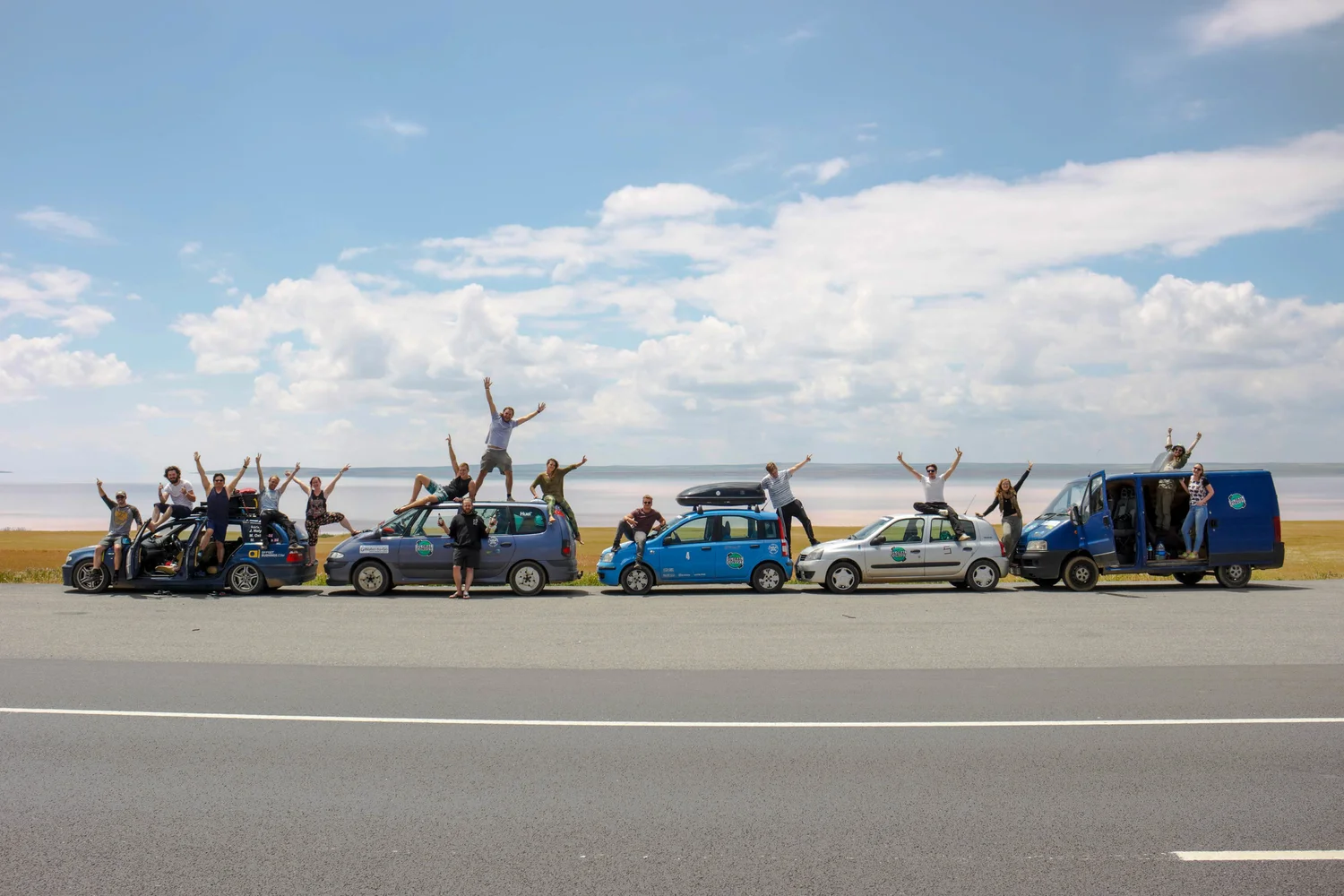
A road trip marketing strategy is pitched to Indian brands as an experiential idea, and most marketing heads cannot tell whether it is a real format or an agency invention. Indian television held 745 million weekly viewers in 2025 while its advertising revenue fell more than ten per cent, a loss of advertiser confidence rather than reach. What a journey sells is a situation the brand did not script, which is the opposite of what product seeding buys.
I have been running these journeys for Indian brands since 2015, and the question I am asked most often is where the format came from. It did not arrive from experiential marketing, and it was not invented by an agency looking for a new line item. It came out of a specific problem that appeared once influencer marketing had solved reach and had not solved anything else. Following the money explains the format better than any case study does.
Because the audience stayed where it was and the proof moved. That is a different sentence from the one the industry usually writes, and the numbers support it.
The FICCI and EY India media report published on 24 March 2026 covers calendar 2025. It shows digital media overtaking television as the single largest segment in Indian media and entertainment, crossing one trillion rupees for the first time. Digital advertising grew 26 per cent to 947 billion rupees and took roughly 63 per cent of all advertising revenue. Linear television advertising revenue fell by more than ten per cent in the same year, and the number of advertisers using the platform fell three per cent.
Now put the audience figure beside it. The same report records 745 million weekly television viewers in India. Reach did not collapse. Advertisers did not leave because nobody was watching. They left a channel where they could no longer show anyone what a rupee had done, and the money went to formats that report back.
The slope matters more than any single year. FICCI-EY for 2024 put digital at 55 per cent of total advertising spend. One year later it is 63 per cent. In 2023 the same annual report had television advertising declining 6.5 per cent, and by 2025 the decline had passed ten per cent.
Madison's 2026 advertising report puts total Indian advertising growth lower, at seven to twelve per cent for 2025 against FICCI-EY's thirteen. The gap does not change the shape of the year. Both have television losing money it used to earn.
No. It is being repriced and re-scoped, and the measured figures say so clearly.
TAM Media Research found celebrities in 29 per cent of all Indian television advertisements in the first half of 2025, with Bollywood accounting for 74 per cent of those appearances. Nearly a third of everything on Indian television in that period was still being sold by a famous face.
Agency Reporter, in August 2026, put celebrity influencer campaigns at roughly 4.1 times the reach and 67 per cent higher brand recall than micro creators. Where reach and recall are the objective rather than a byproduct, the fee is still being earned.
Surveys do find a trust gap, with roughly 61 per cent of consumers trusting influencer recommendations against 38 per cent for traditional celebrities. Trust and reach are different purchases, and a brand booking a film star is usually buying the second one. Indian Television made the point in July 2026. The industry has announced the death of celebrity endorsement at every platform shift, and the budgets have never followed the announcement.
Reach at speed, recall at scale, and increasingly a share of a business rather than a face on a poster. The instrument did not disappear. Its job description narrowed.
The structural change in India is ownership. Kohli, Bhatt, Kaif and others now run their own labels. That creates a conflict a brand has to negotiate around, and it changes the economics of a deal that used to be a straightforward fee for likeness. In luxury, The Hollywood Reporter India documented in June 2026 a shift toward flexible friends-of-the-house arrangements and campaign-specific ambassadors instead of multi-year contracts.
The other half of the same change is distribution. Unilever has publicly described moving from roughly 10,000 named advocates to close to 300,000 across its markets. The unit of endorsement went from one famous person to a network, which is a change in architecture rather than in taste.
BCG's 2025 study of India's creator economy counts two to 2.5 million monetised creators influencing 350 to 400 billion US dollars of annual consumer spending, projected past a trillion by 2030. The same study finds only eight to ten per cent of creators monetise effectively and 90 per cent of creator revenue is still brand-funded. Seventy per cent of brands expect to increase creator budgets by 1.5 to three times over the next two to three years.
What this leaves a brand with is a bigger cast and a smaller guarantee. One signing used to deliver a known quantity of attention on a known date. A roster of creators delivers more attention in total and far less control over what any single piece of it says.
Because the input converged before the output did. A hundred creators who received the same product and the same brief produce a hundred versions of the same post, and the brief was the only thing any of them was given.
Kadence reported in May 2026 that in crowded creator ecosystems consumers recall the creator, the format or the trend while forgetting which brand paid for it. Competing brands blur together because creators rotate through overlapping sponsorships using near-identical language, most visibly in beauty, wellness and supplements. Meltwater puts consumer fatigue with repetitive influencer content at 47 per cent.
The infrastructure made it worse rather than better. Influencer Marketing Hub counts 6,939 specialist influencer agencies and platforms globally, a 36-fold rise since 2015. Tooling that scales creator campaigns also standardises them, because standardisation is what makes them scalable. GRIN reported in March 2026 that mid-tier creators now receive dozens of paid partnership pitches every week, so creators became selective and audiences developed what GRIN calls a finely tuned ad radar.
Then there is what the content itself is made of. New Engen found in August 2026 that more than 40 per cent of long-form LinkedIn posts and about a third of comparable X posts appear to be fully generated by AI. Marketing Week reported in December 2025 that brand strategists were deliberately moving to lower-production, visibly human content to get away from the sameness.
Better briefs do not fix this, and the reason is worth being precise about. What people produce is shaped by the situation they were placed in, not by the instruction they were handed. That is the argument I set out in the piece on shared journeys under the Journey Environment Principle. Identical inputs produce identical outputs. Different situations do not.
Seeding buys the chance that somebody will talk about the product. A road trip marketing strategy buys the certainty that something happened, and hands the account of it to people who were present.
Product seeding is a real and growing practice, and the comparison is fair rather than convenient. Aspire reports seeding at 31 per cent of influencer campaigns on its platform in 2025, up from 20 per cent. The economics are genuinely good. Elev8or, in June 2026, models a 50 dollar retail gift at 25 to 30 dollars all-in once cost of goods, packaging, fulfilment and shipping are counted. A single Instagram Reel from the same tier of creator runs roughly 300 to 800 dollars.
What seeding cannot do is stated plainly in the industry's own guides. It cannot guarantee posts, control messaging, or reach large audiences reliably. Post rates are quoted at 20 to 40 per cent by GRIN, 30 to 80 per cent by Elev8or and 62 per cent by Ainfluencer in mature programmes that add affiliate incentives. The ranges disagree, but none of them claims anything close to everyone.
Sit with the non-posting rate for a moment, because it is the number that reframes everything. A brand seeding 100 creators plans around 30 of them never posting at all. There is no obligation to post, by regulatory design. That is a designed-in loss the category has stopped questioning, and once it is written down the arithmetic of a twenty-person journey looks different from how it looks at first glance.
The two instruments are not competing for the same job. Seeding pushes cost per unit of content down near the cost of goods and wins on the distribution of outcomes across a large group. Nothing about it is designed, because the creator supplies the setting, the framing and the reason. A journey inverts every one of those. Cost per participant is far higher and nothing is probabilistic, because everyone who travelled for four days has material whether or not anyone asked them for it. What the brand supplies is not a product and not a fee. It is a situation that does not otherwise exist and that the participant could not have created alone, which is also why the coverage keeps generating years later.
Both, and the ratio is the actual decision. Journalists produce the piece that is still being found in search two years later, and creators produce the volume that happens while the journey is happening.
The Reuters Institute Digital News Report 2026 was published on 16 June 2026, from nearly 100,000 respondents across 48 countries. It records trust in news at 37 per cent globally, the lowest since the series began, with India at 39 per cent, down four points. For the first time, social and video networks are the most widely used source of news worldwide at 54 per cent, ahead of news organisations' own sites and apps at 51 per cent.
The finding that changes the invitation list is a different one. Twenty-seven per cent of respondents get some news from news-focused creators and 46 per cent from creators of any type, but only three per cent rely on creators alone. People who get news from creators consume more traditional media than the average respondent, not less. The two audiences overlap. Choosing creators over journalists is not choosing a younger audience, it is choosing a different artefact with a different decay curve.
I can show the change on one line, because I have been on three points of it. In July 2017 we took twenty bloggers to Khardung La at 17,582 feet and held a meet at the top, which produced two India Book of Records entries. The word creator was not in use. There were no rate cards, no GST registrations and no agency intermediaries, and coverage on those bloggers' own sites is still live nine years later. In June 2019, on season nine of a manufacturer drive, we moved 26 press cars inside a fleet of 42, filled with journalists working to print deadlines under embargo. Today a group of the same size is mixed, and a meaningful share of the people in it are registered businesses. The creator platform Kofluence puts 15.2 per cent of Indian creators registered as a business entity or GST individual. Nine years ago that figure would have been close to nothing.
A journey built only of creators has no durable artefact. One built only of journalists has no live presence while it is happening. The mix is the design decision and almost nobody publishes how they make it.
Partly, and not for the reason most communications teams assume. There is no published measurement of embargo behaviour in a mixed journalist and creator group anywhere, and I have looked repeatedly.
What the public record holds is practitioner guidance. Airfoil Group advises at least a week of lead time, and roughly a month for a major trade show. Breaking an embargo is treated as a serious breach and the standard sanction is exclusion from future advance access. Read that sanction carefully, because it assumes an ongoing institutional relationship, which is exactly what a brand does not have with a creator invited once. Standard breach protocol is to release to everybody the moment a story starts spreading, which on a four-day journey means the embargo can end on the morning of day one.
Some practitioners have stopped using them. The public relations platform pr.co quotes a communications lead who now insists clients send no embargoes at all, because coverage is usually better without one. The same piece describes a manufacturer using embargoes only for time-sensitive product launches, and offering exclusivity instead for features.
The workable answer is not enforcement. On a drive, decide in advance what is embargoed and what is not, and in practice that means separating the product claim from the journey. Specifications, pricing and performance figures hold until the date. The road, the places, the people met along the way and the experience of being there are released from the first hour. The people posting them have no reason to stay silent, and silence costs them something. An embargo written for people who file does not describe a group that publishes continuously.
Route knowledge that cannot be acquired from a desk, and the judgement to make five or six decisions correctly before anyone gets in a vehicle. The rest is execution and can be bought.
The Indian numbers now support the format from the demand side. EY-Parthenon, with BookMyShow, surveyed 7,450 live event attendees for a report published on 12 March 2026. Fifty-nine per cent recall the brands they engaged with on the ground and 55 per cent report higher purchase intent afterwards. Sixty-three per cent said brand activation improved the experience rather than intruding on it. Among brands that increased experiential spend over three years, 44 per cent reported revenue growth of up to 30 per cent. More than ten lakh people travelled for live events over two years, from nearly 1,200 cities, which makes this a national behaviour rather than a metro one.
Live events were the fastest-growing part of Indian media and entertainment in 2025, up 44 per cent to 145 billion rupees on the FICCI-EY count. Budgets that used to buy airtime are buying rooms and roads.
The clearest statement of what brands now want from a live experience comes from an American survey. Event Marketer's EventTrack 2026 covers more than a thousand Fortune 1000 marketers. It found 64 per cent of consumer marketers ranking media coverage and public relations as their number one objective for events, ahead of brand awareness for the first time. Among business-to-business marketers the same objective rose from 25 to 53 per cent. The point of the event is now the coverage. A road journey produces that across days and geography instead of in one room on one evening.
What the work actually requires is short and unglamorous. Knowledge of what exists along a route that has never been documented. Route feasibility judgement, meaning seasons, surfaces and the distance between one workable stop and the next. Relationships with both journalists and creators, and a view on the ratio. Convoy operation at a scale where the support fleet is larger than the press fleet. And the judgement to decide what is embargoed and what is not. The recce, the medical cover, the fleet composition and what drives the cost are all set out in the piece on how a car launch media drive is planned.
Communication and supply, in that proportion. Almost nothing that has gone badly wrong on a drive I have run was a driving problem.
The first failure is a brief that goes to a team rather than to a named person. On Majuli, on that same manufacturer drive, the accommodation situation was communicated to a group rather than to one individual who owned it. The word basic meant something different to everyone who heard it, and by the time the convoy arrived it very nearly became a serious argument. One person has to hold each fact and be answerable for it.
The second is the thing you cannot buy locally. In Guwahati there was no ice available anywhere in the city that day. We borrowed it from dhabas and small restaurants nearby and there was never enough of it. A route is only as good as what it can resupply, and that is a question to ask at the recce rather than on the morning.
The third is the split between what journalists value and what the client team values. On Majuli the journalists wrote warmly about heritage rooms with no air conditioning and no refrigeration. The client team was not pleased with the same rooms. Both reactions were entirely rational, and a campaign has to be designed knowing they will diverge, because the coverage and the client debrief are two different products.
The fourth is the embargo collapsing on day one, which is covered above and is now the normal case rather than the exception.
None of these is a reason not to run a journey. They are the reasons the format sits with whoever has done it before. Brands hold the reason to care and the product knowledge, and neither of those can be outsourced. Road knowledge accumulates only in organisations that spend their years on those roads, and every capability in the previous section sits on that side of the line. What a journey has to be about in the first place is a separate question with its own tests.
A road trip marketing strategy is a campaign built around a multi-day journey with journalists, creators or both travelling together. The coverage is produced by the participants rather than bought from a publisher. The brand supplies the situation and the access, not the script. It differs from an event because it produces a separate story in every place it stops.
Seeding sends the product to the person and accepts that many recipients will never post. A journey sends the person to the place, and everyone who travelled has material whether or not they were asked for any. Seeding buys probability at volume. A journey buys certainty from a much smaller group.
Reported post rates vary widely by source. GRIN puts them at 20 to 40 per cent across rounds, Elev8or at 30 to 80 per cent, and Ainfluencer at 62 per cent in mature programmes that add affiliate incentives. Non-posting rates of 10 to 40 per cent are normal, because there is no obligation to post by regulatory design.
Estimates run from roughly 3,000 to 3,600 crore rupees for 2025, depending on who is counting and what they count as a creator. The widely quoted 3,375 crore figure is a 2026 projection from an April 2024 report by EY and Collective Artists Network's Big Bang Social, not a measured result. It is smaller than one week of Indian digital advertising, which is worth holding in mind before treating it as the main event.
No. TAM Media Research found celebrities in 29 per cent of all Indian television advertisements in the first half of 2025, with Bollywood at 74 per cent of those appearances. What has changed is the scope of the deal, with Indian celebrities increasingly taking equity or running their own labels rather than appearing as a paid face.
Because a hundred creators who receive the same product and the same brief produce a hundred versions of the same post. Kadence reported in May 2026 that consumers in crowded creator ecosystems recall the creator or the format while forgetting which brand paid. The convergence comes from identical inputs, and a better brief does not change the input.
Both, and the ratio is the decision worth spending time on. Journalists produce the durable artefact that is still being found in search two years later. Creators produce the live volume during the journey itself. The Reuters Institute found in 2026 that only three per cent of people rely on creators alone for news, so the two audiences overlap heavily.
Partly. The standard sanction for breaking an embargo is loss of future advance access, which only works on someone in an ongoing institutional relationship with the brand. A creator invited once has no such relationship. The practical approach is to embargo the product claim and release the journey itself from the first hour.
Airfoil Group advises at least a week of lead time for an embargoed pitch, and around a month for a major trade show. Guidance of two weeks or more is also common, though it assumes the recipient is writing rather than posting. On a multi-day drive the more useful decision is what is embargoed rather than how long.
The answer depends entirely on the definition. BCG counted two to 2.5 million monetised creators in 2025, meaning those with more than a thousand followers who earn from it. The creator platform Kofluence counts 4.0 to 4.4 million active professional creators. Figures above 100 million count anyone who has ever posted content.
Fleet size and composition, the number of days, the ratio of support vehicles to press vehicles, medical and recovery cover, and how remote the route is from resupply. The number of participants matters less than where they are going. A short route through difficult terrain can cost more than a longer one on highways.
Long enough for something to happen in more than one place, which in practice usually means three to five days on the road. Anything shorter behaves like an event with driving attached. Anything much longer starts losing participants to their own deadlines and commitments.
A campaign is bought, scheduled and switched off when the budget ends. A journey produces material that lives on the personal channels of everyone who travelled, which the brand does not control and cannot take down. That is why coverage from a journey is still being found years after the spending stopped.
Honda and Drive to Discover are trademarks of their respective owners, referenced solely as a portfolio example. OYO Rooms is a trademark of its respective owner, referenced on the same basis. All of this work was executed under ScoutMyTrip, a previous venture led by members of what is now the Pollen Dots leadership team.