
Let’s help you
plan your journey
Explore responsibly, discover offbeat places, guided by locals, rooted in culture.
Let’s help you
plan your journey
Explore responsibly, discover offbeat places, guided by locals, rooted in culture.
Soumen Bhowmick
Soumen Bhowmick founded Pollen Dots in 2024 to plan journeys across India and Bhutan. He works in the Commercial Department of Indian Railways, where he has been since 2000. From 2016 to 2020 he was Head of Business Development and Partnerships at ScoutMyTrip, a community-driven road trip planning platform. There he built a nationwide network of local Scouts who helped travellers on the road, and grew the Road Trippers Club to 16 Indian cities. As a core member of Devil On Wheels, he helped travellers plan Himalayan trips and started Spreading Smiles. He has driven solo from Arunachal to Goa and from Himachal to Karnataka, and has run his own caravan for more than ten years. His photographs have won national and international salon awards, and his writing has appeared in Outlook Traveller.
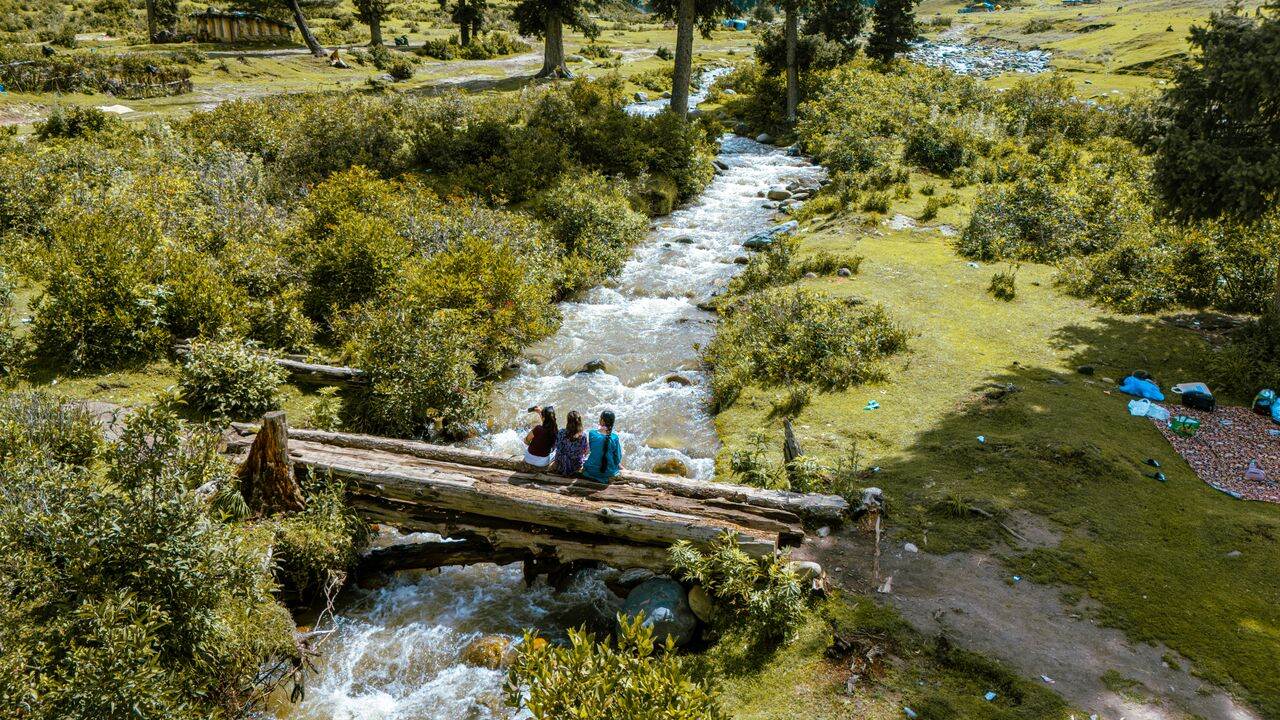
A trip to Kashmir turns on dates, because the roads into the high valleys close with the first heavy snow. The Kashmir winter has a name and a fixed start, Chillai Kalan, the forty hardest days, which begins every year on 21 December. Srinagar, Gulmarg and Pahalgam stay open all year, the passes do not, and the difference decides what a winter trip can include.
The Kashmir Valley is a floor of flat land about a hundred and forty kilometres long, with mountains on every side. Srinagar sits in the middle of it at about 1,585 metres. Gulmarg, Pahalgam and Sonamarg sit higher, on three different sides. The passes out of the valley sit higher again, and they are the first thing to go when it snows.
The snow and the Tulip Garden. Those two set the shape of the year, and everything else fits around them.
Winter runs from December to February, and the forty coldest days start on 21 December. Spring opens with the tulips in the second half of March. Summer, from May to August, is when the high meadows and the trek routes are open. Autumn, in October and November, brings the chinar colour and the saffron harvest.
One date to know about is 31 October 2019. Jammu and Kashmir and Ladakh became two separate union territories that day, and they are written separately here. Leh, Kargil, Zanskar and the monasteries belong to Ladakh, not to this valley.
It is the forty coldest days of the Kashmir winter and it begins on 21 December, the winter solstice. The name is Persian and the date does not move from year to year.
Chillai Kalan is followed by Chillai Khurd, which runs twenty days, and then Chillai Bachha, which runs ten. Those three carry the valley to the end of February. Water freezes in pipes, Dal Lake can ice at the edges, and the chance of heavy snow is at its highest.
It is a cold phase and not a promise of snow. Dry Chillai Kalans happen, and local people talk about those years with worry rather than relief. On the first night of it in 2024, Srinagar fell to minus 8.5 degrees. That was the city's coldest December night since 1974 and the third coldest since records began in 1891.
In the second half of March, for about three to four weeks. The Indira Gandhi Memorial Tulip Garden opened on 16 March in 2026 and is shut for the rest of the year.
The garden runs about 55 hectares on the Zabarwan foothills above Dal Lake. It was built in 2007 to give the valley a spring season, between the winter and summer ones it already had. The 2026 show carried about 18 lakh tulips of more than seventy varieties, with daffodils, hyacinths and narcissus planted alongside.
It works. In 2025 the garden drew 855,125 visitors, which broke every record it had.
The Mughal Road and the Srinagar to Leh highway over Zojila. Both shut with snow, often at a few hours' notice, and both reopen when the Border Roads Organisation has cleared them.
Both closed on 12 November 2026, after the first significant snow of the season. Razdan Pass, on the Gurez road, took about six inches that day, and Sonamarg had its first snowfall. The Mughal Road was cleared and reopened on 13 November. Zojila stayed shut, which is normal from November onward, and that road is the way to Ladakh.
| Road | Links | Winter status |
|---|---|---|
| Jammu to Srinagar, NH 44 | Jammu with the Valley | Open in most weather, closed by landslide or heavy snow |
| Mughal Road | Shopian with Poonch over Pir Ki Gali | Closes with snow, cleared and reopened |
| Srinagar to Leh over Zojila | Valley with Ladakh | Shut through winter |
| Bandipora to Gurez over Razdan | Valley with Gurez | Closes with snow, cut off for long spells |
Check road status with the Traffic Control Unit on the day, not the week before.
Indian nationals do not. Srinagar, Gulmarg, Pahalgam, Sonamarg and the rest of the valley need no permit of any kind.
What the valley asks for instead is identity. Carry original photo identity, an Aadhaar card, passport or driving licence, and carry photocopies, because army and police posts on the border roads keep a copy. The Gurez road is where this matters most, with several posts between Bandipora and Dawar. Photographing a checkpost, a bridge or any military position is not allowed anywhere in the union territory.
Foreign nationals are treated differently on the border roads, and the rules there have changed in recent years. The district administration decides them, so the position is confirmed with the district office before those routes are booked. Our guide to getting ready for a trip in India covers the documents that apply everywhere in the country.
Srinagar has the only airport in the valley. Since June 2025 the valley also has a direct rail link to the Jammu side, which it did not have before.
The Katra to Srinagar Vande Bharat began commercial running on 7 June 2025, the day after the Chenab Rail Bridge opened to traffic. The bridge stands 359 metres above the river and is the highest railway bridge in the world. The line it sits on, the Udhampur to Srinagar to Baramulla link, runs 272 kilometres with 36 tunnels and 943 bridges. Two pairs of trains run six days a week with a halt at Banihal, and the run takes three to four hours.
Inside the valley the railway runs from Banihal through Anantnag, Srinagar and Budgam to Baramulla, and that section has been open since 2013. If dates fall inside a pass closure, the trip can be rebuilt on the valley floor and the Jammu side instead. We make that sort of change on Journeys, Just for You.
March to April for the tulips and the blossom, May to August for the high meadows and treks, and October to November for the chinar colour and the saffron harvest. December to February is the snow season, when Gulmarg is at its busiest. Each of those is a different trip rather than a better one.
No. Indian nationals need no permit for Srinagar, Gulmarg, Pahalgam, Sonamarg or the rest of the valley. Carry original photo identity and photocopies, because army and police posts on the border roads keep a copy.
Chillai Kalan is the forty coldest days of the Kashmir winter and it begins on 21 December every year. It is followed by Chillai Khurd of twenty days and Chillai Bachha of ten. Those three take the valley to the end of February.
Yes. The Katra to Srinagar Vande Bharat started commercial service on 7 June 2025, crossing the Chenab Rail Bridge, which stands 359 metres above the river. Two pairs of trains run six days a week with a halt at Banihal, and the journey takes three to four hours.
The Mughal Road between Shopian and Poonch and the Srinagar to Leh highway over Zojila both close with snow. The Jammu to Srinagar national highway stays open in most weather. Road status is checked with the Traffic Control Unit on the day of travel.
It opened on 16 March 2026 and ran for about three to four weeks. The garden carried about 18 lakh tulips of more than seventy varieties. It is closed for the rest of the year.