
Let’s help you
plan your journey
Explore responsibly, discover offbeat places, guided by locals, rooted in culture.
Let’s help you
plan your journey
Explore responsibly, discover offbeat places, guided by locals, rooted in culture.
Soumen Bhowmick
Soumen Bhowmick founded Pollen Dots in 2024 to plan journeys across India and Bhutan. He works in the Commercial Department of Indian Railways, where he has been since 2000. From 2016 to 2020 he was Head of Business Development and Partnerships at ScoutMyTrip, a community-driven road trip planning platform. There he built a nationwide network of local Scouts who helped travellers on the road, and grew the Road Trippers Club to 16 Indian cities. As a core member of Devil On Wheels, he helped travellers plan Himalayan trips and started Spreading Smiles. He has driven solo from Arunachal to Goa and from Himachal to Karnataka, and has run his own caravan for more than ten years. His photographs have won national and international salon awards, and his writing has appeared in Outlook Traveller.
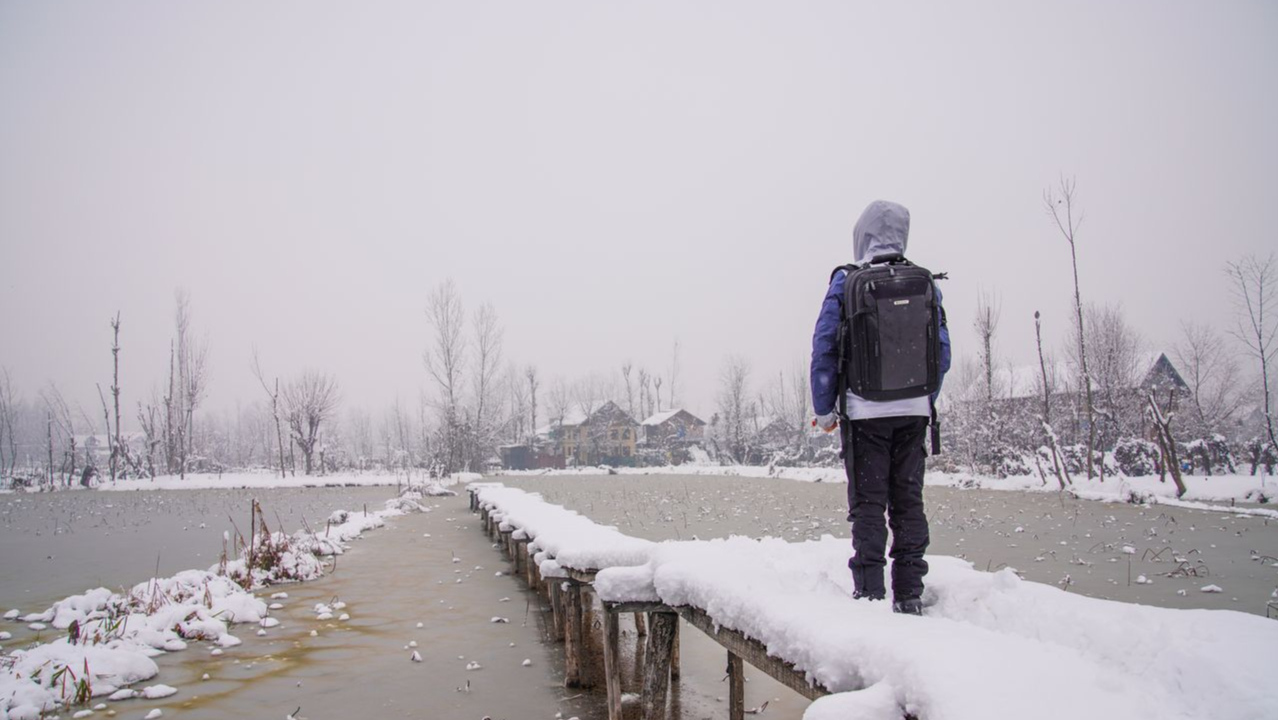
A packing list for Kashmir is set by altitude, because Srinagar and Gulmarg are not the same winter. Gulmarg stands about a thousand metres above the city, and the first snow of the 2026 season reached it in the second week of November while the city had rain. Wool, waterproof boots and original photo identity do most of the work on this list.
Srinagar sits at about 1,585 metres on the valley floor. Gulmarg sits at about 2,650 metres. Pahalgam and Sonamarg sit in between. A week that takes in the city and two of the hill stations crosses all of that. The bag has to hold a cold night and a mild afternoon at once.
Layers of wool, one waterproof outer shell, and boots with grip. Everything else on this list exists because of snow, sun or a checkpost.
| Item | Why |
|---|---|
| Thermal base layers | Nights below freezing from December to February |
| Wool or fleece mid layer | The useful layer all year above 2,000 metres |
| Waterproof jacket | Snow in winter, rain in spring and autumn |
| Waterproof boots with grip | Gulmarg, Sonamarg and any snow walking |
| Wool socks, cap, gloves | The parts that fail first in the cold |
| Sunglasses and sunscreen | Snow throws the sun back at you |
| Original photo ID and photocopies | Posts on the border roads keep a copy |
| Lip balm and moisturiser | Dry cold cracks skin faster than wet cold |
| Power bank | Power cuts follow heavy snow |
Wool next to the skin and something windproof over it. The city is cold rather than extreme, and it is the damp that gets through, not the temperature.
Local people wear a pheran, a long loose woollen gown that goes over everything else, and many carry a kangri, a small earthen firepot in a wicker case, under it. Both are easy to buy in Srinagar and the pheran is the warmest single thing you can put on in that valley.
Indoor heating is local rather than central, so a room can be warm and a corridor freezing. Carry something you can put on and take off without unpacking. A thin stole or scarf is also what you use to cover your head at a shrine or a mosque.
Waterproof boots, waterproof trousers and goggles or sunglasses. Snow on the ground is wet, and anything that soaks through stays soaked for the day.
Boots can be hired at Gulmarg, and so can jackets and trousers, which saves buying equipment for a two-day visit. Gloves and socks are not worth hiring, so carry your own. If you are going up the gondola in stages, the cold at the top is not the cold at the bottom, and the wind does most of it. Our packing list for Ladakh covers high cold in more detail, and some of it applies here.
Sun on snow burns in a way that cold weather hides. Sunscreen and dark glasses go in the bag even in January.
Original identity documents, three or four photocopies, and cash. The road to Gurez crosses Razdan Pass and runs through several army and police posts, and each one keeps a record.
There is no reliable ATM in the Gurez valley, so cash is taken in from Bandipora or Srinagar. Mobile signal is patchy to absent. The road closes with snow and the valley can be cut off for long stretches of the winter. Gurez is a summer and early autumn trip, and the dates are checked before anything is booked.
Do not photograph checkposts, bridges or military positions anywhere in the union territory. A camera pointed the wrong way is the one thing that turns an easy road into a long afternoon.
Rain gear and one less layer. Winter is still sitting on the high ground while the valley floor has turned to spring, so the two halves of the day need different clothes.
The Tulip Garden opens in the second half of March and the blossom follows. Down on the floor the afternoons are mild and the mornings are cold. Up at Gulmarg there is still snow, and the slush is worse for footwear than fresh snow is. Waterproof boots stay in the bag through April. The documents and the planning for all of this are the same as everywhere in the country, and our guide to getting ready for a trip in India sets them out.
Thermal base layers, a wool or fleece mid layer, a waterproof outer jacket, and waterproof boots with grip. Wool socks, a cap and gloves matter as much as the jacket. A pheran, the local woollen gown, is the warmest single thing you can wear in Srinagar and is easy to buy there.
Yes, or hire them there. Snow at Gulmarg is wet and ordinary shoes soak through and stay wet. Boots, jackets and trousers can all be hired in Gulmarg, but carry your own gloves and wool socks.
Original photo identity such as an Aadhaar card, passport or driving licence, plus three or four photocopies. Army and police posts on the border roads keep a copy. No permit is needed for Srinagar, Gulmarg, Pahalgam or Sonamarg.
A waterproof jacket and boots, plus one fewer warm layer than winter needs. The valley floor is mild in the afternoon and cold in the morning, while Gulmarg still has snow and slush. Sunglasses and sunscreen are still useful because of the glare off the snow.