
Let’s help you
plan your journey
Explore responsibly, discover offbeat places, guided by locals, rooted in culture.
Let’s help you
plan your journey
Explore responsibly, discover offbeat places, guided by locals, rooted in culture.
Soumen Bhowmick
Soumen Bhowmick founded Pollen Dots in 2024 to plan journeys across India and Bhutan. He works in the Commercial Department of Indian Railways, where he has been since 2000. From 2016 to 2020 he was Head of Business Development and Partnerships at ScoutMyTrip, a community-driven road trip planning platform. There he built a nationwide network of local Scouts who helped travellers on the road, and grew the Road Trippers Club to 16 Indian cities. As a core member of Devil On Wheels, he helped travellers plan Himalayan trips and started Spreading Smiles. He has driven solo from Arunachal to Goa and from Himachal to Karnataka, and has run his own caravan for more than ten years. His photographs have won national and international salon awards, and his writing has appeared in Outlook Traveller.
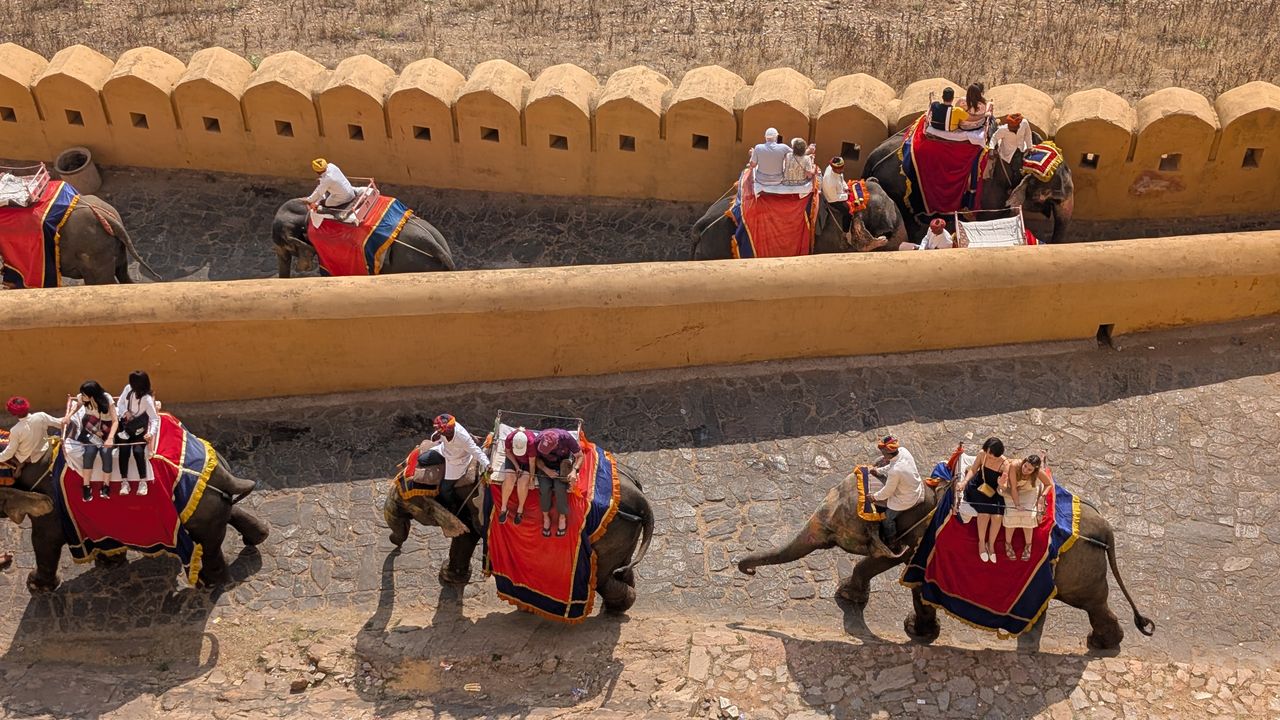
Six forts carry a UNESCO inscription and they are the spine of the places to visit in Rajasthan, running from Chittor in the south to Jaisalmer in the west. Jaisalmer is among the very few living forts anywhere, with close to a quarter of the old city's population still living inside the walls. The lakes at Udaipur, the tiger forest at Ranthambore and the desert beyond Jodhpur fill in the rest.
Everything below is reached by road, and the legs between cities run three to six hours. The guide to preparing for travelling in India runs the general version, and Rajasthan adds distance to it.
Grouped by where they sit, east to west and then south.
Jaipur is the usual arrival and Amer is the fort that carries its UNESCO listing. The city below it is a grid, which is unusual for an Indian city of its age.
Udaipur sits on a chain of lakes with the Aravalli behind it, which makes it the green corner of a dry state. Kumbhalgarh and Chittor are both reachable from it.
Mehrangarh stands on a rock above the blue houses and is the most complete fort in Rajasthan to walk through. West of it the country opens out and the drive becomes the point.
Kumbhalgarh's wall runs about 36 kilometres around the fort, which is remarkable and is not what the signage says. It is not the second longest wall in the world.
A fort does not need a world ranking to be worth a morning, and the invented one has quietly replaced the real thing in most of what is written about it.
Ranthambore covers 1,334 square kilometres including two adjoining sanctuaries, and held 69 tigers as of 2022. The fort inside it is one of the six UNESCO hill forts.
Six forts sit on the UNESCO list and the Thar carries 83 people to the square kilometre, which is a density no other desert on this scale comes near. Our eleven day cultural, desert and wildlife journey through Rajasthan runs the forts and the park together rather than choosing between them. Customised tours is where Bundi, Chittor and the Shekhawati towns get added or left out. Whether a protected place benefits the people inside it is a longer question, and a living fort asks it more directly than most.
Six, inscribed together in 2013 as the Hill Forts of Rajasthan. They are Chittor, Kumbhalgarh, Ranthambore, Gagron, Amer and Jaisalmer. Ranthambore's fort sits inside the national park, and Jaisalmer's is still inhabited.
No. The claim is repeated widely and is not supported by any record. Guinness lists Kumbhalgarh in a category of longest fort walls rather than ranking it against all walls. The wall runs about 36 kilometres, against roughly 3,460 for the Great Wall of China.
69 as of 2022, across 1,334 square kilometres that include the Kailadevi and Sawai Man Singh sanctuaries. The reserve was declared a sanctuary in 1955, came under Project Tiger in 1974 and became a national park in 1980. Zones are booked in advance and the popular ones fill first.
Udaipur for lakes and a short walkable old town, Jodhpur for the single best fort to walk through, and Jaisalmer for the desert and a fort people still live in. Jaipur is the easiest to reach and the busiest. Most seven day circuits take three of the four rather than all of them.