
Let’s help you
plan your journey
Explore responsibly, discover offbeat places, guided by locals, rooted in culture.
Let’s help you
plan your journey
Explore responsibly, discover offbeat places, guided by locals, rooted in culture.
Soumen Bhowmick
Soumen Bhowmick founded Pollen Dots in 2024 to plan journeys across India and Bhutan. He works in the Commercial Department of Indian Railways, where he has been since 2000. From 2016 to 2020 he was Head of Business Development and Partnerships at ScoutMyTrip, a community-driven road trip planning platform. There he built a nationwide network of local Scouts who helped travellers on the road, and grew the Road Trippers Club to 16 Indian cities. As a core member of Devil On Wheels, he helped travellers plan Himalayan trips and started Spreading Smiles. He has driven solo from Arunachal to Goa and from Himachal to Karnataka, and has run his own caravan for more than ten years. His photographs have won national and international salon awards, and his writing has appeared in Outlook Traveller.
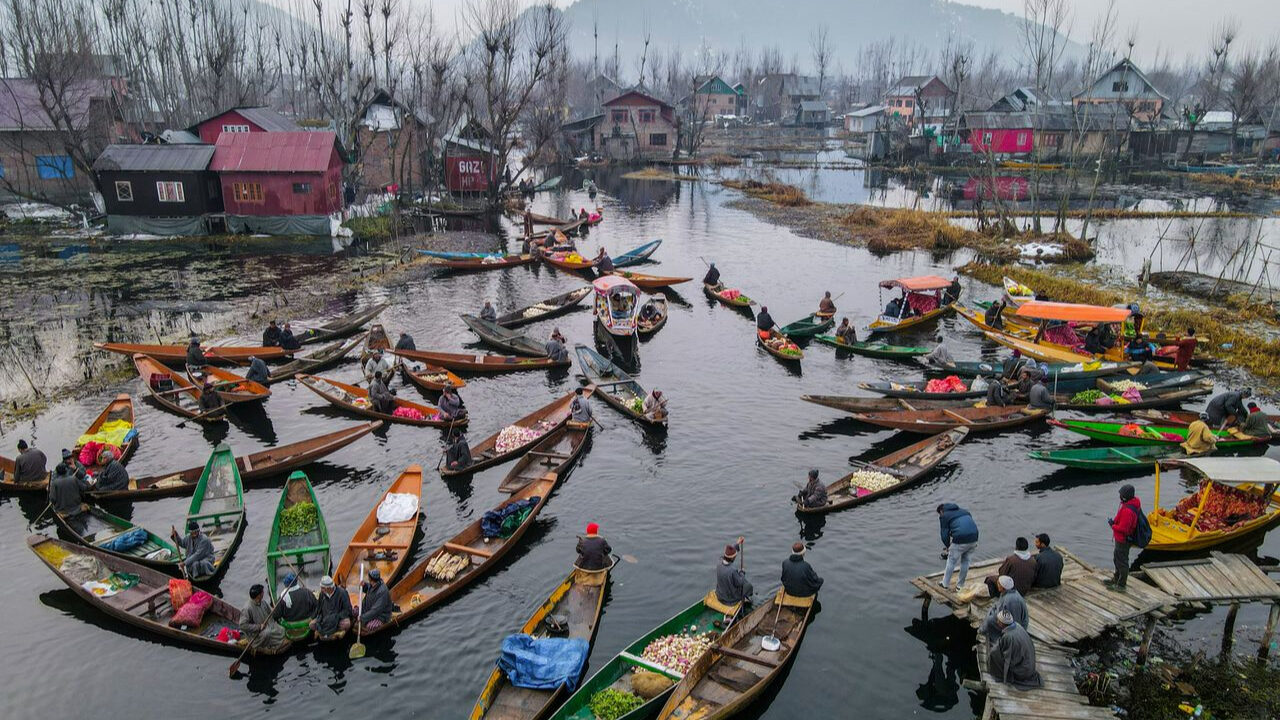
What to buy in Kashmir is easy to choose and hard to verify, because the copies are good. Since February 2022 the GI label on a Kashmir craft has carried a QR code, and a scan names the artisan, the district and a carpet's knots per square inch. Seven crafts hold that tag, saffron holds one of its own, and the label is the only check a buyer can make in a shop.
Kashmir is a craft economy, not a souvenir economy. Srinagar joined the UNESCO Creative Cities Network in 2021 as a Creative City of Craft and Folk Arts, the sixth Indian city on that list. The work is done in workshops around the old city and in villages outside it. What separates a two thousand rupee shawl from a two lakh one is the fibre and the hours, and the label records both.
Shawls, carpets, walnut wood, papier mache and saffron. The check is the same for all of them, which is to look for the GI label and scan the code on it.
The QR-coded GI label was launched in February 2022 and was the first scheme of its kind in India. A scan returns a digital certificate naming the authorised GI user, the manufacturer, the artisan, the district of origin and the raw material used. On a hand-knotted carpet it also gives the knots per square inch, which is the number that sets the price.
| Craft | Where the work is done |
|---|---|
| Kashmir Pashmina | Srinagar and the surrounding villages |
| Kani Shawl | Kanihama, Budgam district |
| Kashmir Sozni embroidery | Srinagar |
| Kashmir Papier Mache | Srinagar old city |
| Kashmir Walnut Wood Carving | Srinagar |
| Khatamband ceilings | Srinagar |
| Kashmir Hand Knotted Carpet | Srinagar and the valley |
Seven, plus saffron as an agricultural product. The seven are Kashmir Pashmina, Kani Shawl, Kashmir Sozni, Kashmir Papier Mache, Kashmir Walnut Wood Carving, Khatamband and Kashmir Hand Knotted Carpet.
Kashmir Saffron took its GI in 2020 and is registered as an agricultural good rather than a craft. Jammu and Kashmir began registering its craft basket in 2007.
Sozni is the one to learn by sight. It is needle embroidery worked so finely that the pattern reads the same on both faces of the cloth. The second face is why it is also called dorukha, meaning two-faced. A machine copy does not do that, and turning the shawl over is the test.
Pashmina is legal and shahtoosh is not. The two look close enough that laboratories need a microscope or a DNA test to separate them, which is exactly why the illegal one still gets sold to tourists.
Pashmina comes from the Changthangi goat, which is combed rather than killed. The goats live on the Ladakh plateau and the raw wool is spun, dyed and woven in the Kashmir Valley. The GI is therefore Kashmir Pashmina, and it covers hand-spun and hand-woven work. What to buy in Ladakh carries the other end of that supply chain.
Shahtoosh comes from the chiru, the Tibetan antelope, and the only way to get the fibre is to kill the animal. The chiru is listed in Schedule I of the Wildlife Protection Act of 1972, the highest protection Indian law gives, and CITES has banned international trade in it since 1979. Buying, carrying or posting a shahtoosh shawl is an offence, and prison sentences have been handed down for it.
A Kani shawl is woven on a loom with small wooden sticks called kanis in place of a shuttle, one for each colour in the row. It comes from Kanihama in Budgam district and holds its own GI.
The weaver does not follow a drawing. The pattern is written out in a coded script called talim, read line by line, and every row is built by moving the kanis by hand. A full shawl can take months and large ones take years, which is the whole of the price.
A printed or machine-woven copy of the same pattern costs a fraction and does not carry a GI label. The weave on the reverse is the giveaway.
From the karewas, the raised tableland around Pampore in south Kashmir, with Pulwama, Budgam and Kishtwar the registered districts. The harvest runs from the middle of October into November.
The flowers are picked by hand in the early morning and the three red stigmas are separated from each flower the same day. The price is that labour. The crop depends on autumn rain, and a dry autumn shows up in the yield within weeks. Srinagar recorded a 79 per cent rainfall shortfall between 1 October and 14 November 2024, and the harvest that year suffered for it.
Buy it in a sealed pack with the GI label on it. Loose saffron sold by weight at a roadside stall is where the dyed safflower and the coloured maize silk turn up.
Saffron, dried morels, walnuts and honey. All four are dry or sealed, and all four survive a flight better than anything from a bakery.
Dried morels, called guchhi locally, are gathered wild in the forests and are among the most expensive edible mushrooms anywhere. Walnuts come out of the same trees that the carvers use. Kashmiri honey is sold through the handicrafts outlets and the markets in Srinagar. Our guide to getting ready for a trip in India covers what can and cannot be posted home from a trip.
Look for the GI label and scan the QR code on it. The scan returns a certificate naming the authorised GI user, the manufacturer, the artisan, the district of origin and the raw material. The QR-coded GI label was launched in February 2022 and was the first scheme of its kind in India.
No. Shahtoosh comes from the chiru, or Tibetan antelope, which is listed in Schedule I of the Wildlife Protection Act of 1972. CITES has banned international trade in it since 1979. Buying, carrying or posting a shahtoosh shawl is an offence and prison sentences have been handed down for it.
A shawl woven with small wooden sticks called kanis, one for each colour in a row, instead of a shuttle. It comes from Kanihama in Budgam district and carries its own GI. The pattern is written in a coded script called talim, and a full shawl can take months or years.
On the karewas, the raised tableland around Pampore in south Kashmir. Pulwama, Budgam and Kishtwar are the districts named in the GI registration. The harvest runs from the middle of October into November.
Kashmir Pashmina, Kani Shawl, Kashmir Sozni, Kashmir Papier Mache, Kashmir Walnut Wood Carving, Khatamband and Kashmir Hand Knotted Carpet. Kashmir Saffron holds a separate GI as an agricultural product, granted in 2020.