
Let’s help you
plan your journey
Explore responsibly, discover offbeat places, guided by locals, rooted in culture.
Let’s help you
plan your journey
Explore responsibly, discover offbeat places, guided by locals, rooted in culture.
Soumen Bhowmick
Soumen Bhowmick founded Pollen Dots in 2024 to plan journeys across India and Bhutan. He works in the Commercial Department of Indian Railways, where he has been since 2000. From 2016 to 2020 he was Head of Business Development and Partnerships at ScoutMyTrip, a community-driven road trip planning platform. There he built a nationwide network of local Scouts who helped travellers on the road, and grew the Road Trippers Club to 16 Indian cities. As a core member of Devil On Wheels, he helped travellers plan Himalayan trips and started Spreading Smiles. He has driven solo from Arunachal to Goa and from Himachal to Karnataka, and has run his own caravan for more than ten years. His photographs have won national and international salon awards, and his writing has appeared in Outlook Traveller.
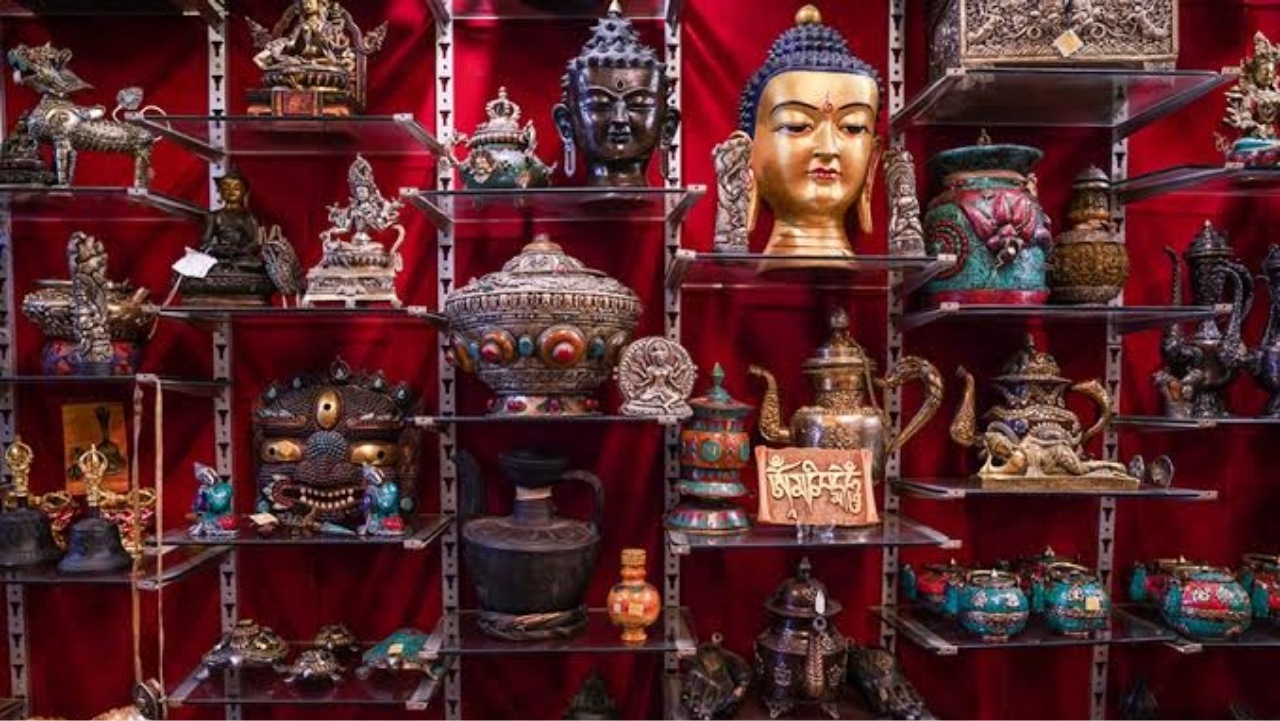
Textiles, stamps, paper and incense are what to buy in Bhutan, and only one of the four is famous well beyond the country. Bhutan issued playable gramophone-record postage stamps in 1973, thin vinyl discs that carry folk songs and a spoken history of the kingdom, and philatelists have chased them ever since. Buy cloth by the weaver, stamps at a post office counter, and leave the mass-made souvenirs where they are.
Anything carried home crosses an Indian border on the way back for most visitors. The customs and baggage side sits in the guide to preparing for travelling in India.
Grouped by what it is, and whether it travels.
Weaving is the national craft and the garments are worn daily rather than kept for display, which is why a good piece costs what it does.
Bhutan's postal history is the one thing on this list with a global following, and it is not a recent reputation.
Three crafts that are still made the old way and still used, which is the test worth applying to anything here.
Two towns hold almost all of it, and the difference between a shop and a cooperative is the difference between a price and a provenance.
Short list, and the first two are legal rather than aesthetic.
Almost every craft on this list is still in daily use somewhere in the country, which is why the good pieces are found in working towns rather than in airport shops. Our nine day journey through the valleys of Bhutan passes through the weaving valleys as well as the dzongs, and customised tours is where those stops get built into a route.
Yes. In 1973 Bhutan issued self-adhesive stamps that are miniature gramophone records, playable on a turntable, carrying Bhutanese folk songs and a spoken history of the kingdom. They came from the stamp agency run by Burt Todd, which also produced issues printed on silk and on steel foil.
Handwoven cloth, if you buy it with a weaver's name attached. Kushuthara brocade represents months of work and is priced accordingly, and yathra wool from Bumthang is the practical everyday version. Both are worn daily in Bhutan rather than made for visitors.
No, not without clearance. Export of antiquities is controlled and anything religious that appears old needs a certificate. The practical rule is to avoid buying old religious objects at all, because the certificate is the seller's responsibility to produce and often is not produced.
No. Yathra is a thick woollen strip woven in the Bumthang valleys of central Bhutan, used for blankets, jackets and bags. Pashmina is a fine goat fibre from the Changthang plateau, a different animal, a different weight and a different country.
At the philatelic counter in the Thimphu post office, which also houses the postal museum. Personalised sheets, printed around a photograph, have been issued since 2008 and are made there. Ask which items are postally valid, because reprints and souvenir sheets are sold alongside them.