
Let’s help you
plan your journey
Explore responsibly, discover offbeat places, guided by locals, rooted in culture.
Let’s help you
plan your journey
Explore responsibly, discover offbeat places, guided by locals, rooted in culture.
Soumen Bhowmick
Soumen Bhowmick founded Pollen Dots in 2024 to plan journeys across India and Bhutan. He works in the Commercial Department of Indian Railways, where he has been since 2000. From 2016 to 2020 he was Head of Business Development and Partnerships at ScoutMyTrip, a community-driven road trip planning platform. There he built a nationwide network of local Scouts who helped travellers on the road, and grew the Road Trippers Club to 16 Indian cities. As a core member of Devil On Wheels, he helped travellers plan Himalayan trips and started Spreading Smiles. He has driven solo from Arunachal to Goa and from Himachal to Karnataka, and has run his own caravan for more than ten years. His photographs have won national and international salon awards, and his writing has appeared in Outlook Traveller.
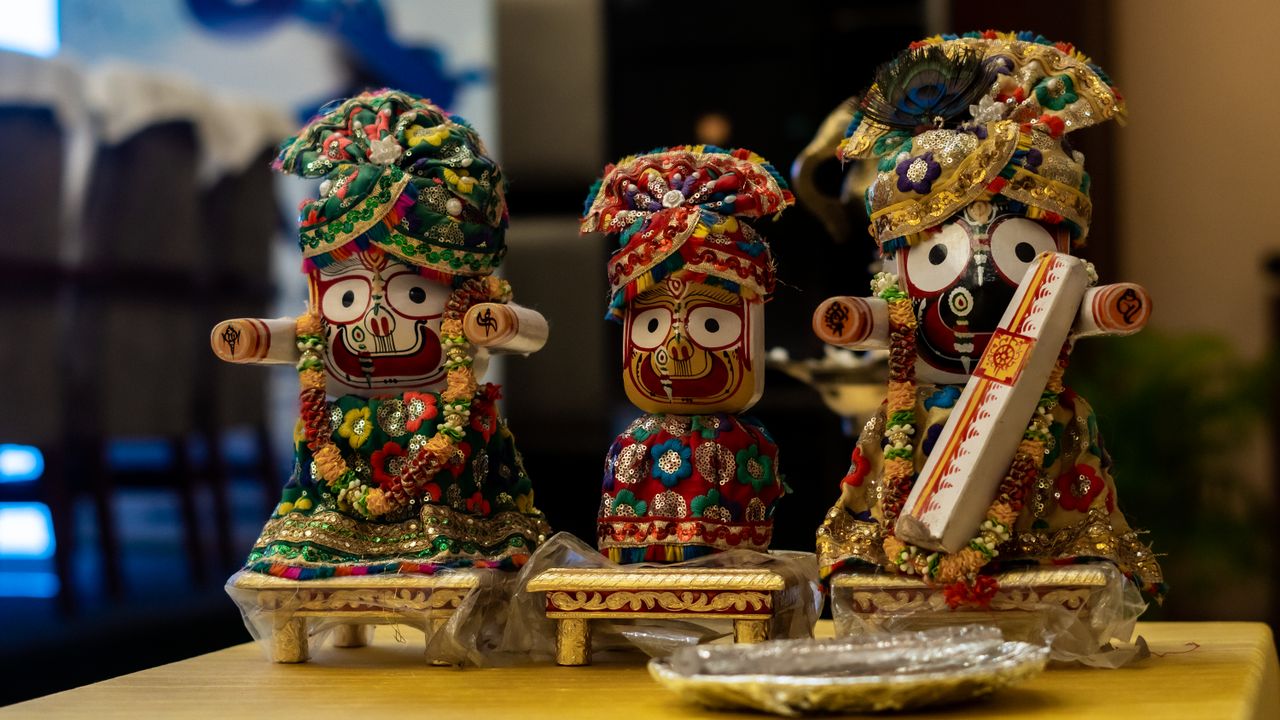
What to buy in Odisha is easier to settle once you know which thing is made where. Seven products from the state were granted a geographical indication on a single day, 2 January 2024, and one of them is a chutney made from red weaver ants. Odisha now holds twenty five of those tags, and the village behind most of them sits within a short drive of Puri, Cuttack or Sambalpur.
Odisha makes things in clusters. Painting is done in one village near Puri and applique in a town on the road to Bhubaneswar. Silver is worked in Cuttack, tie and dye weaving in the western districts, and metal casting in the south. Buying at the cluster costs less than buying in a city shop, and you see the work being done.
Seven crafts carry most of the state's reputation, and each belongs to a named place. The list below is the short version.
| What | Where it is made |
|---|---|
| Pattachitra and palm leaf painting | Raghurajpur, near Puri |
| Applique | Pipili, on the Bhubaneswar to Puri road |
| Silver filigree, called tarakasi | Cuttack |
| Sambalpuri bandha saree | Bargarh, Sambalpur, Balangir, Sundargarh, Jharsuguda |
| Kotpad cloth | Kotpad, Koraput district |
| Dhokra metal casting | Koraput and Dhenkanal |
| Stone carving | Konark and Puri district |
The state runs its own shops as well. Utkalika sells handicrafts and Boyanika sells handloom, and both have branches in Bhubaneswar.
Twenty five, and the count moved by seven in one day. The first was Kotpad handloom fabric in 2005, which came from Koraput.
On 2 January 2024 the registry granted seven more. They are the Dongria Kondh embroidered shawl, Lanjia Saura painting, Khajuri Guda, Dhenkanal Magji, Similipal Kai Chutney, Nayagarh Kanteimundi brinjal and Koraput Kalajeera rice. Six of the seven come from tribal districts.
Similipal Kai Chutney is the one people ask about. It is made from red weaver ants gathered in the forests of Mayurbhanj, and about five hundred families collect and sell them.
In Raghurajpur, a village near Puri where the work is done in the houses. It was developed as Odisha's first heritage crafts village, and nearly every household paints.
Pattachitra is painted on cloth that has been treated and stiffened first. Palm leaf work is different. The lines are cut into the leaf with a stylus and then rubbed with black, so the drawing is scratched rather than painted. Raghurajpur does both, and the artists sell from their own front rooms.
Pipili, on the road between Bhubaneswar and Puri, is the applique town. Shops line the main street and sell canopies, umbrellas, lampshades and cushion covers in cut and stitched cloth.
In bandha the yarn is tied and dyed before it goes on the loom, so the pattern is built into the cloth. A printed copy has the pattern put on the surface afterwards.
There is a simple test. Turn the cloth over. A bandha saree carries the same pattern on both faces, with soft edges where the dye has bled a little along the yarn. A print is sharp on the front and faint on the back. Sambalpuri Bandha Saree and Fabrics holds a GI of its own, and the weaving belongs to Bargarh, Sambalpur, Balangir, Sundargarh and Jharsuguda.
Kotpad cloth from Koraput is the quieter one. It is dyed with the root of the aal plant and comes out in deep red and brown, and it was the first product from the state to get a GI.
In Cuttack, where it is called tarakasi. Fine silver wire is drawn, twisted and soldered into open patterns, and the artists work with an alloy that is at least ninety per cent silver.
The scale the craft can reach shows up at Durga Puja. In 2004 the Ranihat committee in Cuttack put up a filigree backdrop weighing 483 kilograms, and the next year the Haripur Dolamundai committee installed 500 kilograms. The pandals in Cuttack have competed on filigree ever since.
What travels home is smaller. Earrings, pendants, boxes and brooches are the usual pieces, and the weight is marked.
Turmeric, rice, coffee and jaggery. All four are sold dry and all four carry a GI.
Kandhamal Haladi is turmeric from Kandhamal, and it was registered on 1 April 2019, which is Odisha's own foundation day. Koraput Kalajeera is a small black aromatic rice. Khajuri Guda is date palm jaggery. The coffee grown in Koraput is sold as Araku Valley Arabica Coffee, a GI shared with Andhra Pradesh. Odisha coffee reaches the shelf under a name that belongs to two states.
Odisha Rasagola was certified on 29 July 2019. West Bengal had registered Banglar Rosogolla in 2017. They are separate registrations and both stand, which is why what to buy in West Bengal carries the other half of that story. Sweets do not travel well in any case, so the rasagola is eaten in Odisha and the turmeric goes in the bag.
Packing, customs and courier rules for craft purchases are the same across the country, and our guide to getting ready for a trip in India covers them. Our ten day journey through the sacred coast and tribal heartland of Odisha runs through the coast and the southern districts, which is where most of these clusters are.
Pattachitra painting from Raghurajpur, applique from Pipili, silver filigree from Cuttack and Sambalpuri bandha sarees from the western districts. Kotpad cloth from Koraput and Dhokra metal casting are the other two that carry a GI. Food items include Kandhamal turmeric, Koraput Kalajeera rice and Khajuri Guda jaggery.
Twenty five. The first was Kotpad handloom fabric in 2005. Seven were granted on a single day, 2 January 2024, including Similipal Kai Chutney, the Dongria Kondh embroidered shawl and Koraput Kalajeera rice.
Turn the cloth over. In a bandha the yarn is tied and dyed before weaving, so the pattern appears on both faces with slightly soft edges. A printed saree is sharp on the front and faint on the back.
A chutney made from red weaver ants, gathered in the forests of Mayurbhanj district. It was granted a geographical indication on 2 January 2024. About five hundred tribal families in the district collect and sell the ants and the chutney.
Both hold one. West Bengal registered Banglar Rosogolla in 2017 and Odisha Rasagola was certified on 29 July 2019. They are separate registrations over separate goods, so neither cancels the other.