
Let’s help you
plan your journey
Explore responsibly, discover offbeat places, guided by locals, rooted in culture.
Let’s help you
plan your journey
Explore responsibly, discover offbeat places, guided by locals, rooted in culture.
Soumen Bhowmick
Soumen Bhowmick founded Pollen Dots in 2024 to plan journeys across India and Bhutan. He works in the Commercial Department of Indian Railways, where he has been since 2000. From 2016 to 2020 he was Head of Business Development and Partnerships at ScoutMyTrip, a community-driven road trip planning platform. There he built a nationwide network of local Scouts who helped travellers on the road, and grew the Road Trippers Club to 16 Indian cities. As a core member of Devil On Wheels, he helped travellers plan Himalayan trips and started Spreading Smiles. He has driven solo from Arunachal to Goa and from Himachal to Karnataka, and has run his own caravan for more than ten years. His photographs have won national and international salon awards, and his writing has appeared in Outlook Traveller.
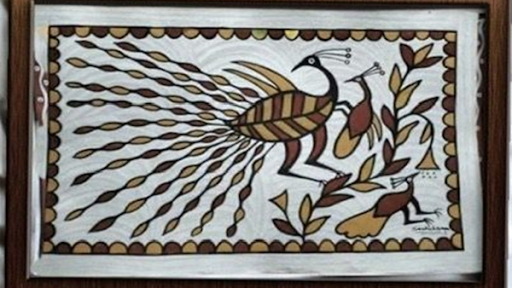
What to buy in Jharkhand is tasar silk, and the best place to buy it is not a saree shop. The cocoon is reared on wild arjun trees here and reeled here, then sent to Bhagalpur in Bihar to be woven, so the saree sold as Bhagalpuri silk is Jharkhand silk. Sohrai painting comes from Hazaribagh, and more than half of India's lac comes from four Jharkhand districts.
Jharkhand sells raw material. More than half of India's lac comes from here. So does most of India's tasar silk. The sal and arjun forests grow both. Almost none of it carries the state's name by the time it reaches a shop in Delhi. Everything on this list is better bought close to where it was made. For the practical side of carrying them home, see the guide to getting ready for a trip in India.
| What | Where | What to look for |
|---|---|---|
| Sohrai and Khovar painting | Hazaribagh | Natural soil colours, not poster paint |
| Tasar silk | Santhal Pargana, Kuchai, state outlets | A copper tone, not bleached white |
| Lac bangles and lac work | Ranchi, Khunti, Simdega | Weight, and a clean join |
| Bamboo and cane | Across the plateau | Tight weave, no split ends |
| Palash dye and colour | Hazaribagh, Khunti, March and April | Dry flowers or powder, no added scent |
JHARCRAFT is the state corporation. Its outlets carry all of these, and the bill names the society the piece came from.
Palash is the state flower. It blooms on bare branches from February to April, and the flowers are dried and ground into a yellow-orange dye. Holi colour is made from it.
Two wall paintings from Hazaribagh district. Women paint them on the walls of mud houses.
Sohrai is painted after the harvest, for the cattle festival of the same name. Khovar is painted for the wedding season. Sohrai is full of animals, plants and figures, drawn in lines and dots. Khovar is usually one colour and it is about fertility.
The colours are not bought. They are soils dug from nearby ground. Black comes from charcoal, white from limestone, red and yellow from ochre. There are manganese tones as well. Kurmi, Santhal, Oraon, Munda and Agaria women all paint it, so no single community owns it.
It is painted large on the walls of Birsa Munda Airport at Ranchi, and on the railway stations at Hazaribagh and Tatanagar.
Yes. Sohrai-Khovar Painting is a registered geographical indication. It is registered under class 16, handicrafts, for Hazaribagh district. A women's cooperative at Hazaribagh holds it.
The application went in during August 2019. It was advertised in the GI journal in January 2020. The certificate is dated September 2021, and the protection runs from that date.
It was the first GI registered for anything from Jharkhand.
From the forest, not from a farm. Tasar silkworms eat the leaves of arjun and asan trees growing wild. So tasar is a forest silk, and it cannot be reared indoors the way mulberry silk can.
Jharkhand rears more tasar than any other state in India. The work happens in West and East Singhbhum, Saraikela, Dumka, Pakur, Godda, Sahebganj, Dhanbad, Giridih, Latehar, Palamau, Garhwa and Simdega.
The weaving happens somewhere else. Bhagalpur in Bihar is the main weaving town for this yarn, and the cloth made there sells as Bhagalpuri silk. The cocoon behind it grew on a Jharkhand tree.
| Stage | Where it happens |
|---|---|
| Rearing on arjun and asan | Jharkhand forests |
| Reeling cocoon into yarn | Jharkhand, in village units |
| Weaving into cloth | Mostly Bhagalpur, Bihar |
So in Jharkhand you buy yarn, stoles and fabric, often straight from the village that reeled it. A finished saree bought here was usually woven elsewhere. Bishnupur in West Bengal weaves its own silk sarees on a different tradition, and those are in what to buy in West Bengal.
More than half of India's lac comes from it. In 2019-20 the state made about 55 per cent of the national total. Chhattisgarh and Madhya Pradesh came next. India makes more than half the world's lac.
Lac is a resin. An insect makes it on the branches of ber and palash trees. It is scraped off, heated, hardened and shaped. The red bangles sold across north India start here. So does shellac.
Nearly ninety per cent of the state's lac comes from a few districts. Khunti, Simdega, Gumla and Ranchi are the top four.
The only research institute in the world that works on lac alone sits at Namkum in Ranchi. It opened in 1924 as the Indian Lac Research Institute and it still works on lac.
| Outlet | What it carries |
|---|---|
| JHARCRAFT state outlets | Tasar silk, Sohrai painting, lac, bamboo |
| Hazaribagh, at the source | Sohrai and Khovar painting |
| Reeling villages, Santhal Pargana and Kuchai | Tasar yarn, stoles, fabric |
| Khunti and Simdega | Lac bangles and lac work |
A state outlet bill names the society. Keep the bill. It is the only way to check a GI claim later.
The five day journey through the waterfalls, forests and plateau views of Jharkhand runs through the lac belt on the Ranchi plateau. North Bengal including the Dooars is across the eastern border, and we cover North Bengal separately.
Sohrai and Khovar painting from Hazaribagh, tasar silk from the forest districts, lac bangles and lac work, bamboo, and palash dye in spring. All of it comes out of the forest.
The cocoon usually is. Tasar is reared and reeled in Jharkhand, and the cloth is mostly woven in Bhagalpur in Bihar, where it sells as Bhagalpuri silk. Jharkhand rears more tasar than any other state.
Sohrai-Khovar Painting, registered for Hazaribagh district under class 16, handicrafts. A women's cooperative at Hazaribagh holds it. It was the first GI registered for anything from Jharkhand.
About 55 per cent of the national total in 2019-20, which makes it the biggest producer. Khunti, Simdega, Gumla and Ranchi account for most of it.
At JHARCRAFT, the state handloom and handicraft outlets, where the bill names the society that made the piece. Buying at the source works too: Hazaribagh for Sohrai painting, a reeling village for tasar.