
Let’s help you
plan your journey
Explore responsibly, discover offbeat places, guided by locals, rooted in culture.
Let’s help you
plan your journey
Explore responsibly, discover offbeat places, guided by locals, rooted in culture.
Soumen Bhowmick
Soumen Bhowmick founded Pollen Dots in 2024 to plan journeys across India and Bhutan. He works in the Commercial Department of Indian Railways, where he has been since 2000. From 2016 to 2020 he was Head of Business Development and Partnerships at ScoutMyTrip, a community-driven road trip planning platform. There he built a nationwide network of local Scouts who helped travellers on the road, and grew the Road Trippers Club to 16 Indian cities. As a core member of Devil On Wheels, he helped travellers plan Himalayan trips and started Spreading Smiles. He has driven solo from Arunachal to Goa and from Himachal to Karnataka, and has run his own caravan for more than ten years. His photographs have won national and international salon awards, and his writing has appeared in Outlook Traveller.
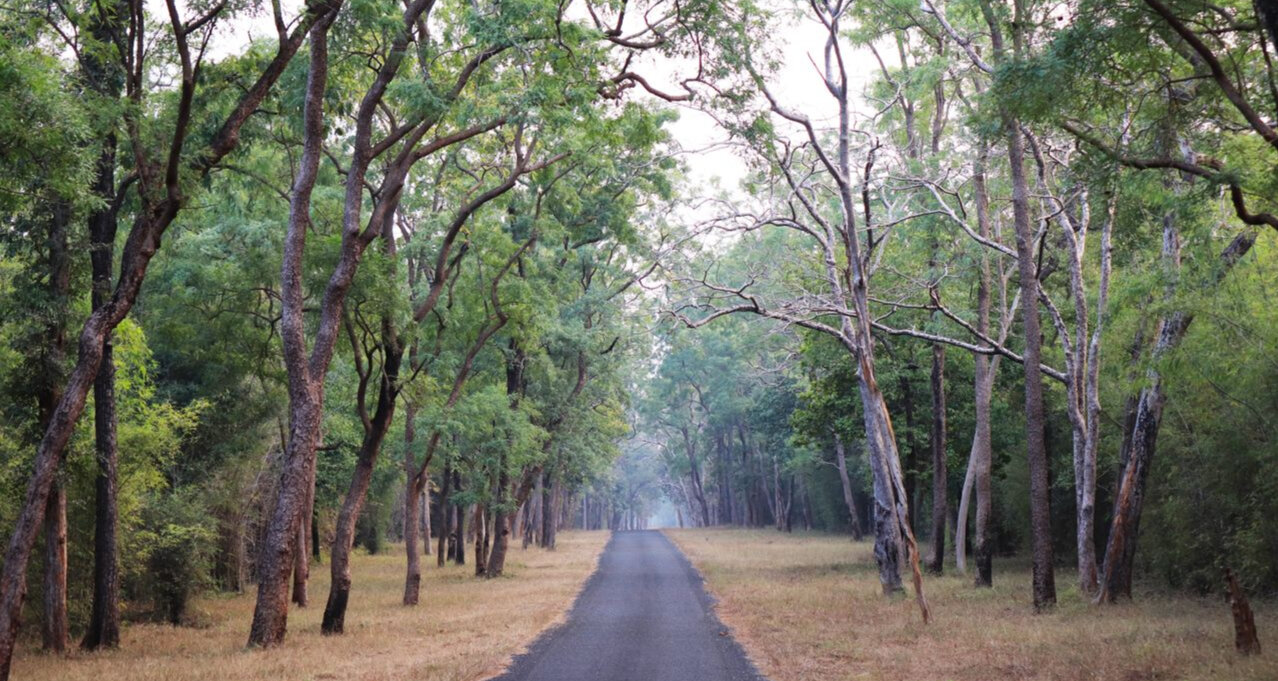
The places to visit in Jharkhand are Betla, Netarhat, the Ranchi waterfalls, Maluti and Deoghar. The first tiger census anywhere in the world was taken at Palamau in 1932, by counting pugmarks, forty-one years before Project Tiger began. Maluti is a village of seventy-two terracotta temples, and it is the only Indian site on the Global Heritage Fund's list of the world's twelve most endangered.
Jharkhand means land of forests, and most of what there is to see is inside one. The state has no World Heritage site. It has a tiger reserve older than Project Tiger, the highest waterfall in eastern India's plateau country, and seventy-two terracotta temples in one village. Ground rules for the trip itself are in the guide to getting ready for a trip in India.
| Place | District | What it is |
|---|---|---|
| Betla and Palamau | Latehar | The only tiger reserve in Jharkhand |
| Netarhat | Latehar | Hill station, sunrise and sunset points |
| Lodh Falls | Latehar | The highest waterfall in the state |
| Hundru Falls | Ranchi | A 98 metre drop on the Subarnarekha |
| Maluti | Dumka | Seventy-two terracotta temples |
| Parasnath and Shikharji | Giridih | The holiest Jain pilgrimage site |
| Deoghar | Deoghar | Baidyanath Dham, a Jyotirlinga |
The west and the east are a full day's drive apart. Ranchi is between them.
Betla National Park sits in the middle of Palamau Tiger Reserve. The reserve is in Latehar district, on the Chhotanagpur plateau, about 170 km from Ranchi by way of Latehar.
The whole reserve is about 1,130 square kilometres. Roughly 414 of those are the core. The forest is dry and deciduous and sal is the main tree. From February the palash flowers red on bare branches, which is the state flower and the reason the forest here is called flame of the forest. Three rivers run through it: the North Koel, the Auranga and the Burha.
Palamau was one of the first nine reserves Project Tiger set up. It is still the only one in the state. Its records list tiger, leopard, Asiatic elephant, gaur, sloth bear, grey wolf, wild dog and four horned antelope. There are far more elephants and leopards here than tigers. Elephants are what a drive usually turns up.
Two old forts stand inside the forest. The Chero rulers of Palamau built them.
The 1932 count was made from pugmarks on the ground, under J.W. Nicholson, then Divisional Forest Officer, Palamau. No tiger had been counted anywhere in the world before that. Project Tiger came forty-one years later.
Netarhat is a hill station on the plateau, in Latehar district, 145 km from Ranchi. People here call it the Queen of Chhotanagpur. Its sunrise and sunset points look straight off the edge of the plateau, and the view is clearest in the summer months.
| Spot | From Netarhat |
|---|---|
| Magnolia Point, for sunset | 10 km |
| Koel View Point | 3 km |
| Upper Ghaghri Falls | 4 km |
| Lower Ghaghri Falls | 10 km |
| Sadni Falls | 35 km |
| Lodh Falls | 60 km |
Lodh Falls is the highest in Jharkhand. It comes down in steps on the Burha river. It is inside Palamau Tiger Reserve, so the last part is a walk through forest. It is also the 21st highest waterfall in India.
Hundru is the big one. The Subarnarekha river drops 98 metres there, 45 km from Ranchi, off the Ranchi to Purulia road. The water has cut the rock below into shelves and pools.
Jonha and Dassam are the other two. All three can be done from Ranchi in a day. They are full from July to October and run thin after that. By March there is little water, but the palash is in flower along the road out.
A village in Dumka district with seventy-two terracotta temples still standing, out of an original hundred and eight. It is 55 km from Dumka town and 16 km from Rampurhat across the West Bengal border, on the Chila river.
The Baj Basanta family built them between the seventeenth and nineteenth centuries. The family broke into four branches, and each branch built temples to outdo the others. So one village ended up with dozens. The writing on the walls is in early Bengali script. The temples are named after women of the family. The oldest is the shrine of Mauliksha, the family deity.
The men who made the terracotta panels came from Bishnupur in Bengal. The same tradition built the Malla temples there, which are in places to visit in West Bengal. The panels at Maluti carry scenes from the Ramayana and the Mahabharata, with scenes of ordinary village life beside them.
The village was once called Gupta Kashi, the hidden Varanasi. Most of the temples left are in poor shape, and that condition is why Maluti is on the Global Heritage Fund list.
Two pilgrimage places, both on the eastern side, each busy in its own season.
Baidyanath Dham at Deoghar is one of the twelve Jyotirlingas. It is also a Shakti Peetha. The Shravani Mela runs the whole month of Shravan, July into August. Kanwariyas walk barefoot from Sultanganj in Bihar carrying Ganga water. Basukinath, 45 km away in Dumka district, takes the overflow.
Parasnath hill in Giridih district is the highest point in Jharkhand. It sits on the Delhi to Kolkata highway. Shikharji is on it, also called Sammed Shikhar. Twenty of the twenty-four Jain tirthankaras are held to have reached moksha there. The hill is named after Parshvanatha, the twenty-third. A shrine to each of the twenty stands along the climb.
The five day journey through the waterfalls, forests and plateau views of Jharkhand runs Betla, Netarhat and the falls, which is the stretch with the longest driving days. To add Maluti and Deoghar in the east, or to move the dates out of Shravan, Journeys, Just for You builds the route round the days you have. North Bengal including the Dooars is across the eastern border, and we cover North Bengal separately.
Betla National Park, in the middle of Palamau Tiger Reserve, in Latehar district. It is the only tiger reserve in the state and one of the first nine Project Tiger set up.
Lodh Falls, on the Burha river in Latehar district. It is also the 21st highest in India. It is inside Palamau Tiger Reserve, so the last part is a walk through forest.
Seventy-two, out of an original hundred and eight. They stand in one village in Dumka district, 55 km from Dumka town. The men who built them came from Bishnupur in Bengal.
Twenty of the twenty-four Jain tirthankaras are held to have reached moksha on it, which makes Shikharji the holiest Jain place. The hill is named after Parshvanatha, the twenty-third tirthankara.