
Let’s help you
plan your journey
Explore responsibly, discover offbeat places, guided by locals, rooted in culture.
Let’s help you
plan your journey
Explore responsibly, discover offbeat places, guided by locals, rooted in culture.
Soumen Bhowmick
Soumen Bhowmick founded Pollen Dots in 2024 to plan journeys across India and Bhutan. He works in the Commercial Department of Indian Railways, where he has been since 2000. From 2016 to 2020 he was Head of Business Development and Partnerships at ScoutMyTrip, a community-driven road trip planning platform. There he built a nationwide network of local Scouts who helped travellers on the road, and grew the Road Trippers Club to 16 Indian cities. As a core member of Devil On Wheels, he helped travellers plan Himalayan trips and started Spreading Smiles. He has driven solo from Arunachal to Goa and from Himachal to Karnataka, and has run his own caravan for more than ten years. His photographs have won national and international salon awards, and his writing has appeared in Outlook Traveller.
Almost every protected name in Karnataka is something made by hand rather than grown. Until 2001 a sandalwood tree in the state was the exclusive property of the government, even when it stood in a private garden, and the landowner carried the duty of protecting it. So the answer to what to buy in Karnataka runs through craft towns, and each protected name belongs to one named place.
A protected name ties a craft to a place and a method and sits in a public register that anyone can search.
Five crafts and two things from the hills.
A heavy silk saree with a protected name of its own.
The registration covers the state rather than one town, so there is no single village behind it. The state silk outlets sell it with its own mark and a bill.
Silk sold loose in a market is not the registered cloth, whatever name the shop uses.
Mysore sandalwood oil, Mysore sandal soap, Mysore agarbathi, Mysore betel leaf and Mysore jasmine all carry protected names of their own. The word Mysore runs through more Karnataka registrations than any other place name.
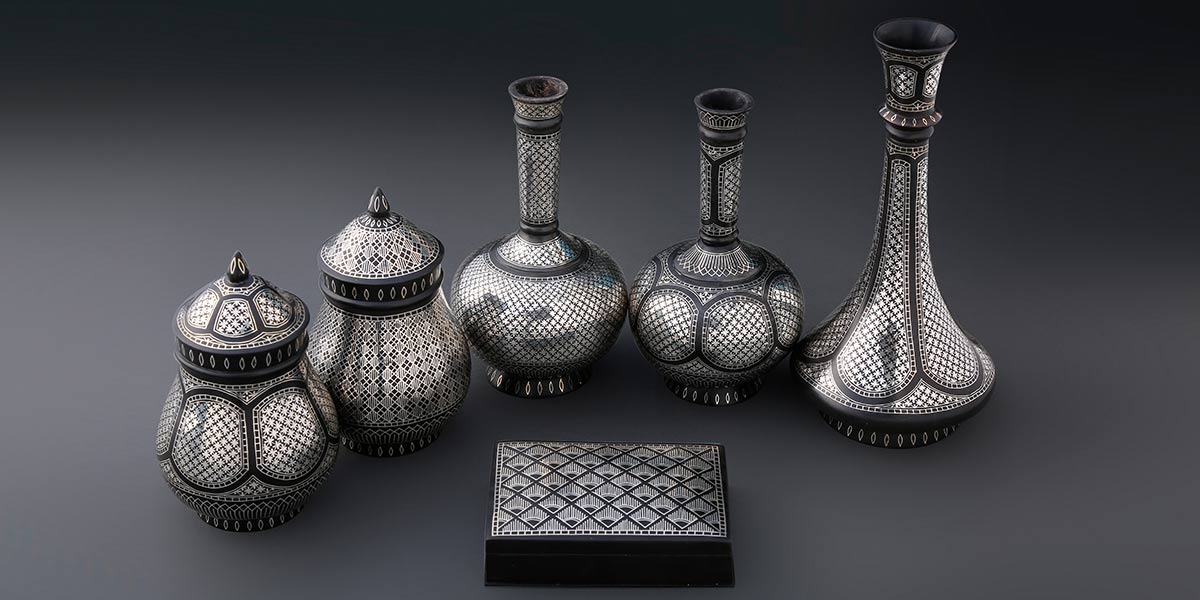
Blackened metal inlaid with silver, made in Bidar in the far north of the state.
The metal is darkened until it reads almost black, and silver wire or thin sheet is set into the surface. The pattern comes up bright against the dark ground.
The work appears as boxes, plates, vases and jewellery. On a finished piece the silver lies flush with the surface rather than standing on it, and the piece is heavy for its size.
Bidar lies closer to Hyderabad than to Bengaluru. The craft carries the town's name and the registration is tied to it.
Channapatna, a town on the road between Bengaluru and Mysuru.
The toys are turned on a lathe from soft wood and coloured with lacquer. The colour goes on while the piece spins, so it sinks into the wood rather than sitting on it like paint. The toys are made and sold for small children on that basis.
Channapatna stands directly on the Bengaluru to Mysuru highway, which makes it the craft town in Karnataka that needs no detour.
Four, each tied to a different place.
| Saree | Place |
|---|---|
| Ilkal | Ilkal, Bagalkot district |
| Molakalmuru | Molakalmuru, Chitradurga district |
| Udupi | Udupi, on the coast |
| Patteda Anchu | North Karnataka |
A style can be copied on a power loom anywhere. The protected name belongs to the place.
Alongside the sarees, Karnataka's register holds Kasuti embroidery, Navalgund durries, Karnataka bronzeware, Mysore rosewood inlay and Ganjifa playing cards. The handicraft entries outnumber the agricultural ones several times over.
The oil and the soap, yes. Raw wood, no.
Karnataka holds close to sixty per cent of India's wild sandalwood. Under the Karnataka Forest Act the trees were the exclusive property of the state for most of the last century, wherever they grew.
The law changed in 2001 to let private owners grow their own sandalwood. The rules changed again in 2022 to let growers sell to buyers other than the state. The trade remains licensed, and the oil and the soap are the registered forms sold in the state outlets.
India's sandalwood output fell from about 4,000 tonnes a year in the 1960s to around 350 tonnes by 2014. That shortage is why the licensing survived the change in ownership.
Coorg oranges run from about November to January, and Coorg coffee comes from the same hills. Our seven day journey through coastal Karnataka and the Western Ghats passes through that growing country. Journeys Just for You runs on your own dates. A short guide to getting ready for a trip in India covers papers and bookings.
Mysore silk, Bidriware from Bidar, Channapatna wooden toys, handloom sarees from Ilkal and Molakalmuru, and sandalwood oil and soap. Almost every protected Karnataka name is a handmade craft rather than a food.
From the state silk outlets, where the saree carries its own mark and comes with a bill. Silk sold loose in a market is not the registered cloth.
A blackened metal body with silver set into the surface as wire or thin sheet. It is made in Bidar in north Karnataka. On a finished piece the silver lies flush with the surface.
Yes. They are turned from soft wood and coloured with lacquer rubbed in on the lathe, which is why they are made and sold for small children.
Not raw wood. Sandalwood trees in the state were government property even on private land until 2001, and the trade is still licensed. The oil and the soap are the registered forms sold in state outlets.