
Let’s help you
plan your journey
Explore responsibly, discover offbeat places, guided by locals, rooted in culture.
Let’s help you
plan your journey
Explore responsibly, discover offbeat places, guided by locals, rooted in culture.
Soumen Bhowmick
Soumen Bhowmick founded Pollen Dots in 2024 to plan journeys across India and Bhutan. He works in the Commercial Department of Indian Railways, where he has been since 2000. From 2016 to 2020 he was Head of Business Development and Partnerships at ScoutMyTrip, a community-driven road trip planning platform. There he built a nationwide network of local Scouts who helped travellers on the road, and grew the Road Trippers Club to 16 Indian cities. As a core member of Devil On Wheels, he helped travellers plan Himalayan trips and started Spreading Smiles. He has driven solo from Arunachal to Goa and from Himachal to Karnataka, and has run his own caravan for more than ten years. His photographs have won national and international salon awards, and his writing has appeared in Outlook Traveller.
A trip to Jharkhand is waterfalls, sal forest and terracotta temples, and the state holds no World Heritage site. The world's first tiger census was taken at Palamau in 1932, by counting pugmarks, forty-one years before Project Tiger began. Its one international listing is Maluti, a village in Dumka district where seventy-two terracotta temples still stand out of a hundred and eight.
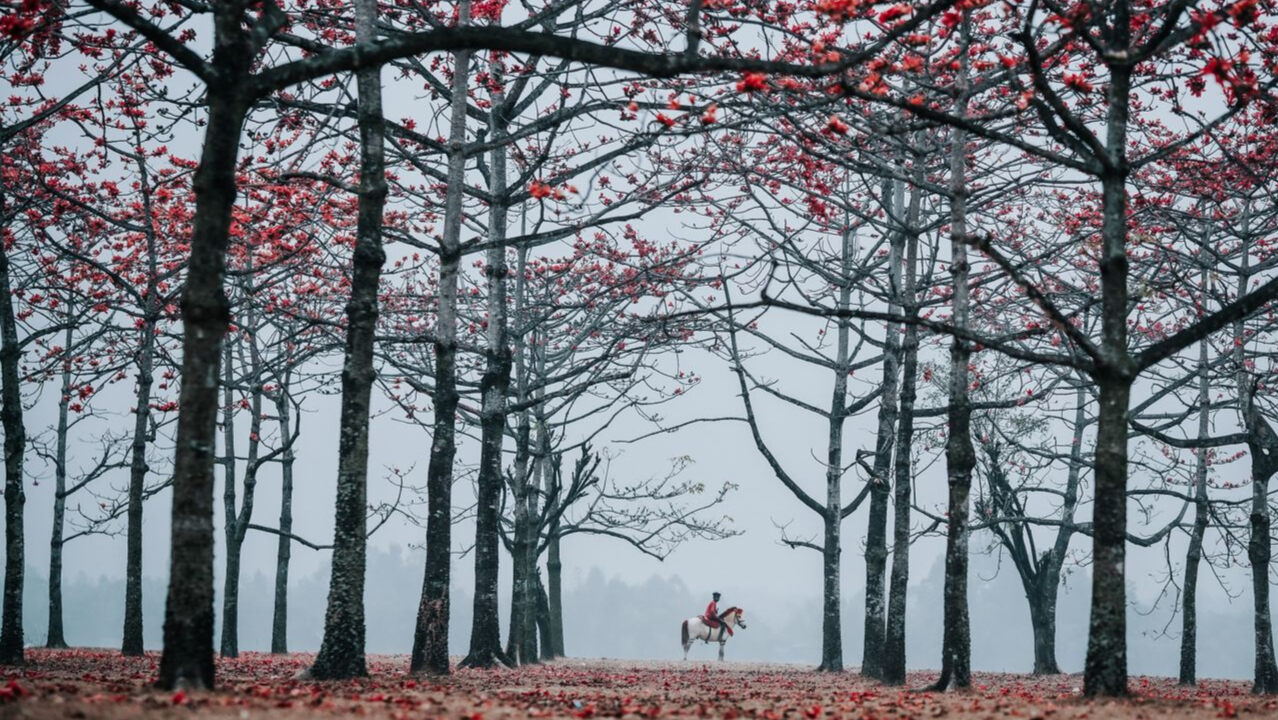
Jharkhand has two seasons worth planning around. Palash is the state flower and it blooms from February to April. The flowers open before the leaves do, so a bare tree goes solid red, and that is why palash is called flame of the forest. The waterfalls are at their fullest much later, from July to October. The groundwork for travelling in the country sits in the guide to getting ready for a trip in India.
The west and the east of the state are a full day's drive apart. The roads run through forest for long stretches.
| Part | What is there |
|---|---|
| Ranchi plateau | Hundru, Jonha and Dassam falls, the lac belt |
| West, around Latehar | Palamau Tiger Reserve, Betla, Netarhat, Lodh Falls |
| East, Santhal Pargana | Baidyanath Dham, Basukinath, Maluti, the tasar belt |
| Giridih | Parasnath hill and Shikharji, on the Delhi to Kolkata highway |
| South, around Jamshedpur | Dalma hills, Dimna lake, the steel city itself |
Five days is enough for one of these. Ten days covers two.
| Airport | Flights |
|---|---|
| Ranchi, Birsa Munda, IXR | The busiest. Delhi, Mumbai, Kolkata, Bengaluru |
| Deoghar, DGH | Open since 2022. Delhi, Kolkata, Ranchi, Patna |
| Jamshedpur, Sonari, IXW | Reopened January 2023. Kolkata and Bhubaneswar |
| Bokaro and Dumka | Built. Still waiting for DGCA clearance |
Tatanagar at Jamshedpur is the biggest railway station in the state. It is on the Howrah to Mumbai line, 250 km from Howrah. More than a hundred trains a day run through it. Dhanbad is on the Grand Chord, the Howrah to Delhi line. The Howrah to Ranchi Shatabdi takes about seven hours.
| Leg | Distance |
|---|---|
| Ranchi to Hundru Falls | 45 km, off the Ranchi to Purulia road |
| Ranchi to Netarhat | 145 km |
| Ranchi to Palamau Tiger Reserve | 170 km, via Latehar |
| Ranchi to Deoghar | 250 km |
| Netarhat to Lodh Falls | 60 km |
| Dumka to Maluti | 55 km |
| Rampurhat to Maluti | 16 km |
| Deoghar to Basukinath | 45 km |
Rampurhat is in West Bengal. Maluti is closer to Rampurhat than to any town in Jharkhand.
No. Nothing in Jharkhand is on the World Heritage List. Nothing here is on India's waiting list for it either.
Maluti is the one place in the state with an international listing. The Global Heritage Fund put it on a list of the twelve most endangered heritage sites in the world. It is the only Indian site on that list. Maluti is a village in Dumka district. Seventy-two terracotta temples still stand there, out of an original hundred and eight.
Parasnath hill holds Shikharji. Twenty of the twenty-four Jain tirthankaras are held to have reached moksha on it. Baidyanath Dham at Deoghar is one of the twelve Jyotirlingas. It is also a Shakti Peetha. Neither place is a World Heritage site.
At Palamau, in 1932. The count was made from pugmarks on the ground. J.W. Nicholson ran it. He was Divisional Forest Officer, Palamau, at the time.
No tiger had ever been counted anywhere before that. Project Tiger started in 1973, forty-one years later. Palamau was one of its first nine reserves and it is still the only tiger reserve in Jharkhand. Betla National Park sits inside it. So does Lodh Falls, the highest waterfall in the state.
| Months | What it is like |
|---|---|
| February to March | Palash and simul in flower across the plateau. Sarhul and Baha. Easiest months to see animals at Betla |
| April to June | Hot on the plain. Netarhat stays cooler and is known for its sunrises |
| July to September | Monsoon. Falls at full volume. Forest tracks wet. Deoghar packed for Shravani Mela |
| October to November | Falls still high, air clear, forest green |
| December to January | Cold nights on the plateau, mild days, falls low |
March gives you red forest and dry tracks. October gives you full waterfalls. The two do not happen in the same month.
The Shravani Mela runs for a whole month. The month is Shravan. It falls across July and August.
Pilgrims walk to Baidyanath Dham from Sultanganj in Bihar. They carry Ganga water. They walk barefoot. They are called kanwariyas.
Deoghar is fuller that month than at any other time of year. Rooms go early. Mondays are the most crowded, because Monday is Shiva's day.
Many pilgrims go on to Basukinath, 45 km away in Dumka district.
Three of the big ones move. Their dates come from the moon and from when the sal trees flower.
| Festival | When | Date set by |
|---|---|---|
| Sarhul | Chaitra, March or April | The third day of the Chaitra moon, and the sal flowering |
| Baha | February or March | The Santhal flower calendar, three days |
| Karam | Bhadra, August or September | The eleventh of the Bhadra moon |
Sarhul means worship of sal. It is a public holiday in the state. It is the new year for the Oraon, the Munda, the Ho and others. The pahan is the village priest. He offers sal flowers to the village deity, and field work starts after that.
Karam is for Karam Devta. Branches of the karam tree go into the middle of the village ground. People dance round them all night.
One date never moves. Jharkhand was made a state on 15 November 2000, under the Bihar Reorganisation Act. That day is Birsa Munda's birthday. He was born on 15 November 1875, and the date was picked for that reason. Since 2021 the Union government has kept 15 November as Janjatiya Gaurav Divas too.
A five day journey through the waterfalls, forests and plateau views of Jharkhand runs the western side, where the driving days are longest. For dates outside October and November, or for a route that takes in the plateau and Santhal Pargana both, Journeys, Just for You works to the week you have. North Bengal including the Dooars is across the eastern border, and we cover North Bengal separately.
Five days for one part of the state. Ten days for two. The west and the east are a full day's drive apart.
No. Nothing here is on the World Heritage List, and nothing here is on India's waiting list for it. The one international listing is Maluti, named among the twelve most endangered heritage sites in the world.
Ranchi is the busiest, with flights from Delhi, Mumbai, Kolkata and Bengaluru. Deoghar has been open since 2022 and Jamshedpur since January 2023. Bokaro and Dumka are built and waiting for clearance.
Palamau Tiger Reserve, in Latehar district on the Chhotanagpur plateau. Betla National Park sits inside it. It was one of the first nine reserves Project Tiger set up.
March or October, and they give you different things. In March the palash is in flower across the plateau and the forest tracks are dry. In October the waterfalls are still full from the monsoon.
Jharkhand was made a state on 15 November 2000, under the Bihar Reorganisation Act. That day is Birsa Munda's birthday. He was born on 15 November 1875, and the date was picked for that reason.