
Let’s help you
plan your journey
Explore responsibly, discover offbeat places, guided by locals, rooted in culture.
Let’s help you
plan your journey
Explore responsibly, discover offbeat places, guided by locals, rooted in culture.
Soumen Bhowmick
Soumen Bhowmick founded Pollen Dots in 2024 to plan journeys across India and Bhutan. He works in the Commercial Department of Indian Railways, where he has been since 2000. From 2016 to 2020 he was Head of Business Development and Partnerships at ScoutMyTrip, a community-driven road trip planning platform. There he built a nationwide network of local Scouts who helped travellers on the road, and grew the Road Trippers Club to 16 Indian cities. As a core member of Devil On Wheels, he helped travellers plan Himalayan trips and started Spreading Smiles. He has driven solo from Arunachal to Goa and from Himachal to Karnataka, and has run his own caravan for more than ten years. His photographs have won national and international salon awards, and his writing has appeared in Outlook Traveller.
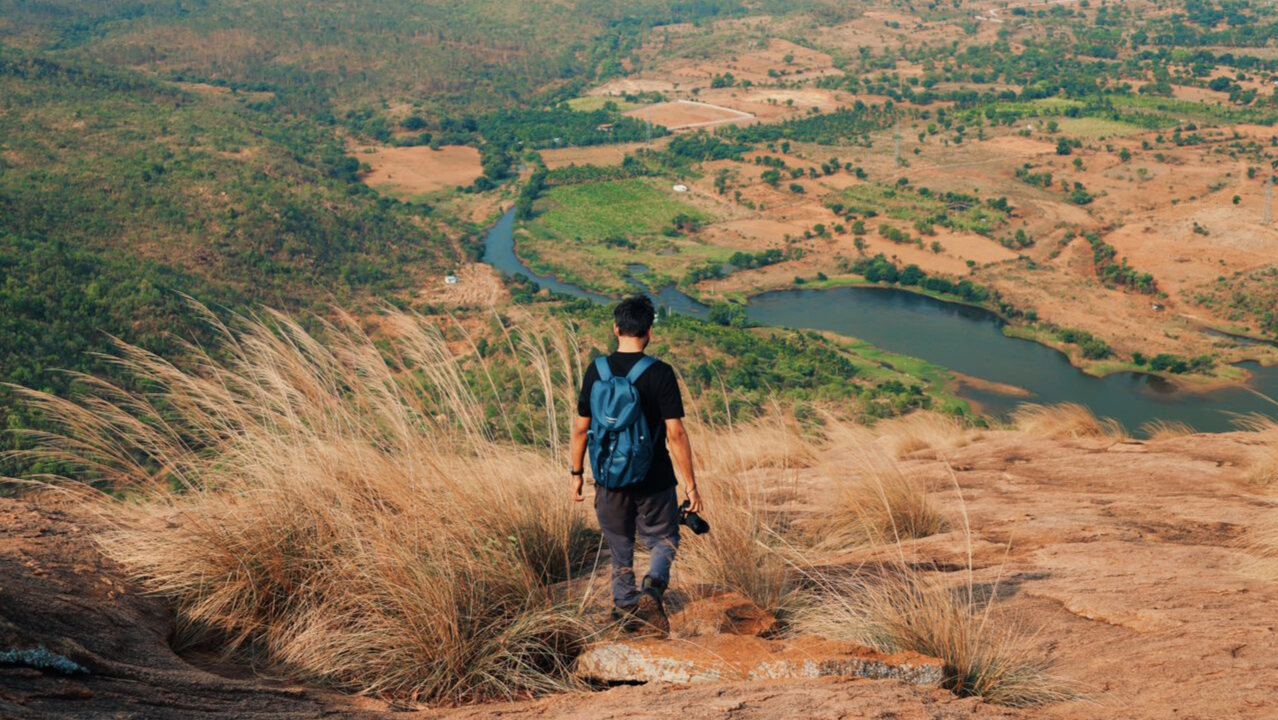
A packing list for Karnataka has to cover three kinds of ground in one bag. Hampi is bare granite with almost no shade, and the rock holds heat from late morning. Safari jeeps in Bandipur and Nagarahole are open at the sides and leave before sunrise, and coastal air holds enough damp that washed cotton stays wet for a full day.
Karnataka's famous stone sites are working temples rather than museums, so shoes come off at the gate and covered shoulders and knees are the rule inside.
Four things cover every region of the state.
A pair of socks goes with the temple days, for hot stone floors inside.
The same four work in every month. What changes with the season is the rain layer and the weight of the warm one.
| Season | What changes |
|---|---|
| October to February | A fleece for mornings, nothing waterproof |
| March to May | More water, a wider hat, lighter cotton |
| June to September | A rain jacket, quick drying clothes, spare shoes |
Closed shoes and covered skin. The site is granite for several kilometres, with no tree cover over most of it.
The ground is uneven and warm, and the walking runs to hours rather than minutes. Flip flops and open sandals do badly on it.
Water stalls sit near the main temple. The outer parts of the site have none.
Bicycles and scooters are rented in Hampi Bazaar and at Hosapete. Both run over rock and loose sand, which is another reason the shoes matter more than the bag.
Shoulders and knees covered, and shoes left outside.
Virupaksha at Hampi and all three Hoysala temples hold daily worship. The stone floors inside heat up through the middle of the day, which is what the socks are for.
Some temples ask for no leather inside, so a cloth or canvas bag passes where a leather one does not. Most have a counter for shoes at a few rupees.
Photography is restricted inside several shrines even where it is open in the courtyard. Hampi, Pattadakal and the three Hoysala temples are all protected monuments, and a drone needs written permission at any of them.
A warm layer, dull colours and a torch.
The jeeps are open at the sides and moving, so a November to February morning runs colder inside the vehicle than the air outside a room.
Safaris run in forest department vehicles rather than private cars, so there is no boot to leave things in. One small bag per person is what fits.
Bandipur runs five hours a day, the Sunkadakatte zone six and Nagarahole four. Our seven day journey through coastal Karnataka and the Western Ghats sets its mornings around those hours. Journeys Just for You runs on your own dates.
Quick drying clothes and a second pair of shoes.
The coast runs about 320 kilometres, from Karwar in the north to the Kerala border in the south. It is warm and damp through the year and wettest from June to September.
Thick cotton stays wet for a whole day in that air. Salt air reaches into bags and cases.
A short guide to getting ready for a trip in India covers papers and bookings.
Closed walking shoes, loose clothes with sleeves and a hat. The site is open granite with almost no shade and runs for several kilometres. Two litres of water a person covers a morning.
One light layer. The plains and the coast are warm, and safari mornings and hill nights are cold between November and February. A fleece or windcheater is enough.
No. Working temples ask for shoulders and knees covered, and that includes Virupaksha at Hampi and all three Hoysala temples. Trousers or a long skirt and a scarf cover it.
A rain jacket, quick drying clothes and a spare pair of shoes. From June to September the coast and the hills take heavy rain, and coastal wind defeats an umbrella.