
Let’s help you
plan your journey
Explore responsibly, discover offbeat places, guided by locals, rooted in culture.
Let’s help you
plan your journey
Explore responsibly, discover offbeat places, guided by locals, rooted in culture.
Soumen Bhowmick
Soumen Bhowmick founded Pollen Dots in 2024 to plan journeys across India and Bhutan. He works in the Commercial Department of Indian Railways, where he has been since 2000. From 2016 to 2020 he was Head of Business Development and Partnerships at ScoutMyTrip, a community-driven road trip planning platform. There he built a nationwide network of local Scouts who helped travellers on the road, and grew the Road Trippers Club to 16 Indian cities. As a core member of Devil On Wheels, he helped travellers plan Himalayan trips and started Spreading Smiles. He has driven solo from Arunachal to Goa and from Himachal to Karnataka, and has run his own caravan for more than ten years. His photographs have won national and international salon awards, and his writing has appeared in Outlook Traveller.
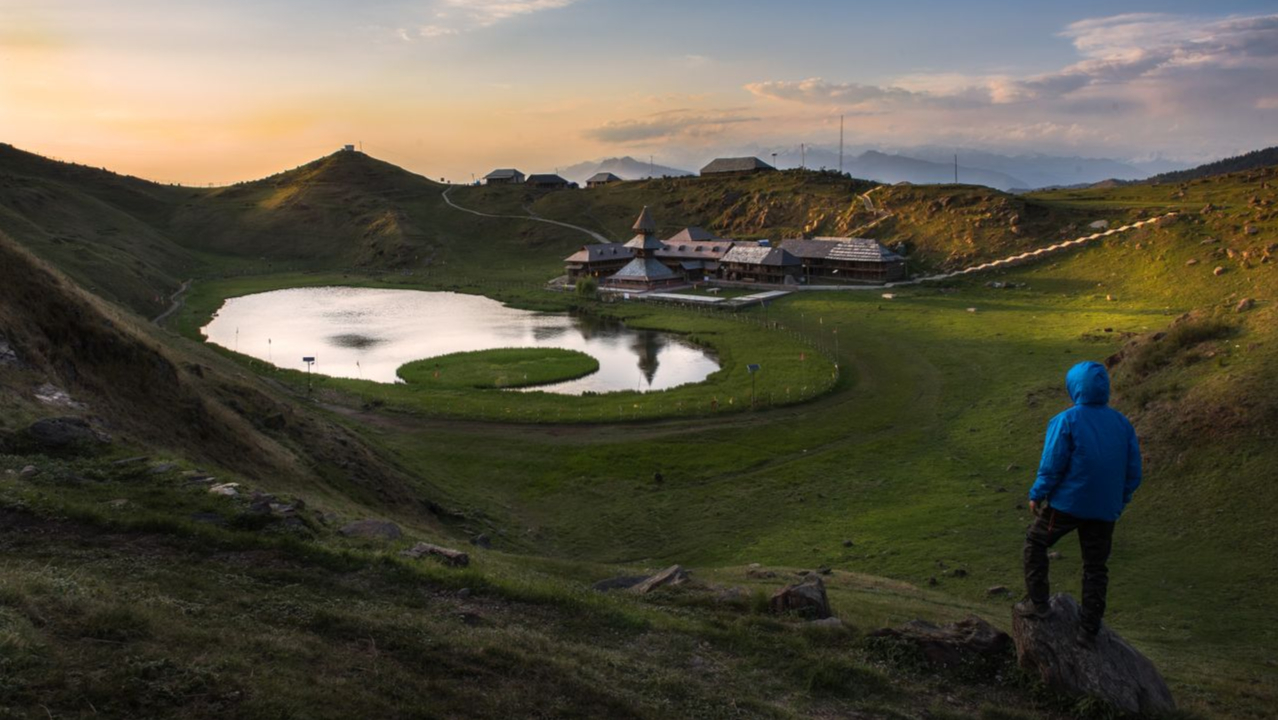
The places to visit in Himachal Pradesh split four ways, and two narrow gauge mountain railways run through them. The Kalka to Shimla line was inscribed by UNESCO on 8 July 2008, and the Kangra valley line, which is longer, has only been on the tentative list since 2014. Choose between the Shimla hills, the Kullu and Manali valleys with the Great Himalayan National Park, the Kangra belt at Dharamshala, and Chamba with Khajjiar.
Both lines were built to the same 762 mm gauge and both still run. The one that carries the World Heritage listing is the shorter of the two. The guide to preparing for travelling in India takes the practical questions, and this takes the places.
The Kalka to Shimla line was added to the Mountain Railways of India World Heritage Site on 8 July 2008. The Kangra valley line was submitted to UNESCO's tentative list on 15 April 2014, as part of a proposed extension, and it has not been inscribed.
Shimla was made the summer capital of British India in 1864, after the Viceroy, John Lawrence, decided on the move the previous year. It has been the capital of Himachal Pradesh since the state was formed on 25 January 1971.
The Great Himalayan National Park Conservation Area was inscribed by UNESCO in 2014 under criterion ten, which covers biodiversity. 90,540 hectares, from about 1,500 metres to 6,000.
Dharamshala was declared the second capital of Himachal Pradesh on 19 January 2017. The state assembly had already been holding winter sessions there, the first full one outside Shimla having run in December 2005.
Khajjiar's name came from one visit by one diplomat, and the marker he left is still the reason the place is on itineraries.
The state is large enough that two of these four belts in one trip is the practical limit, and the drives between them are long. Our eight day Himachal journey runs the rivers and the mountain roads rather than a hill station a day. Customised tours is where the belts, the railways and the driving days get arranged around one another.
Two. The Kalka to Shimla railway, added to the Mountain Railways of India site on 8 July 2008, and the Great Himalayan National Park Conservation Area, inscribed in 2014 under criterion ten. The Kangra valley railway is on the tentative list from 2014 and has not been inscribed.
The name came from a single visit. On 7 July 1992 the Swiss envoy Willy P. Blazer gave Khajjiar the title, put up a marker giving the distance to Bern as 6,194 km, and took a stone from the site for the collage around the Swiss Parliament building.
The ground at Chail in Himachal Pradesh, at 2,444 metres, is described as the highest. It was established by Rajinder Singh, Maharaja of Patiala, who kept a summer retreat there. It is now the playground of Chail Military School and is used for polo in the school holidays.
Shimla and the hills around it, because the listed narrow gauge railway from Kalka delivers you into them and the drives are shorter. The Kangra valley at Dharamshala, Palampur and Bir is the next belt. Kullu, Manali and Lahaul need more driving days than either.