
Let’s help you
plan your journey
Explore responsibly, discover offbeat places, guided by locals, rooted in culture.
Let’s help you
plan your journey
Explore responsibly, discover offbeat places, guided by locals, rooted in culture.
Soumen Bhowmick
Soumen Bhowmick founded Pollen Dots in 2024 to plan journeys across India and Bhutan. He works in the Commercial Department of Indian Railways, where he has been since 2000. From 2016 to 2020 he was Head of Business Development and Partnerships at ScoutMyTrip, a community-driven road trip planning platform. There he built a nationwide network of local Scouts who helped travellers on the road, and grew the Road Trippers Club to 16 Indian cities. As a core member of Devil On Wheels, he helped travellers plan Himalayan trips and started Spreading Smiles. He has driven solo from Arunachal to Goa and from Himachal to Karnataka, and has run his own caravan for more than ten years. His photographs have won national and international salon awards, and his writing has appeared in Outlook Traveller.
Films, books and stories put places in your head long before you go, and by the time you arrive you are not looking so much as checking. Some of the places I know best I have never been to, and one of them does not exist, which tells you something about how this works. A story is a good reason to want to go somewhere and a poor guide once you are there.
Long before I stood at some of the places I now remember clearly, I had already met them in stories. Sometimes through the flicker of a cinema screen. Sometimes through the quiet pages of a book. Those early encounters did not feel like imagination. They felt like introductions, and when I finally travelled, I did not feel like I was arriving. I felt like I was returning to something that had already settled somewhere inside me.
By turning a place into a feeling before it is ever a location.
A desert battlefield. A cliff above the sea. A frozen blue lake. A forest full of silence. A hill town wrapped in nostalgia. Each of these entered my life as an emotion first and a destination second, and the order matters, because emotions are much harder to revise than facts.
That is what a story does. It gives a place context, conflict, weather and a mood, and it hands all of it over in one piece. Nobody making the film or writing the book was trying to describe the place accurately. They needed it to carry something.
But that is not how it arrives. What arrives is a complete impression, and impressions last. Years later you can describe the light on a lake you have never stood beside.
This is where the Destinations series begins, with the idea that a place already exists in fragments before anybody gets there.
Three, and each one arrived as a different feeling.
Longewala came through Border. I had never seen a desert stretch that wide or a silence that heavy. The film was about a battle, but what it actually showed was isolation, fear and the weight of a place that barely appears on most maps. When I later read about the real Longewala, none of it felt unfamiliar. The sand and the distance were already there.
Chapora came through Dil Chahta Hai, and it was never really about the fort. It was about standing still on a cliff while everything ahead of you is unresolved. Friendship, hesitation, the year before things change.
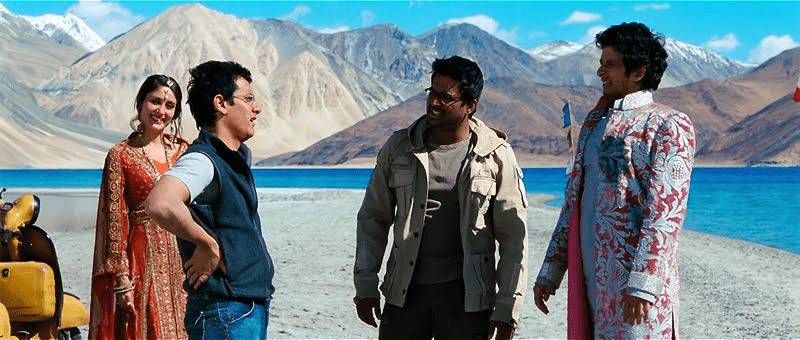
Pangong came through Three Idiots. A blue so unlikely it looked invented. It became a symbol of release and arrival long before I understood that Ladakh was a region rather than a mood.
What all three share is that the landscape was doing emotional work. The terrain that makes a frame like that is usually land that grows very little and is hard to live in, which is never the part that gets filmed.
The inside of a place rather than the surface of it.
Jim Corbett's writing made the jungle feel alive to me long before I understood any of its geography. Not the shape of it, but how it behaves. What is loud and what is quiet, and what the quiet means.
Ruskin Bond's Mussoorie was never a hill station. It was childhood, rain, loss and a kind of patient resilience. I knew what its afternoons felt like before I knew where it sat on a map.
That is the difference. A film gives you ninety seconds of the best light. A book gives you a season, a smell, an argument between neighbours, and the boredom in between.
It also lasts longer, because you built the picture yourself out of sentences. Something you assembled is much harder to give up than something you were shown.
Yes, and two of mine have.
Afghanistan came through The Kite Runner, and it was never a country in the news after that. It was friendship, guilt, migration, houses that no longer exist and a hope that refuses to close.
Istanbul came through The Museum of Innocence. Lanes of obsession, a museum built out of memory, teacups holding years inside them, streets carrying longing rather than crowds.
I have not been to either. I probably will, eventually. But both have already changed how I think about distance and belonging, and about what it means for a place to still be somebody's home after they have left it.
That is not a small thing. Most of what I understand about why people travel came from somewhere other than travelling, which is part of why I ended up thinking about journeys the way I do.
Macondo does, and it is one of the strongest places I carry.
It is the village in One Hundred Years of Solitude and it has no coordinates. Rain that does not stop for years. Generations repeating the same mistakes with different names. Love that outlasts the people who felt it. A village carrying its own memory around like a living thing.
I will never go. There is nowhere to go.
And yet it changed how I look at real places, because it taught me that a destination is not only a set of coordinates. It is what accumulates in a place over time, and what a place cannot put down.
Once you have thought about somewhere that way, you start looking for the same thing in places that do exist. That turns out to be a much better question than what is there to see.
It fills up, and it fills up in one very specific spot.
Pangong is the clearest case. One closing sequence in 2009 turned a remote high-altitude lake into somewhere people cross a mountain range to photograph. Camps followed. Then pressure on a road never built for that traffic. Then a queue at a single point on a shoreline that runs for well over a hundred kilometres.
Longewala went differently, because what travelled was the story rather than the scenery. People go to stand where something happened, not to look at something.
The pattern with film locations is consistent. Arrivals first, then infrastructure, then pricing, then a version of the place assembled for the people arriving. Nobody is at fault. It is what happens when demand appears somewhere with no capacity for it.
The closest thing to it is what a festival does to a town, except a festival ends on Sunday and this does not.
Because the version in your head has no weather, no traffic and nobody living in it.
A location is shot in the right light, cleared of whatever was unhelpful, and cut down to the good minute out of the four hours around it. A book is worse in a different way, because you filled in every gap yourself, and you filled them in flatteringly.
The real place has a bus stand. It has a season you may have picked wrong. It has somebody selling the same souvenir as the four people either side of him, because that is what sells.
Most people read that gap as disappointment. It is better read as the first accurate information you have received.
The cure is not lower expectations. It is different attention. What ordinary life shows you is available at every one of these places, standing next to the famous view, with nobody looking at it.
Go, and hold the story loosely.
Three things make the difference.
Give the famous spot an hour rather than a day. Whatever brought you is worth seeing once, and rarely worth more than that.
Spend the rest of the time within a few kilometres of it, at hours when nobody else is out. The land around a filmed location is the unfilmed version of the same place, with people in it.
And find out what the place was before the story arrived, and what it has been doing since. That is almost never in anything written for visitors, and it is the thing that turns a location back into a place.
Not all journeys begin with a ticket. Many begin with a story, and there is nothing wrong with that. It only means the journey does not start from zero. It starts from memory, and the useful part is finding out which parts of that memory were yours and which were somebody else's. That is most of what care-based travel asks for.
Yes, and heavily. Cinema creates emotional familiarity with a place, and familiarity turns into curiosity and then into a booking. Many people travel to check an impression they formed years earlier, often without realising that is what they are doing.
Pangong Lake in Ladakh after Three Idiots, Chapora Fort in Goa after Dil Chahta Hai, and Longewala in the Thar after Border. The first two travelled as scenery. Longewala travelled as a story, which is why people go there to stand where something happened rather than to look at something.
One closing sequence in 2009 turned a remote high-altitude lake into a place people cross a mountain range to photograph. Camps followed, then pressure on a road never built for that traffic, then a queue at a single point on a shoreline running well over a hundred kilometres.
Yes. A film gives you the surface and the best light. A book gives you the inside: a season, a smell, an argument between neighbours, and the boredom in between. Books also last longer, because you built the picture yourself out of sentences.
Yes. Afghanistan through The Kite Runner and Istanbul through The Museum of Innocence both changed how I think about distance and belonging, and I have been to neither. What a story gives you is a way of paying attention, and that travels to wherever you actually go.
Yes. Macondo, the village in One Hundred Years of Solitude, has no coordinates and is still one of the strongest places I carry. It teaches that a destination is not only a set of coordinates, but what has accumulated in a place over time, which is a better question to ask of somewhere real.
Because the version in the film has no weather, no traffic and nobody living in it. A location is shot in the right light, cleared of anything unhelpful, and cut down to the good minute out of the four hours around it. The real place has a bus stand and a season you might have picked wrong.
Only if you expect the place to match. Stories are entry points rather than descriptions. Used as a reason to go, they are good. Used as a standard the place has to live up to, they guarantee disappointment and stop you seeing what is actually in front of you.
Yes, but hold the film loosely. Give the famous spot an hour rather than a day, then spend the time within a few kilometres of it at hours when nobody else is out. The unfilmed version of the same landscape is usually right there, with people in it.
Read about the place rather than about visiting it. Local news, regional writing and anything about the main work of the district will tell you more than travel content will. Find out what the place was before the story arrived, and what it has been doing since.